
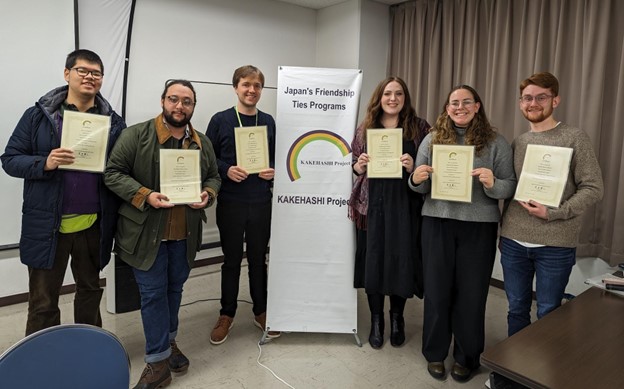
Pictured above are the 2024 SAIS Kakehashi Cohort, from left to right: Zi Zhuang, SirMichael Cianci, Devin Woods, Katherine Trauger, Kayla Goldstein, and Jackson Martin
By: Kayla Goldstein
Edited By: Joseph Schneider
Prestigious schools across DC pride themselves on the unique qualities that set them apart from other DC-based programs; usually highlighting career placement services, specialized focus areas, or scholarship opportunities. Johns Hopkins does the same; for one reason or another, we all chose this institution to give us a degree and throw us right back into the idyllic world of post-grad DC competition. But, one thing Johns Hopkins SAIS has truly mastered is the art of hosting an event-packed, culturally rich, all-expense paid trip to Japan that hardly anyone knows about.
Now, you might be asking, “How is it that Johns Hopkins SAIS has a free trip to Japan exclusively for students, and I haven’t heard about it?” Excellent question. Schools of this caliber often host extravagant events in the city, dinners with lecturers, and events with free food each and every week. But how are trips — focused on cross-cultural experiences, international relations, and security partnerships — seemingly few and far between aside from the coveted capstones reserved for second years? It’s a good thing you’re reading this article then. It will walk you through how to get noticed by the selection board and highlight what could await you on the Kakehashi Program: SAIS’ free, yet oddly clandestine, Japanese exchange that takes you directly from your DC apartment to the bustling and pristine streets of Tokyo.
Day 1: Arrival
Fresh off the plane, our SAIS team was greeted by two Kakehashi Program representatives who led us, alongside students from George Washington, Cornell, and two lucky employees from DC- and New York-based think tanks, to a chartered bus that would bring us to our hotel in Tokyo. We dropped off our belongings and quickly began the day with our first stop: a trip to the Tokyo National Museum. Filled with fantastic exhibits hosting Japan’s cultural treasures, the Tokyo National Museum features artifacts and crafts ranging from the Edo Period to this day. We perused samurai sword collections, rooms laden with traditional kimono, tea ceremony ceramics, contemporary calligraphy workshops, and more. The museum itself — one of many in the complex of Tokyo’s art-rich center — was an architectural triumph, emulating Western styles that profoundly influenced the late Meiji Era.
After a quick snack post-museum at the notorious tea vending machines sprinkled throughout the country, the program transported us to the Panasonic Group Solutions Showroom, where we witnessed a fantastic exhibition of Panasonic’s vision for a perfect future. Our team learned about Panasonic’s role in shaping the digital age and the company’s historic contributions to technology and innovation. We were briefed on their vision for robotics and unmanned vehicles, their move to green energy and solar technology, and their meditation room, complete with relaxing eucalyptus mist. If there were ever a time to petition for SAIS student tuition to fund a meditation room at the Bloomberg Center, it would be right now, as most of us finish up midterm season.
We ended the day of heavy programming with a visit to the Japanese Ministry of Foreign Affairs (MoFA). At MoFA, we participated in a fast-paced briefing and discussion with staffers on the most relevant topics in US-Japan relations, including US-Japan security cooperation, Okinawan affairs, public diplomacy, and threats from regional actors such as the DPRK and the PRC.
Day 2: Japanese Dyeing Workshop
Our second day on the ground led us to a traditional kimono dyeing workshop in Shinjuku, where we experienced dyeing our own fabrics and learned about the traditional techniques used to dye textiles in Tokyo and around Japan. Of course, we got blue dye all over ourselves, but we had a lot of fun testing different styles and working with the fabric and tools provided to us to experiment with original Japanese patterns and designs.
After the workshop, we met with Dr. Yasushi Watanabe, an esteemed professor at Keio University and soft power enthusiast based in Tokyo. During the lecture, we discussed Japanese politics, public diplomacy, cultural influence, media, and our experiences as foreigners in Japan.
Day 3: Shinkansen and University of Aizu
On our third day, we took Japan’s high-speed bullet train, the Shinkansen, to Fukushima Prefecture to visit the University of Aizu and connect with students in rural Japan. The transport to Fukushima was speedy and convenient and provided a unique opportunity to observe Japan’s natural beauty and mountainous countryside.
The university exchange was remarkable, featuring discussions and workshops where our group exchanged opinions and perspectives with local and foreign University of Aizu students while gaining insight into their studies, labs, research, and programming. We were welcomed with a university tour and then spent a social hour engaging with the students where we chatted about shared interests and described what connects us most. For my group, it was our favorite meals from home. At some point in our storytelling, we began comparing meals, offering competing views for the best cuisine, and drawing pictures as visual aids. Apparently, I had quite the foodie group. Some of the University of Aizu students may now have an insatiable desire to try American gas-station sushi and experience the delights of Texas Roadhouse.
Day 4: Homestay at Fukushima
On our fourth day, we met our homestays, native Fukushima residents working in the agriculture industry. As a homestay frequent flier, I was thrilled to find this on our trip’s itinerary and had been looking forward to it for weeks prior. When I first met my host family, Riichi-san and Harumi-san, my first thought was “this will be interesting.” The older couple were kind in their gestures, but we quickly realized they did not speak a lick of English. And contrary to my boastful naivete, I had no more than three months of Duolingo Japanese under my belt. Although it prepared me to order sushi in a culturally appropriate manner, it did not give me the necessary vocabulary to speak with Riichi-san and Harumi-san for more than three seconds. For the full evening and into the next day, we learned to communicate. Not so much with words, but with our gestures, the sounds we made, our eyes, and our laughter. The Kakehashi Program gave us all Japanese language booklets, which became a true lifeline and which I’ve kept with me as a reminder of the experience and tool for my future language studies. My homestay buddy, Katherine, and I used every page of this booklet, as we sat on the floor across the dining table from our host parents who mirrored us in their use of the translative text. Before using our phone translation apps, we tackled Japanese speech on our own with the help of this little blue book, asking questions and laughing through our answers.
“Nice weather we are having, right?”
No. It was minus 10 degrees and snowing.
“Do you like Indian food?”
“No. We eat Japanese food. We don’t eat Indian food. Too spicy.”
“My favorite Japanese foods are sushi, onigiri, soba, udon, and takoyaki.”
“Wait. You know takoyaki? You like takoyaki? We’ll go get takoyaki right now.”
And we did. We left on a takoyaki run and it was the best I’ve ever had. Back and forth we went, laughing so hard our lungs began to burn. We cooked together, shared stories, and drank sake all night while asking questions we always wanted to know from another perspective. The language we spoke was unrecognizable to the other, but we had the shared language of emotion, especially humor. The misunderstandings, the jokes, the joy. All of it was universal in a way only we will understand. We get to keep it for ourselves and remember it for the rest of our lives as we communicated with our hosts, although we came from different worlds. There is something beautiful in knowing a person by communicating this way. I will never experience anything like Riichi-san and Harumi-san’s hospitality ever again–not in the way they opened their homes, hearts, and minds to us, so fully. I hope I can one day describe to them what their generosity and joy for life meant to me. When I do, it will be in Japanese.

Pictured are Harumi-san and Riichi-san, seated around the dinner table and laughing profusely at our jokes
After we parted ways with our host families, our cohort got together to describe our experiences living with locals. Each of us said much of the same: despite our language barrier, we drank together, laughed together, and enjoyed engaging in conversation. Ultimately, we understood each other, but not with words.
Day 5: Host Family Farewell and Visit to Ouchi-juku
Reeling from our goodbyes to our host families, our group moved from Fukushima to Ouchi-juku, a historical and cultural site filled with souvenir shops and incredible local cuisine such as negi soba served with leek spoons and local peach ice cream. We enjoyed loading up on goodies for the trip back to Tokyo, and I personally bought about ten pairs of handcrafted chopsticks; my apparent obsession over the course of the trip.
Day 6: Departure from Tokyo
The entire way home, our group reflected on our trip thus far. A couple of days in Japan turned into a huge collection of memories and experiences filled with good food and good people. It was a bittersweet departure, especially when each of us wanted to stay for longer to explore the city on our own. I’m excited to come back one day, visit my host family, and eat more of the incredible cuisine I grew up enjoying as a kid with an affinity for chopsticks.
If all of this sounds good to you, it would be wise to get on the radar of the team that orchestrates SAIS’s involvement with the Kakehashi Project year after year.
Free Trip to Japan? Sign Me Up
The Reischauer Center for East Asian Studies is one of SAIS’ best-kept non-secrets. The Center consistently hosts Japan-focused events, including book talks, lectures, and topical student- and faculty-driven discussions. It’s strategically situated on the 6th floor of the new Bloomberg Center, and hosts an elite faculty consisting of Dr. Calder and former SAIS students, now graduated fellows. The Center partners with the Japan International Cooperation Center (JICE), the host of the Kakehashi Program, a trip that aims to promote student understanding of Japan by exposing select students to Japanese politics, economics, society, culture, history, and foreign policy. Through Kakehashi — which translates to bridge in Japanese — students participate in university lectures, tours of private and public institutions and are exposed to history and culture through museum visits and homestay experiences. To boost your chances of experiencing this trip, show your interest early. Meet the team at the Reischauer Center, attend their events, and indicate your interest in cultural exchange. They are an incredible team with exceptional qualifications and are truly some of the kindest people you’ll meet in DC. Stay updated on their events for opportunities to get more involved and for good measure, try learning some Japanese — the earlier the better — because it’s certainly not easy.