
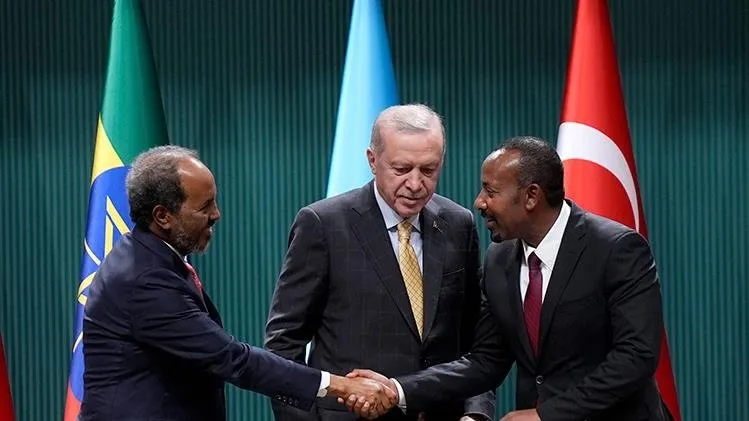
On December 11th, 2024, Somalia and Ethiopia signed the joint Ankara Declaration, brokered by Türkiye to ease tensions between the two east African countries. In addition to guaranteeing Ethiopia access to the sea, its terms call on the two countries to respect each other’s “sovereignty,” a clear allusion to the root of these tensions: the January Memorandum of Understanding (MoU) between Ethiopia and Somaliland. This MoU dictated that, in exchange for guaranteed access to the sea, Ethiopia would recognize Somaliland as a sovereign state. Despite being mostly free from Mogadishu’s influence since declaring independence in 1991, Somalia still claims Somaliland as legally part of its territory and views any efforts to undermine that claim as an affront on Somalian sovereignty.
The signing of the declaration is yet another twist in the political drama that is the Horn of Africa. Here are some key takeaways:
It’s Not Over for Somaliland, But it’s Certainly Harder Now
Somaliland might have thought January’s MoU to be their first step to international legal recognition, but the declaration presents yet another roadblock. No other country recognizes the breakaway region’s sovereignty, though Somaliland has informal relations with numerous nations, such as the United States, United Kingdom, and Taiwan. Somaliland’s lack of international legal recognition from its partners is likely due to the low return on investment; although access to the Gulf of Aden is valuable, the US and other global powers already have so in Djibouti. A new port in Berbera would be redundant and also entrench the African view that Westerners continue to neo-colonially meddle in their internal affairs. Another historic obstacle has been the African Union’s unwillingness to recognize due to its founding policy of upholding colonial borders for fear of spillover effects. Despite having said Hargeisa has legitimate claims to independence in an unpublished 2005 memo, the AU refuses to hear those claims because it fears recognition might encourage other secessionists’ violent pursuits on the continent. Biafra in Nigeria and the Sahrawi Arab Democratic Republic are two violent secessionist movements that might be reenergized should Somaliland secede, directly in opposition to the AU’s raison d’être of continental stability and security.
It would be wrong to say that Somaliland’s cause is lost forever, because we all remember what happened in similarly war-torn South Sudan in 2011. Anything could happen, but the Ankara Declaration will prove to be another painful thorn in Hargeisa’s side.
Abiy is Making his Case as an African player in the Post-Tigray World
Conversely, the Ankara Declaration was a much-needed win for Ethiopian President Abiy Ahmed. During the height of the 2020-22 civil war in Tigray, which killed approximately 600,000 people, many observers feared we might be witnessing the end of Ethiopia itself. Though the brutal war would come to an end, Ahmed’s problems would not. Needing to shore up support in the war’s shadow and a pervasive economic crisis, the Nobel winner declared sea access “vital” in 2023 and pledged to secure a port on the Red Sea. His government would consequently sign the January MoU with the unrecognized Somaliland government, enraging Mogadishu. These significant domestic and foreign policy mishaps might lead the average observer to conclude that Abiy was no longer fit for his office, but the political power play of reneging the January MoU has cast those thoughts aside.
By fulfilling his pledge, Abiy kills multiple birds with one stone. The Ankara Declaration secures Ethiopia’s long sought after sea access, mends its relationship with Somalia, creates new economic opportunities in the Red Sea, and reaffirms their role as a geopolitical player on the continent. Perhaps Abiy was cleverly using the January MoU as a ploy; by agreeing to recognize Somaliland’s sovereignty, Ahmed was attempting to elicit a reaction from Somalia and draw them to the negotiating table, knowing that Mogadishu would agree to just about anything to prevent Somaliland’s secession. He leveraged that knowledge into a deal whose scales were very much tilted in Addis Ababa’s favor.
Ahmed’s power play shows that he can still operate despite perceived missteps. Though his administration has been mired in controversy ever since the beginning of the war, perhaps this declaration is the catalyst he needed to remind the world that he’s a real player on the world stage.
Another Victory in Africa for Türkiye
Türkiye’s brokering of this deal is yet another victory for them in Africa. The transcontinental relationship took off in 2005 upon Erdogan’s inauguration as President. With talks of Türkiye’s joining the European Union going nowhere, Erdogan decided to instead pursue deeper relationships in Africa. In the ensuing years, Ankara would erect an embassy in Mogadishu, train Somalian troops in counterterrorism techniques, sell military drones to Addis Ababa, and export over $100 billion dollars in goods to the continent at large. This mediation, providing other potentially fruitful outcomes, further underscores Türkiye’s commitment to Africa’s future.
Türkiye’s economic outlooks in Somalia and Ethiopia may improve because of their mediation. Over 200 Turkish companies have already invested billions of dollars in the Ethiopian market, and with a Turkish led deal that will perceivably protect that market, those companies only stand to gain a stronger economic foothold in the country. In Somalia—as late as last week—Türkiye announced that they would build a rocket launching facility, which Somalian President Hassan Sheikh Mohamud believes will generate opportunities for Somalian employment and “billions” in revenue. Türkiye has also agreed to begin a joint onshore hydrocarbon exploration in Somalia earlier this year, furthering its economic commitment to the country.
Mediating this deal could present new economic opportunities for an opportunistic Erdogan, leading to more wins on a continent where he is already a deeply respected leader.
Edited By: Joseph Schneider