
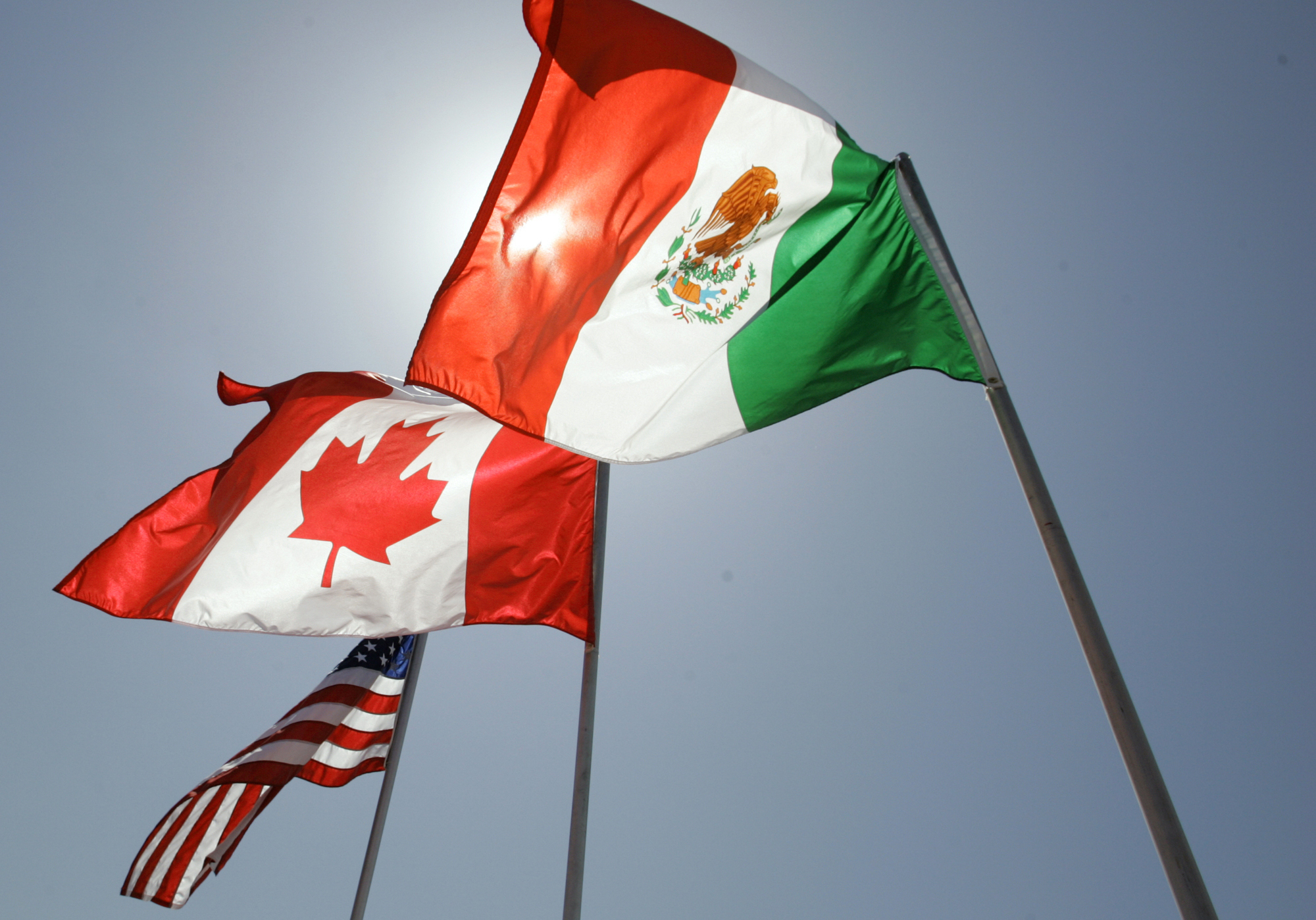
The North American political landscape has undeniably shifted, driven by a relentless surge of nationalism which asserts that a nation’s complex challenges can be boiled down to a few oversimplified problems with easy, unilateral solutions. In an era of deep economic interdependence, such reactionary rhetoric belies a fundamental reality: the ship has long sailed, and we’re all on board. In fact, we’re not just passengers; we built this thing together, and if one sinks, we all go down. Simply put, North American integration is not dead—because it can’t be.
The U.S., Mexico, and Canada are too inextricably woven together to be unraveled. Bounded by the shared forces of geography, history, culture, security, and economic ties, no amount of political posturing or hollow nationalistic platitudes can undo that reality. North American competitiveness and resilience are vital for supply chain stability, energy security, affordable consumer goods, economic efficiency, and ultimately, the collective well-being of all three nations. Ironically, the slogan “Made in America” should fundamentally be reinterpreted as produced within North America. Many goods, particularly in the automotive and electronics industries, cross North American borders 6–7 times before reaching completion. Hence, the very structure of production depends on supply chains spanning Canada and Mexico, each specializing in key stages of manufacturing. Unraveling this system is not to restore national strength, but to jeopardize the societal fabric that has sustained North American economic hegemony for decades.
The geographical proximity and intertwined histories of the United States, Mexico, and Canada have naturally fostered deep economic and cultural integration. For example, the U.S.-Mexico border has long been one of the busiest and most interconnected in the world. With nearly a million legal crossings daily—including workers, students, professionals, tourists, and commercial freight—the border has cultivated thriving binational communities. These communities embody a unique blend of Mexican and American influences, where language, traditions, and commerce seamlessly intertwine. In this way, the border is not a mere dividing line, but rather an economic and social lifeline that sustains millions on both sides.
This interdependence extends far beyond border communities. While far from perfect, the mutual trade agreements of NAFTA and USMCA have undeniably driven substantial economic growth and efficiency. Moreover, agreements have delivered significant benefits to consumers, lowering prices on everything from agricultural products to gasoline, while also expanding product variety and an overall increase in quality. The numbers speak for themselves: North American intra-regional trade nears $2 trillion annually, accounting for roughly 20% of all global trade.
Unraveling this system would not just raise costs, but would paralyze supply chains that depend on cross-border coordination, setting off a cascading effect that risks destabilizing consumer markets, employment, security, energy, and beyond. A retreat into economic nationalism would throw North America into economic disarray, mirroring the disastrous “beggar-thy-neighbor” policies of the 1930s that collapsed global trade and prolonged economic hardship. In an era of unprecedented interdependence and globalization, a return to economic nationalism would be catastrophic. North America would find itself trapped in a brutal tit-for-tat of trade wars and economic retaliation, leaving all three nations weaker, more divided, and globally uncompetitive. Worse still, these economic fractures could spill over onto the international stage, further isolating the U.S. diplomatically and weakening its ability to maintain its security alliances, which may even turn allies closer to U.S. adversaries, effectively reshaping global power dynamics.
However, recognizing this interdependence does not diminish the real and pressing challenges at the border. Illegal crossings, fentanyl seizures, and organized crime increases have seen an alarming rise in the post-COVID era. That said, these obstacles should not lead to futile finger-pointing and retaliatory measures that clearly alienate the nation’s biggest trading partners that also have a shared stake in these matters. Resorting to unilateral action and punitive protectionist measures would not only fail to resolve these mutual concerns, but actually risk aggravating them. The reality is clear: intra-regional challenges demand intra-regional solutions.
The U.S., Mexico, and Canada must recognize that their shared prosperity and security depend on confronting these challenges together. Only through rigorous negotiation, cooperation, and compromise can a sustainable and effective path forward be forged. As the USMCA sunset review approaches in 2026, it is essential to stay in good faith and examine the systematic issues of what needs to change. It is within this space that negotiation, diplomacy, and the effective leveraging of economic power can ensure that all countries step up in addressing their genuine concerns.
Putting North America first is putting America first. The fact is that globalization and regional trade agreements have profoundly intertwined the societal fabric of our nations. Self-interest, therefore, necessitates cooperation and interdependence. The reality is inescapable—our economies, industries, and futures are too deeply intertwined to pursue anything other than collective action. There is no viable alternative. We built this ship together, and if one sinks, we all go down. North American integration is not a choice. It is an economic and geopolitical necessity. North American integration is not dead. It can’t be.
Edited By: Eric Omorogieva