
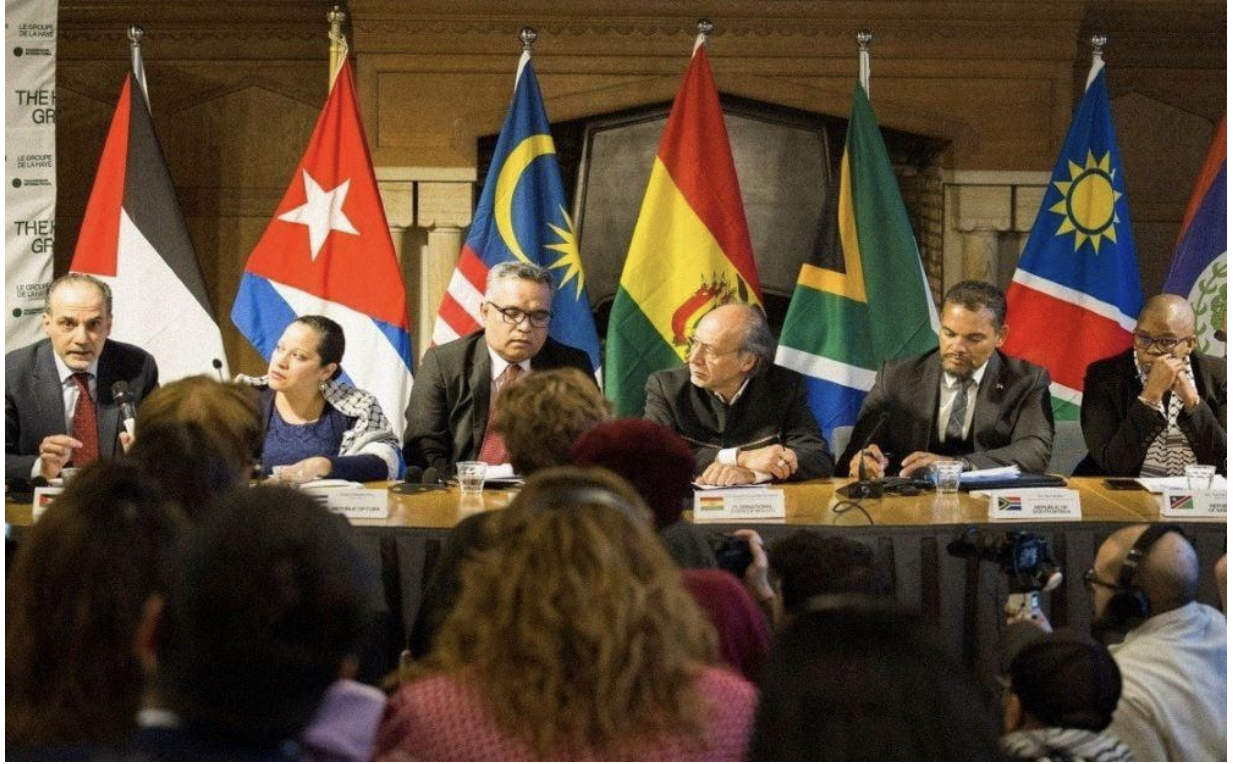
On January 31, 2025, a new international coalition emerged: The Hague Group. Comprising nine nations—South Africa, Malaysia, Namibia, Colombia, Bolivia, Chile, Senegal, Honduras, and Belize—the group unites to challenge Israel’s actions in Gaza and the Occupied Palestinian Territories. This coalition seeks not only to hold Israel accountable for alleged violations of international law, but also to confront the historical impunity that has shielded Israel from meaningful consequences.
The formation of The Hague Group follows growing international concern over the escalating humanitarian crisis in Gaza, where more than 60,000 Palestinians have been killed since October 2023. In response to the international community’s failure to hold Israel accountable, the Group’s inaugural statement clearly establishes their mission: 1) to enforce arrest warrants issued by the International Criminal Court (ICC) against Israeli officials, including Prime Minister Benjamin Netanyahu and former Defense Minister Yoav Gallant, for alleged war crimes and crimes against humanity, 2) to prevent the transfer of arms to Israel, especially when there is a risk that these weapons will be used to violate international humanitarian law or the Genocide Convention, and 3) prevent vessels from docking at any ports where there is a risk of that vessel being used to carry fuel and weaponry to Israel.
The Hague Group intends to go beyond rhetoric. In a symbolic yet significant act of defiance, Namibia has already refused to allow Israeli military vessels to dock at its ports, while Colombia has cut diplomatic ties with Israel and halted coal exports. The formation of The Hague Group signals a significant shift in global geopolitics. While the U.S. and Israel have historically enjoyed strong support from European nations, the emergence of a united front from the Global South signals a new dynamic in international relations. The group represents a dividing line in the world, with countries from Africa, Latin America, and Asia supporting Palestine, while Western powers continue to back Israel.
Countries like South Africa and Namibia bring a unique perspective to the coalition. Both have a history of resistance to apartheid and colonialism, drawing parallels between their own struggles for justice and Palestine’s fight for self-determination. South African Minister Ronald Lamola emphasized that The Hague Group’s formation is a turning point, sending a powerful message that “no nation is above the law.”
Despite its bold mission, The Hague Group faces several challenges. Expanding its base of support is perhaps the most pressing issue. As geopolitical expert Dr. Azmi Hassan of the Nusantara Academy for Strategic Research argues, the group must broaden its appeal beyond the Global South to effectively challenge Israel and its allies. While the coalition is growing, its influence remains limited without broader backing, particularly from Europe and the Middle East.
In addition to the need for wider international support, the group’s members face significant political and economic risks. Countries like Colombia, Bolivia, South Africa, and Malaysia have already experienced backlash from Western powers due to their stance on Palestine. As former South African Minister Ronnie Kasrils notes, nations like South Africa are often vilified for their principled positions, with Israel’s allies working to undermine their credibility. Malaysia’s Prime Minister Anwar Ibrahim has even claimed that his country is receiving threats as a result of its unwavering support for Palestine. Some analysts view this as a positive sign of Malaysia’s growing influence in global geopolitics. However, such positions come at a cost, as seen in Colombia’s economic struggles. In 2024, its exports to Israel fell by 45.3%, from $499 million in 2023 to $272 million, highlighting the financial consequences of challenging Israel’s actions.
The Hague Group’s formation marks a pivotal moment in the struggle for Palestinian
self-determination and justice. By uniting countries from the Global South to challenge Israel’s impunity, the group highlights the global significance of the Palestinian cause. For the Hague Group to be effective, it must broaden its support base and withstand pushback from Western powers. While the path ahead is challenging, continued international solidarity can help build momentum for Palestinian justice. Ultimately, the Hague Group is a unified stand against the oppression of Palestinians and a beacon of hope for a future defined by justice, dignity, and peace.
“When future generations inquire [about] our contribution to Palestine’s right to self-determination, our response must be that we took concrete measures, or we will be remembered as leaders who watched and did nothing,” Namibia’s Minister of Justice Yvonne Dausab stated.
Edited By: Eric Omorogieva