
Trump’s Foreign Policy Contradictions
Love him or hate him, Donald Trump’s appeal largely stems from his unfiltered and brazen rhetoric, defying political norms and challenging the sacred cows of his own party. This was center stage in the 2016 presidential campaign, where he championed an “America First” foreign policy doctrine that condemned the interventionist zeal of past administrations, deriding the trillion-dollar failures of Iraq and Afghanistan as proof that a new path must be forged. Unlike the Bush-era neoconservatives, who sought idealistic state-building projects, Trump contended that such naïveté had ruptured U.S. hegemony and credibility on the world stage.
And yet, despite his denunciations of endless wars and Washington’s foreign policy establishment, Trump ultimately fell into the same strategic miscalculations on Iran. To be fair, it’s hard to blame him; the Islamic Republic’s very existence stands as a stark and ignominious reminder of America’s foreign policy failures leading up to the 1979 Iranian Revolution. The hostage crisis left an indelible mark on the U.S. psyche, cementing Iran’s status as Washington’s perennial boogeyman in the region. This enduring legacy fuels the belief that the regime’s downfall is inevitable and that all it needs is a decisive “push” from the United States.
The Fallout from JCPOA Withdrawal
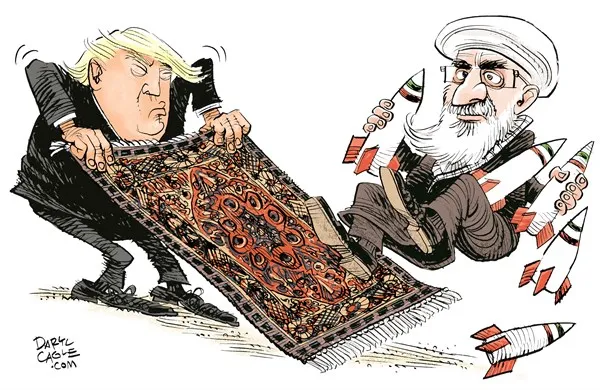
That push was on full display when Trump unilaterally withdrew from the Joint Comprehensive Plan of Action (JCPOA), better known as the Iran Nuclear Deal. Under the counsel of John Bolton and Mike Pompeo—two hardline neoconservatives—Trump was sold the illusion that withdrawing from the JCPOA would be the nail in the coffin, delivering the long-awaited collapse that had been prophesied. Ironically, the biggest collapse was not the regime itself but rather its reformist faction, who had staked their credibility on diplomacy and were politically humiliated when the U.S. reneged on its commitments.
The JCPOA was far from perfect, but it was working. Under the agreement, Iran significantly reduced its uranium stockpile, curtailed its enrichment levels, and opened its facilities to extensive international inspections conducted by the International Atomic Energy Agency (IAEA), which verified Iran’s compliance with the agreement. In exchange for nuclear restrictions, the deal eased sanctions, triggering an immediate economic recovery. According to the Rethinking Iran Initiative, between 2016 and 2017, Iran’s economy grew by 13%, oil exports nearly doubled, and inflation fell below 10%. However, following the U.S. withdrawal from the deal and the reimposition of maximum-pressure sanctions, these gains were swiftly reversed. Between 2018 and 2021, Iran’s economy contracted by nearly 12%, inflation soared past 40%, and poverty rates surged. The Rethinking Iran Initiative analyzed this trend using World Bank and IMF data (World Bank, 2021; IMF, 2019).
Despite these economic hardships, isolation paradoxically empowered the regime. The assassination of Qassem Soleimani further entrenched Iran’s hardliners, who leveraged his death to rally nationalist fervor and reinforce the belief that Washington could never be trusted. As reformists faded from the political scene, Iran doubled down on its “resistance foreign policy,” expanding its proxy network across the Middle East.
A Changing Political Landscape
Now, in a twist of fate, Trump is back in the Oval Office and uniquely positioned to reassess his Iran strategy. His decision to revoke the security clearances of Bolton and Pompeo signaled an awareness of past mistakes. This shift comes at a critical time, as Iran itself has undergone a political transformation. Indeed, the sudden death of President Ebrahim Raisi triggered snap elections, resulting in the victory of Masoud Pezeshkian, a reformist who has expressed openness to diplomatic engagement with the West. His administration includes prominent Western-educated figures, most notably Javad Zarif, one of the original architects of the JCPOA. Had hardliner Saeed Jalili—an adamant opponent of U.S. diplomacy—won the election, the Middle East could have already been embroiled in a full-scale conflict.
Despite Ayatollah Khamenei’s hardline rhetoric, the Iranian regime—which just marked its 46th anniversary—recognizes that its survival hinges on negotiation and compromise. Iran faces severe internal crises—its proxy network is crumbling, the rial is plummeting, inflation remains at crippling levels, and the country is experiencing acute energy shortages. These pressures oblige Iran’s leadership to reconsider its diplomatic posture. This moment mirrors 2013, when economic desperation forced Iran into back-channel negotiations with the U.S., ultimately leading to the JCPOA. At the same time, with regional actors like Saudi Arabia signaling their willingness to mediate between Washington and Tehran, there couldn’t be a more opportune moment for Trump to seize the diplomatic initiative, recalibrate U.S.–Iran relations, and craft a deal that both strengthens American strategic interests and stabilizes the Middle East.
Trump’s Foreign Policy Crossroads
Trump now stands at a defining foreign policy crossroads. One path leads him to double down on the failed maximum-pressure campaign, the very strategy that exacerbated regional instability, sent oil prices soaring, and brought the Middle East closer to all-out conflict.
The other path presents an opportunity for diplomatic recalibration—one that aligns with Trump’s “America First” doctrine while allowing him to reshape U.S.–Iran policy on his own terms. Instead of reviving the JCPOA in its original form, he could introduce what might be called the “Trump Comprehensive Plan of Action” (TCPOA), a rebranded and toughened agreement unaffiliated with the Obama administration. Just as he repackaged NAFTA into the USMCA, Trump could craft a more substantial agreement that incorporates a phased reduction in Iranian funding for militias and regional proxies, tighter enforcement mechanisms for nuclear compliance, and further commitments to peace that safeguard U.S. and allied interests in the region.
In return, Iran could receive a structured, long-term pathway for sanctions relief, enabling international investment and allowing the nation to fully realize its economic potential. A successful agreement could also empower Iranian reformists, weaken the grip of hardliners, and potentially pave the way for further democratic reforms. However, success would hinge on Washington providing credible assurances that it will not unilaterally withdraw from the deal again—a critical factor that doomed the JCPOA under Trump’s first term.
A bold and provocative deal with Iran would not only stabilize the region but also secure Trump a legacy foreign policy achievement that sets him apart from the neoconservatives who came before him. For all of his rhetoric about ending “forever wars,” Trump’s first-term Iran policy contradicted his own doctrine. Now, he has a second chance to prove it.
But this is not just about Iran—it is about the global order and America’s role in shaping it. Trump is at a crossroads. Will he forge a new path, learn from past missteps, and deliver the diplomatic breakthrough that has eluded U.S. leaders for decades? Or will he succumb to the same neoconservative mindset that led to failed interventions and strategic blunders?
Whichever path Trump chooses, the fate of U.S. credibility and its standing as a global leader hangs in the balance.
Edited By: Kripa Sridhar