
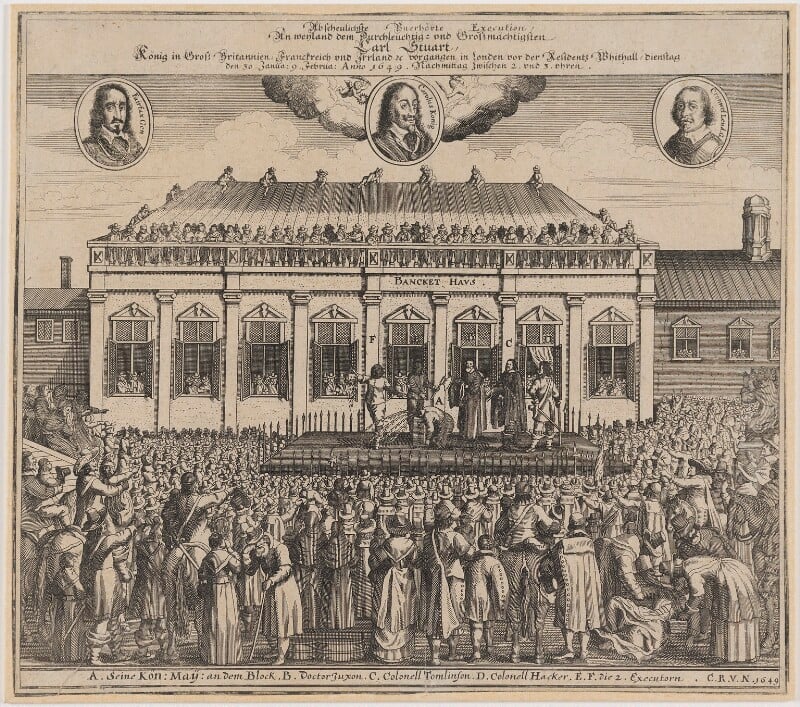
March 27 marked the 400-year anniversary of the accession of Charles I to the thrones of England, Scotland, and Ireland. Charles is remembered for his ill-fated struggle with Parliament, culminating in a civil war that lost him his crown and his head. That struggle originated in the King’s assertion of royal prerogative, notably his attempt, in 1626, to raise taxes without Parliament’s consent. A century and a half before John Dickinson coined the slogan “no taxation without representation,” the House of Commons sought to enforce exactly that.
The Declaration of 1776 seriously misrepresented the extent of royal prerogative, which the Civil War and the Glorious Revolution had decisively repudiated. In taxing the American colonies, King George was asserting the sovereignty of the British parliament, not the Crown. The greater irony, as one historian has observed, is that the powers subsequently allotted to the presidency were those the revolutionaries believed (wrongly) to be the King’s prerogative: to appoint and dismiss the cabinet, to make war and peace, to veto bills from the legislature. The result was an executive that, in many respects, resembles an elected monarchy.
Before President Trump, many presidents were accused of behaving like kings: witness all the cartoons depicting the supreme officeholder in ermine and regalia. More astute observers saw that it was a feature, not a bug. “We elect a king for four years,” said William Henry Seward, Lincoln’s Secretary of State, “and give him absolute power within certain limits, which after all he can interpret for himself.” The Founders were deliberately vague on the limits of executive power, and it hardly needs saying that this power has expanded significantly over time.
Compared to his predecessors, President Trump has been more vocal in asserting executive prerogative. During his first term, he declared that Article II of the Constitution means “I have the right to do whatever I want,” less than reassuringly adding: “But I don’t even talk about that.” In his second term, with his deportation orders and federal agency challenges challenged in court, he will most certainly talk about it. The president’s tendency to arrogate to himself powers that are constitutionally vested in the legislature, as in his impounding federal funds, eerily echoes King Charles’s extension of royal prerogative to public expenditure. Trump’s defiance of court order and his long-standing disdain for congressional oversight resemble in all respects the King’s contention that Parliament need not be informed on arcana imperii, matters of state. The Supreme Court’s decision to extend legal immunity on presumption to all the president’s official acts has been viewed as imposing such a blanket muffler on scrutiny of the executive, even if it does not excuse the president from obeying the law.
In one sense, one must be thankful for President Trump. By his regal braggadocio, he has irrevocably thrust the issue of executive power back into the limelight. In particular, Trump’s elevation of co-tycoons to political office, emblematized by the unprecedented licence of Elon Musk, has provoked anxieties even among those partly sympathetic to his agenda. Vulgar opinion views Mr Musk either as the power behind the throne (a black-capped cardinal) or a refulgent egomaniac who will inevitably butt heads with the Egomaniac-in-Chief. The more prosaic truth is that Musk is a courtier, whose staggering rise resembles that of a 17th-century royal favorite or minion.
The word “minion” today has a pejorative value, denoting a slavish and thus uninspired follower. Originally, however, it meant simply “favorite” or “darling”. In the late 16th century, King Henry III of France gathered around him a group of handsome, fashionable young aristocrats to whom he conceded great power and opportunities for enrichment. Their detractors dubbed them the mignons, the “darlings” of the King. The French has a shade of daintiness or effeminacy, which vanished when the word was imported into English. In Shakespeare’s Timon of Athens (1609), a prostitute asks of the title character: “Is this the Athenian minion, whom the world / Voiced so regardfully?” Forsaken by his fair-weather friends, Timon represents the precarity of the favorite’s good fortune, which his lord can take away in a twinkling. Sonnet 25 describes this state directly:
“Great princes’ favorites their leaves spread
But as the marigold at the sun’s eye,
And in themselves their pride lies buried,
For at a frown they in their glory die.”
These lines likely allude to Robert Devereux, a dashing general and favorite of Elizabeth I. When a rival faction appeared to dislodge him from the Queen’s graces, Devereux lost his head, figuratively and then literally. A contemporary parallel is the little-lamented Yevgeny Prizoghin, the mercenary leader who led an ephemeral mutiny against the Kremlin, earning himself a single ticket to a Tver meadow.
To a monarch, hereditary or elected, powerful favorites have one tremendous value: to act as lightning rods for public discontent. James I, Charles’s father and predecessor, showered offices and peerages on his lover George Villiers, appointing him Foreign Minister and raising him to Duke of Buckingham. Yet the British historian Lucy Hughes-Hallett, in a new biography of Buckingham titled The Scapegoat, shows that King James understood such expediencies. He likened favorites to burning lenses standing between himself and his subjects: to the latter, they seemed to multiply the heat of oppression, while, from the King’s view, they acted as screens from preventing the heat from reflecting on the Crown. Francis Bacon, the legendary scientist and jurist, warned Villiers that his great honors were tied up with his potential to be a fall guy. In another irony, it was Bacon who was sacrificed to divert blame from the King and Buckingham.
Charles I’s conflict with Parliament began on account of the same Buckingham, whom the Commons tried to impeach after a botched naval expedition. The King dissolved Parliament rather than see his father’s favorite and his close friend become a scapegoat. Both politically and in regard for Buckingham, the King’s show of loyalty was ill-judged. Desperate to recoup his popular support, the Duke sent out more expeditions which, due to the lack of parliamentary subsidy, were severely underfunded and cost tens of thousands of lives. Now the most hated man in England, Buckingham was assassinated at thirty-five by a disgruntled officer. It would take a decade more for the chivalrous Charles to lay down his friends in self-preservation, by which point it was too late. When, on the eve of the Civil War, Parliament condemned to death the Earl of Strafford, Charles tearfully signed the execution warrant, remarking that the condemned man was “happier than I.”
President Trump, by contrast, appears to have few compunctions about casting off his minions. It is entirely plausible that he will turn on Musk, but it will be business, not personal. Conveniently for the president, the prevailing attention on DOGE’s antics increases Musk’s value as an expiatory victim and scapegoat.