
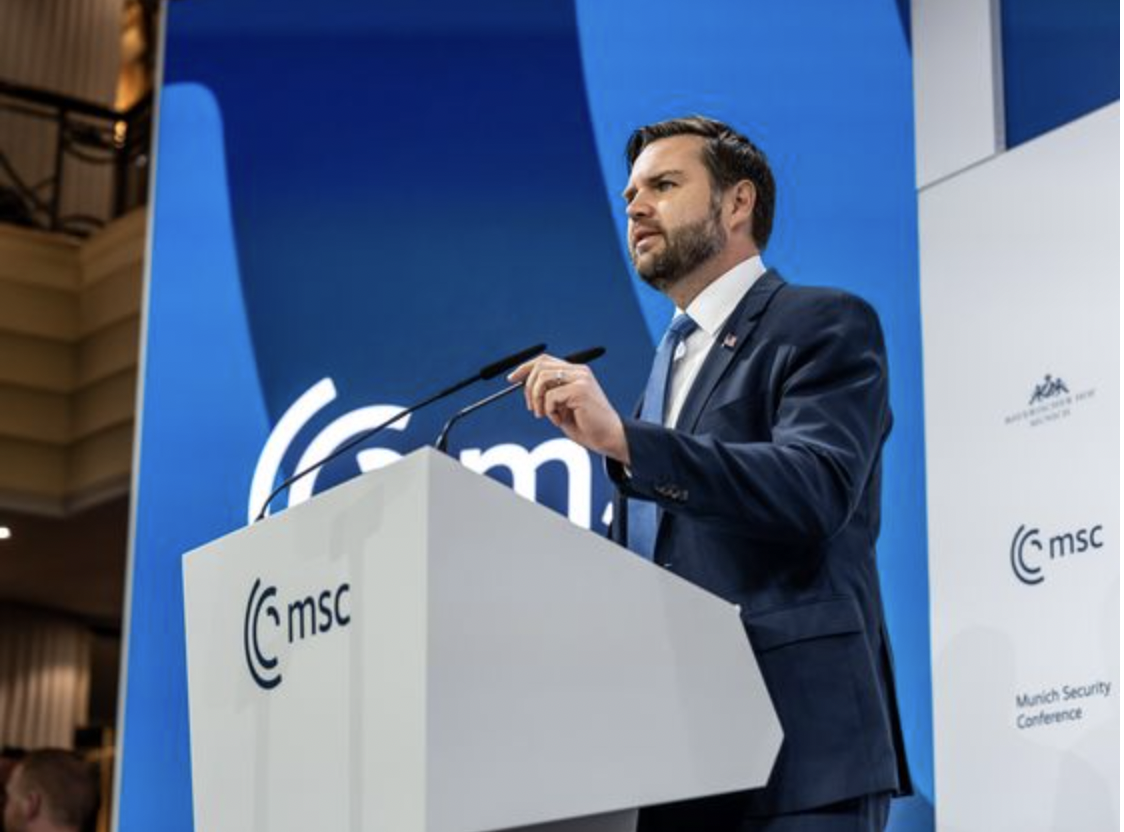
“I felt like I was witnessing the collapse of the post-WWII world order.” – Professor Mara Karlin
Since its founding in 1963, the Munich Security Conference (MSC) has served as a barometer for transatlantic cooperation. But in 2025 it became a moment of reckoning. Professor Mara Karlin, a SAIS faculty member and participant in the conference, described it as “the most consequential in decades.”
As European leaders, policymakers, and analysts gathered in Munich, expectations were high for renewed discussions on defense burden-sharing, European security, and U.S. commitments abroad. The conference began with traditional debates on NATO commitments and European defense, but by Friday, the atmosphere shifted dramatically. The turning point came when U.S. Vice President J.D. Vance delivered a speech that “shook the transatlantic foundation.”
Vance stunned attendees by endorsing far-right political parties in Europe, particularly in Germany ahead of its parliamentary elections, in a move that struck at the heart of the transatlantic alliance. He went further, arguing that the greatest security threat to Europe was not Russia or China, but “the threat from within.” Declaring that “the crisis this continent faces right now… is one of our own making,” he launched a sharp critique of European governance, accusing leaders in Brussels and Berlin of choosing censorship over democracy. Pointing to the UK and Sweden as examples of democratic backsliding, he condemned EU officials for social media bans and criticized British police enforcement of abortion clinic buffer zones. He also commented on NATO burden-sharing, insisting “our European friends must play a bigger role,” while America shifts focus to “areas of the world that are in great danger.”
“The transatlantic relationship was different after that speech,” Karlin reflected. “Fundamentally, a lot of European leaders began to doubt America’s commitment to the post-WWII international order.”
The fallout from Vance’s remarks was swift. What many European leaders once saw as mere rhetoric became a tangible shift in U.S. foreign policy. European officials, alarmed by what they perceived as political interference, openly condemned the speech. German Defense Minister Boris Pistorius rebuked the speech, stating, “We do not only know against whom we are defending our country, but also for what. For democracy, for freedom of expression, for the rule of law, and for the dignity of every individual.”
Historically, the U.S. has used the Munich Security Conference to reinforce alliances and push for greater European defense spending, but this year confirmed growing fears that Washington is stepping back from its leadership role. On Saturday, reports surfaced that the U.S. was preparing to negotiate with Russia over Ukraine’s future without involving Kyiv or European allies, while still expecting Europe to provide resources for the agreement. Some argue that this approach reflects a broader strategic mindset in Washington. As Karlin put it, “there are some folks who believe that you can only focus on one region, only focus on one challenge,” but events in one part of the world inevitably reverberate elsewhere. The Trump administration’s decision to exclude Ukraine and European nations from discussions about their own security is not only detrimental to European stability, she noted, but also sends a troubling signal to allies and adversaries around the world. “Simply put, the Trump administration’s approach to Ukraine is being closely watched by U.S. allies and partners in Asia—and by China as well,” raising concerns about broader implications for American credibility. Karlin characterized this strategy as “short-sighted.”
Ukrainian President Volodymyr Zelensky responded with a direct call for European self-sufficiency, urging leaders to create a unified Armed Forces of Europe. He emphasized that Ukraine’s military had halted Russia’s advance and warned that other European nations could face a similar threat. “If Russia came for you, could your army fight the same way?” he challenged, underscoring the urgency of stronger collective defense.
This pattern of U.S. disengagement is not new to Trumpian foreign policy. As figure 1 shows, Trump’s first administration recorded the highest level of international disengagement post-Cold War, reinforcing European fears of waning U.S. leadership.

By the conference’s end, many leaders were no longer asking how to work with the United States, but whether it was actively undermining global stability. As Karlin put it, concerns had grown that America might not just step back from leadership—but act as “an arsonist” in global crises. Karlin observed that many countries were already beginning to take action. “It became clear that a lot of countries would indeed take this opportunity to invest more in themselves, to set up new partnerships and relationships, and to frankly turn away from the United States.”
The 2025 Munich Security Report underscored the shift toward a multipolar world, emphasizing that U.S. global leadership can no longer be assumed. It noted that Trump’s presidential victory effectively buried the long-standing belief that a liberal internationalist strategy best served U.S. interests. While the report acknowledged that the U.S. remains a dominant military power, it highlighted that when adjusted for purchasing power parity, the defense spending gap between the U.S. and its rivals has significantly narrowed, challenging the notion of unquestioned American military superiority.
With the U.S. stepping back, the question remains: Who will fill the vacuum? Karlin does not see a single power stepping up to replace Washington’s role. Instead, she predicts an increase in European cooperation on defense, growing competition with China, and a reordering of alliances across the Global South. The Munich Security Report echoes this view, noting China’s bid for leadership and Europe’s struggle for strategic autonomy amid internal divisions and economic fragility.
When asked what advice she would give SAIS students, Karlin urged them to recognize “when paradigms are becoming obsolete” and to stay adaptable. “The WWII rules-based international order has faced all sorts of challenges in recent years…but what we saw at Munich was the devastating blow that sowed the seeds for its destruction.”
