
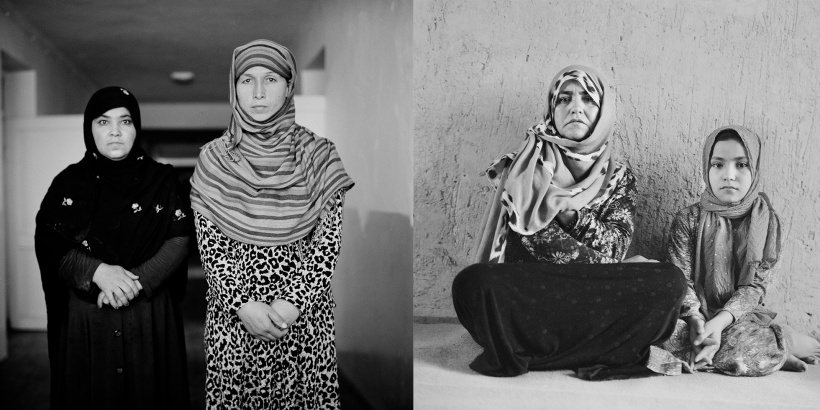
For as long as Afghanistan has existed, its wars have placed a heavy toll on the women left behind. From the Soviet invasion to internecine civil strife, from Taliban repression to the relentless cycles of violence that have ravaged the nation, men have vanished, claimed by prison, torture, assassination, or the battlefield. In their absence, the women have remained, often rendered invisible in the shadows of history, their suffering enshrouded by the spectacle of geopolitics. Among the most harrowing legacies of Afghanistan’s nearly half-century of war is the staggering number of widows—estimated today to exceed two million—, many of whom dwell in poverty and social marginalization (current official figures are elusive). Afghanistan, today, holds one of the highest widow-to-population ratios in the world—an emblem of forgotten grief and unacknowledged resilience. In this landscape of loss, Afghan women have emerged as the quiet casualties of a nation perpetually at war.
In August 2021, the withdrawal of U.S. forces from Afghanistan marked a dramatic turning point. In a matter of days, local capitals capitulated under the Taliban. President Ashraf Ghani fled the country, leaving a power vacuum, a population gripped by fear and uncertainty, and an undoing of two decades of tenuous progress. By the end of 2021, the Taliban had entrenched themselves in power once again, imposing a state vision cloaked in religious orthodoxy. Their resurgence today has brought with it a reversion to that same brutal architecture of gender-based subjugation. Under the guise of enforcing virtue, the Taliban have been denied education to women beyond primary school, barred them from employment, silenced them in the media, and cloistered them within the confines of their homes. The regime’s draconian mandates prohibit women from travelling alone, visiting parks, or receiving vocational training. The psychological toll from these measures on Afghan women has eroded their aspirations. In this climate of despair, suicide has emerged as a tragic option in some cases. Yet, as international attention pivots toward more strategically resonant theatres—Ukraine and Gaza—, Afghanistan slips further from global consciousness. The plight of its women now echoes in a chamber of indifference.

According to data from Beyond 9/11, the average Afghan widow is merely 35 years old, with an estimated 94% unable to read or write. Nearly 90% are mothers, typically to four children. These women are not only bereaved, but disproportionately exposed to social ostracizing, coerced remarriages, domestic abuse, and a systemic deprivation of educational and economic agency. The loss of a husband under such traumatic circumstances often triggers a cascade of mental and physical complications. Yet, the public health discourse around this remains underdeveloped. Their suffering is compounded by Afghanistan’s deeply patriarchal sociocultural structures, where a woman’s identity is patriarchal rather than individual. Widows, however, are often viewed as “women without identity and protection.” The term deg-e be-sarposh—a pot without a lid—is commonly used to describe them. In many cases, they are either sent back to their father’s home or married to a brother-in-law. Either way, they are frequently seen as a burden—an extra economic liability—, especially in times of war, when families are already under strain.
In traditional Afghan households, a woman’s life is closely tied to her husband’s family, where she is expected to find security and belonging. But when the husband dies, this arrangement often unravels, leaving the widow in a precarious position. In many cases, the loss of a husband not only removes emotional support but also triggers a shift in how the woman is treated; she becomes seen as a burden in already-strained households. Women living in extended families face added restrictions from male relatives, such as fathers, brothers, or in-laws, when their husbands are no longer present. Without the social standing that comes from being a wife both relatives and the broader community frequently subject these women to mistreatment. The legal framework offers little protection. Afghan law allows a husband’s family to take custody of children if a widow remarries outside the family, forcing many women to remain single to keep their children with them, despite the financial and emotional difficulties. If the widow has sons who can eventually support her, there is a small degree of security. But for those with only daughters, many are forced to marry them off to settle debts. For all mothers—widowed or not—their foremost concern remains the well-being of their children and the hope of securing a more stable and dignified future for them. Yet, for Afghan widows, this hope is a daily struggle against despair.
Officials from the Ministry of Women’s Affairs (MoWA) have highlighted that access to shelter, food, livelihood opportunities, and basic social protection remains among the most urgent concerns facing Afghan widows today. In the absence of institutional support, many resort to carpet weaving, tailoring, field labor, or domestic chores to make ends meet. Some are forced into begging and prostitution. The little income these jobs generate is rarely enough to sustain a household. Widows often go for days with little more than bread and tea, channeling every bit of their energy into feeding their children. In a society where men are still overwhelmingly seen as the primary earners, widows face deep structural disadvantages. The term commonly used to describe them, bisarparast—“without a caretaker”—reflects a societal mindset that ties a woman’s legitimacy and security to the presence of a male guardian.

Widows are frequently overlooked for employment. Even where legal entitlements exist, such as military pensions for the widows of fallen soldiers, bureaucratic hurdles and lack of male assistance often make accessing them nearly impossible. As a result, many are left without any sustainable source of income. The average working widow earns the equivalent of $20 a month—barely enough to afford a meal. A few managed to generate income through small-scale food ventures, preparing and selling traditional Afghan dishes such as bulani, mantu, ashak, and shor nakhod in local markets. Some can be seen on the crowded streets of Afghanistan, pleading for help with their children by their side. Most of the women she encountered lacked any formal education, leaving them few alternatives beyond housework or begging. “For them, life is just one continuous struggle.” One avenue of economic activity for women has historically been carpet weaving. Under hardline religious interpretations based on a hadith, the Taliban prohibited the depiction of living beings, discouraging idolatry, and main design elements in carpets, such as flowers, birds, and animals, began to disappear. Ironically, these motifs were replaced with symbols of modern warfare—parachutes, tanks, and bombs. During the American-led invasion post-2001, even images from U.S. military propaganda, including depictions of the burning Twin Towers, found their way into carpet patterns, offering a visual record of conflict, which has seeped into the threads woven by unseen hands.

Established in the 1990s by a group of war widows, Zanabad—meaning “Women’s Town”—stands as a rare example of women carving out space for themselves in a society where women are strongly discouraged from living independently, let alone build homes with their own hands. Zanabad stands atop the rocky terrain of Kart-e Naw, a rocky summit 15 kilometres south-east of Kabul—a district originally formed by displaced families during the wars of the 1980s. In the early days, these women were met with resistance and scorn from their surroundings. The neighboring families, particularly those with male members, ostracised them, accusing them of immoral behavior. Yet, over time, attitudes shifted. As poverty levels rose across the city, the economic divide between the widows and their neighbors narrowed. The women’s resilience, self-reliance, and commitment to building their lives from the ground up earned them a reluctant respect. The late Bibi ul-Zuqia—known widely as “Bibikoh“—emerged as the matriarch of the settlement. Widowed twice, she first lost her husband in a rocket strike in Parwan, and later her second—her brother-in-law and a mujahedeen fighter—was killed in combat. Following his death, her in-laws turned against her, and she was eventually forced out of her neighborhood. Bibikoh, however, chose to lead the development of Zanabad, creating not just housing but a sanctuary for women like her. The area, now absorbed into Kabul’s expanding suburbs, is still known locally as the “hill of widows.” Women here refer to each other as sar-posh—meaning a protective cover—highlighting the solidarity they have forged.

Following the collapse of the previous government in August, international organizations have halted or scaled back their operations, while domestic businesses—both public and private—have contracted under the weight of political instability and regime change. This has contributed to a dramatic rise in unemployment, with few opportunities available, especially for women, and even harder for widows. The obstacles facing women in this environment are multifaceted: limited internet access, isolation, and stringent social codes that restrict their movements and expressions. Under the Taliban’s intensifying restrictions and tight oversight from their families, women who attempt to speak out or pursue economic independence do so at great personal risk—including imprisonment, violence, or death. Still, many of these women are choosing to share their experiences. They understand the power of testimony and are willing to tell their stories, not out of defiance alone, but in the hope that someone—anyone—might listen, and that the world might acknowledge their struggle. Their message is clear – their survival is not just a cry but a measure of our humanity.

Editor: Joseph Schneider