
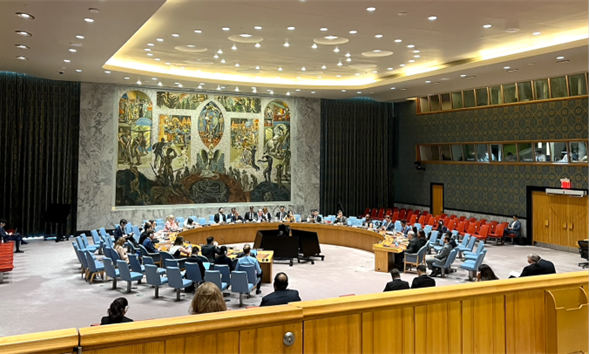
On Sept. 23, 2025, standing in front of the Verde Antico marble, U.S. President Donald Trump addressed world leaders at the United Nations General Assembly. The speech was filled with warnings, but one question stood out: “What is the purpose of the United Nations?”
Questioning the U.N.’s existence is nothing new. Since its inception, the organization has operated under a mandate to maintain international peace and security. Yet, conflict has persisted since the signing of the U.N. Charter in 1945. Combined with structural limitations and bureaucratic inefficiencies, the U.N.’s legitimacy faces its toughest challenge yet—a crisis that could determine its future.
Major U.N. Challenges
The 2030 Agenda for Sustainable Development, adopted in 2015, has guided the U.N.’s work for nearly a decade. But as 2030 approaches, only 18% of Sustainable Development Goals (SDGs) are on track, while another 18% are moving in reverse. The vision of a peaceful, sustainable world appears increasingly distant.
The biggest obstacles to achieving lasting peace and development lie within the U.N.’s structure. The Security Council holds the greatest responsibility for global security, empowered to impose sanctions and authorize military action. Of its 15 members—five permanent and 10 nonpermanent—the five permanent members (the P5: China, France, Russia, the United Kingdom, and the United States) have veto power over any resolution. Russia has exercised the veto most frequently, followed by the U.S. This structure effectively reinforces the influence of the world’s major powers.
The U.N.’s bureaucracy is another common target of criticism. Slow responses and hiring delays have led some to call the institution Kafkaesque. Yet the structure provides necessary stability and coordination for a system of this size. Peacekeeping missions, for example, are often cited as success stories. Complaints of inefficiency often mask deeper political efforts to undermine the organization’s legitimacy.
Financing remains a pressing challenge. The U.N. relies on member states for funding through assessed and voluntary contributions. Assessed contributions fund the regular budget, peacekeeping operations, and the Working Capital Fund, which covers unforeseen expenses. These assessments are based on criteria such as gross national income, debt burden, exchange rates, and per capita income. However, most funding now comes from voluntary contributions earmarked for specific projects—making up 67% of U.N. system revenue in 2022.

Source: United Nations Virtual Global Town Hall which occurred 18 June 2025, provided by UN Controller Chandramouli Ramanathan
Despite the increase in earmarked funding, the lack of regular budget contributions has strained U.N. resources. A persistent liquidity crisis, ongoing for at least seven years, has recently become more acute. Late or missing payments from member states have left the U.N. facing a projected $786 million cash deficit by the end of 2025. The United States, historically contributing 22% of the regular budget, has reduced funding under the Trump administration, allowing other nations to gain influence.

Source: United Nations Virtual Global Town Hall which occurred 18 June 2025, provided by UN Controller Chandramouli Ramanathan
During my time at the U.N., long-term staff at the Secretariat often reminisced that the U.N. “used to have money.” Staff have grown increasingly resourceful, collaborating across departments and relying on virtual meetings to cut costs. But morale remains strained amid financial uncertainty.
Opportunities and Reform
In September 2024, the “Summit of the Future” convened heads of state, U.N. staff, civil society, and NGOs. The conference produced the “Pact for the Future”, adopted by consensus in the General Assembly, outlining 56 targeted actions to reform global governance. The pact directly addresses many of the U.N.’s structural weaknesses.
Action 39 calls for Security Council reform to make it more representative, with a focus on underrepresented regions such as Africa, Asia-Pacific, and Latin America and the Caribbean. It also emphasizes strengthening the General Assembly, Economic and Social Council, Peacebuilding Commission, and the broader U.N. system.

The pact also includes a “Global Digital Compact” to close digital divides and ensure that artificial intelligence (AI) serves humanity’s collective good. AI is already transforming U.N. operations, helping advance SDG implementation. A “Declaration on Future Generations” further recognizes the vital role of youth and the importance of addressing long-term challenges that will shape the next century.
Building on these commitments, the “UN80 Initiative”—launched in March 2025 by U.N. Secretary-General António Guterres—focuses on identifying efficiencies, reviewing mandates, and exploring structural reforms.
However, it has sparked controversy over proposed cost cuts, including a long-standing hiring freeze and significant funding reductions in the Secretariat’s 2026 budget. Guy Ryder, under-secretary-general for policy and chair of the UN80 Task Force, has insisted that the initiative aims to strengthen, not shrink, the institution. Yet questions remain: Will these reforms truly make the U.N. more effective, or will they erode its core functions?
Solving global crises and achieving a sustainable future requires intergovernmental cooperation and a renewed commitment to multilateralism. Without the U.N., the world would face far greater challenges in coordinating international action.
While funding shortages and structural flaws hinder its work, much of the U.N.’s dysfunction reflects the failures of its member states. The organization can facilitate peace, but it is the responsibility of nations to uphold it. Reform is necessary, but existential doubt about the U.N.’s purpose only invites chaos. If the United Nations didn’t exist, what would replace it?
The decisions made today will determine whether the U.N. remains a cornerstone of global cooperation—or a relic of the past.
Background: I interned for three months and later worked for nine months (August 2024–September 2025) at the United Nations Department for Economic and Social Affairs.
Edited by: Krithiga Narayanan