
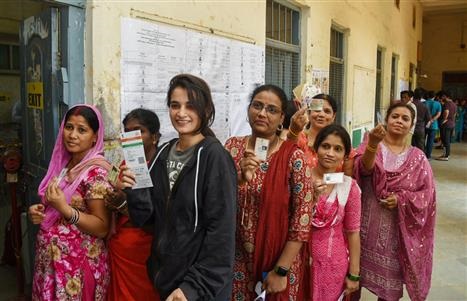
Democratic decline is now a worldwide phenomenon. According to the latest 2025 V-Dem democracy report, democracy is at its lowest point in more than 50 years. This is largely because some of the biggest democracies in the world are autocratizing, including countries like India, which was once hailed as the largest democracy in the world.
Electoral processes are a key element of any democracy, featuring free and fair elections, universal suffrage and vibrant electoral plurality. But now, there is a visible rising trend of autocratic regimes maintaining the facade of democracy to extract the privileges that come with it, which includes holding political, diplomatic and economic power in the global politics of the free world.
According to the report, India is joining the ranks of these countries, thus tipping the scales in favor of global autocratic trends. In the recent general elections held in 2024 in India, the premise was of free and fair elections. But opposition leaders have alleged widespread irregularities and voter disenfranchisement, claims the ruling government denies.
The institutional capture of the Election Commission of India by the ruling party has been cited as the primary concern of the opposition. The evidence presented by the opposition leader, Rahul Gandhi, in a press conference highlighted mass disenfranchisement of voters by deleting them from voting lists and the addition of fake voters. The election commission and government officials have dismissed these allegations as unfounded.
Electoral institutions cannot be held accountable, as a law passed in 2023 by the ruling party in the Indian Parliament offers protections to the Chief Election Commissioner and other election commissioners. Section 16 of this law states:
“Notwithstanding anything contained in any other law for the time being in force, no Court shall entertain or continue any civil or criminal proceedings against any person who is or was a Chief Election Commissioner or an Election Commissioner for any act, thing or word, committed, done or spoken by him when, or in the course of acting or purporting to act in the discharge of his official duty or function.” Thus, this severely compromises electoral integrity and trust in electoral institutions, challenging their very democratic nature.
When the very institutions that should protect democracy work against it, what possible actions can opposition leaders and policymakers take to preserve democracy? Working together in coalition with the people, press and watchdogs to build a shadow electoral audit process during the time of elections is an exemplary action that can be taken, so that when election results are released through official channels, accountability and transparency can be maintained.
Should leaders also utilize the power of social media to garner support? But in an increasingly polarizing world fueled by misinformation, social media is weaponized by authoritarian rulers, making it ineffective in aiding and consolidating democratic rule. Grassroots community engagement and local movements can help build democracy at the local level and strengthen it from the bottom up.
These movements require strong leaders who need to be inclusive, bringing together diverse groups of individuals. The premise for such a grassroots movement in India was laid by the leader of the opposition before the general elections, when he marched across India. This walk was called the “Bharat Jodo Yatra,” meaning a walk to unite India.
This movement was similar to Mahatma Gandhi’s early nonviolence activism during his fight for freedom against British colonial rule in India, the Salt March. Even though this walk across India generated electoral momentum and public trust for the opposition, it could not win completely against entrenched electoral authoritarianism. This is where local community leaders at every level can help. These trusted grassroots leaders can bring communities together, build social cohesion, act as shadow electoral auditors, and serve as ambassadors for democracy.
Edited by: Zeynep Reyyan Erdem and Blake Uhlig