
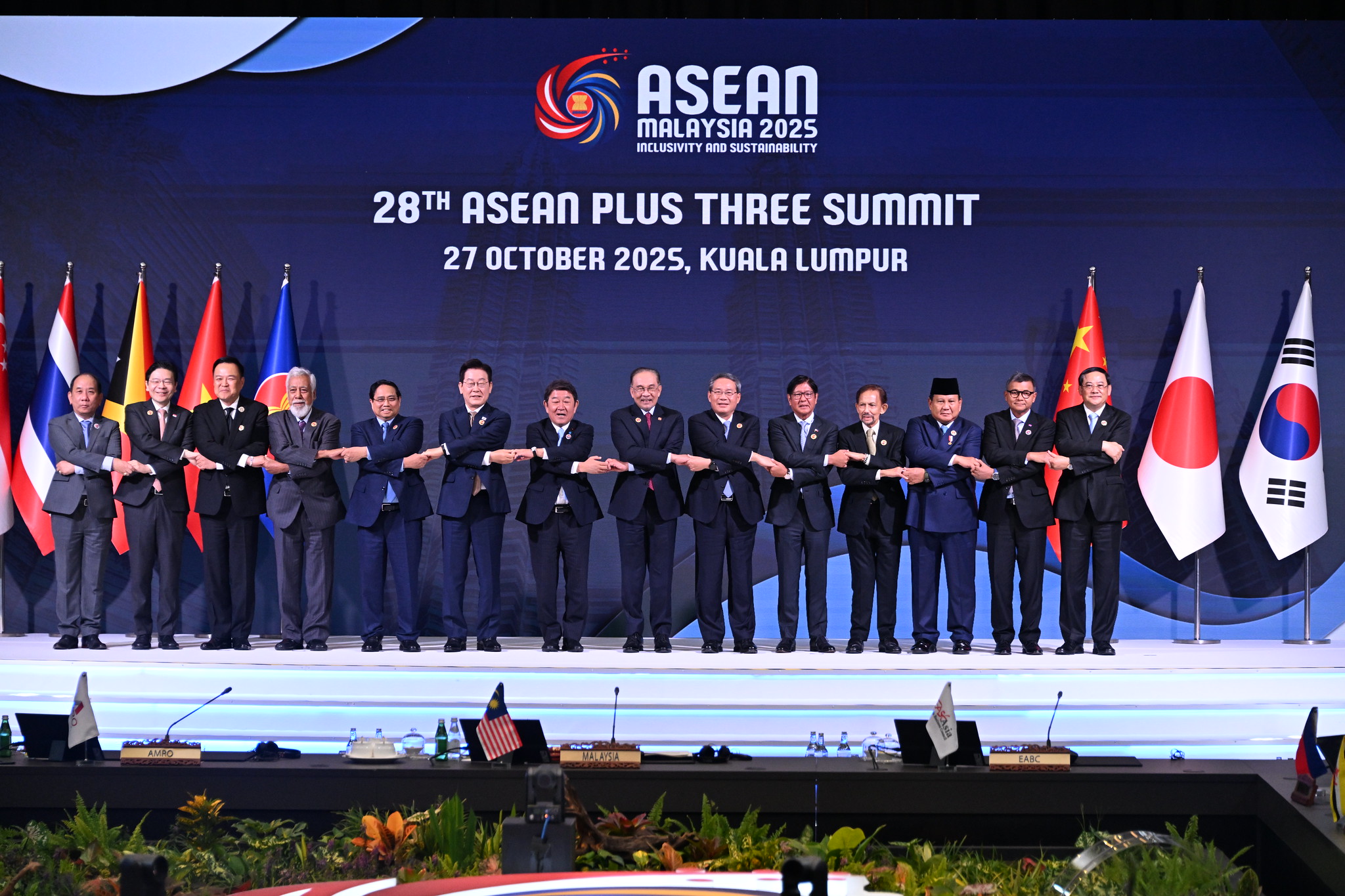
The return of strongman rule in Southeast Asia reflects a rational response to historical trauma, civil conflict, and weak governance. Leaders increasingly legitimize authoritarian governance through discourses of national security, “Asian Values,” and economic pragmatism—narratives that resonate deeply with local populations. As a multipolar world emerges, the region stands at a strategic crossroads between China and the United States. While Washington champions democracy in rhetoric but tolerates authoritarian allies, Beijing offers investment without political conditions. Hedging between these powers allows Southeast Asian regimes to maintain centralized control and extract benefits from both sides. Authoritarianism in the region has thus reemerged not as ideology but as a pragmatic strategy for state survival—sustained by both internal dynamics and the permissive structure of the international system.
The liberal order is no longer dominant. Instead, multipolar competition among the U.S., China, Japan, and the EU has intensified. For small and medium states in Southeast Asia, this means navigating security dilemmas and ensuring regime durability. Authoritarianism here is less aberration than adaptation. Most regional leaders govern nations shaped by colonial rule, Cold War proxy conflicts, and civil unrest. The memory of collapse and occupation remains fresh, shaping fears of instability. ASEAN’s creation itself reflected this defensive impulse: to preserve regional autonomy and prevent the region from becoming a great-power battleground.
In weak states marked by corruption and fragile institutions, leaders often view dissent as a threat to cohesion. Repression becomes preemptive, justified as necessary for unity. Yet control today is not enforced solely through coercion—it is legitimized through sophisticated narratives. Three stand out: national security imperatives, cultural relativism rooted in Asian values, and economic pragmatism. These discourses resonate deeply with populations whose lived experience privileges order and prosperity over abstract liberal ideals.
National security remains the most common justification. In the Philippines, the Anti-Terrorism Act of 2020 grants sweeping powers for warrantless arrests and detention, a law kept intact under Marcos Jr. in the name of internal stability amid tensions with China. In Indonesia, Jokowi’s government labeled Papuan separatists “terrorists,” legitimizing expanded military operations. In both cases, the language of security masks the consolidation of state power.
The second pillar is the invocation of “Asian values.” Southeast Asian leaders frequently contrast their governance with Western liberalism, emphasizing collective harmony, order, and development. Singapore’s Lee Kuan Yew famously argued that social stability and economic progress require disciplined governance, not liberal pluralism. Such ideas resonate because of shared postcolonial experiences: societies scarred by occupation, ethnic diversity, and weak statehood often prioritize unity over contestation. Western-style democracy is portrayed as chaotic or elitist, while Asian traditions—rooted in hierarchy and consensus—favor authority and cohesion.
Economic pragmatism forms the third pillar. Many leaders argue that centralized control ensures efficiency and growth, positioning dissent as an obstacle to prosperity. The rise of East Asian economies like Singapore and South Korea provides a convenient precedent: both achieved industrialization under strong, often illiberal, governments. Singapore remains a hybrid model—democratic in form but authoritarian in practice—where rapid development and limited political freedom coexist. Across Southeast Asia, regimes frame prosperity as proof of legitimacy, reinforcing the belief that order and growth justify limited liberties.
Globally, authoritarianism’s resilience is strengthened by the decline of liberal influence. The U.S. retreat from democratic promotion, particularly under President Trump, marked a turning point. His “America First” approach reduced Washington’s credibility as a values-based partner. He questioned alliances, cut humanitarian aid, and even praised Duterte’s drug war. For Southeast Asian leaders, this signaled that the world’s leading democracy would tolerate repression if it served strategic interests. Meanwhile, democratic crises in the West—from the U.S. Capitol riot to Europe’s populist surges—undermined the liberal model’s moral authority. If even established democracies falter, Southeast Asian governments argue, stability-first governance is the safer path.
China’s rise offers an alternative model: modernization without democracy. Through the Belt and Road Initiative, Beijing provides infrastructure and investment with no political conditions. Cambodia, Laos, and Myanmar welcome this non-interference, while Indonesia and Vietnam balance deep economic engagement with quiet political autonomy. China’s success story—economic growth under one-party control—legitimizes centralized governance as both effective and modern. For regional leaders, survival now depends less on Western approval and more on internal strength and diversified partnerships.
Both great powers, despite ideological differences, ultimately enable authoritarianism when it aligns with their interests. The U.S. speaks of “shared values” yet applies them selectively: maintaining aid to Duterte, deepening ties with Vietnam’s one-party state, and resuming cooperation with Thailand after its 2014 coup once China drew closer. China, meanwhile, makes no pretense of democracy promotion. Its partnerships are openly transactional—based on sovereignty, infrastructure, and mutual noninterference. For small states, Beijing’s hands-off approach appears respectful compared to Western conditionality.
In this dual engagement space, Southeast Asian regimes perfect the art of hedging. They engage economically and militarily with both powers, leveraging strategic ambiguity to shield domestic repression from scrutiny. The Philippines tilts between Chinese investment and U.S. defense cooperation; Indonesia drills with the U.S. while welcoming Chinese infrastructure projects; Vietnam aligns with the U.S. on security while maintaining strong ties with Beijing. Hedging reduces external pressure for reform and grants regimes maneuverability. If the West criticizes rights abuses, China stands ready with loans and diplomatic backing.
The result is an international order that no longer rewards moral clarity. Authoritarian leaders in Southeast Asia now justify control not in defiance of global norms but through them—claiming stability, sovereignty, and pragmatism as virtues. In a world where power trumps principle, repression becomes resilience and survival replaces reform. The danger lies not in democracy’s dramatic collapse but in its quiet normalization of decline—when leaders and citizens alike stop expecting it to endure.
Edited by: Krithiga Narayanan