
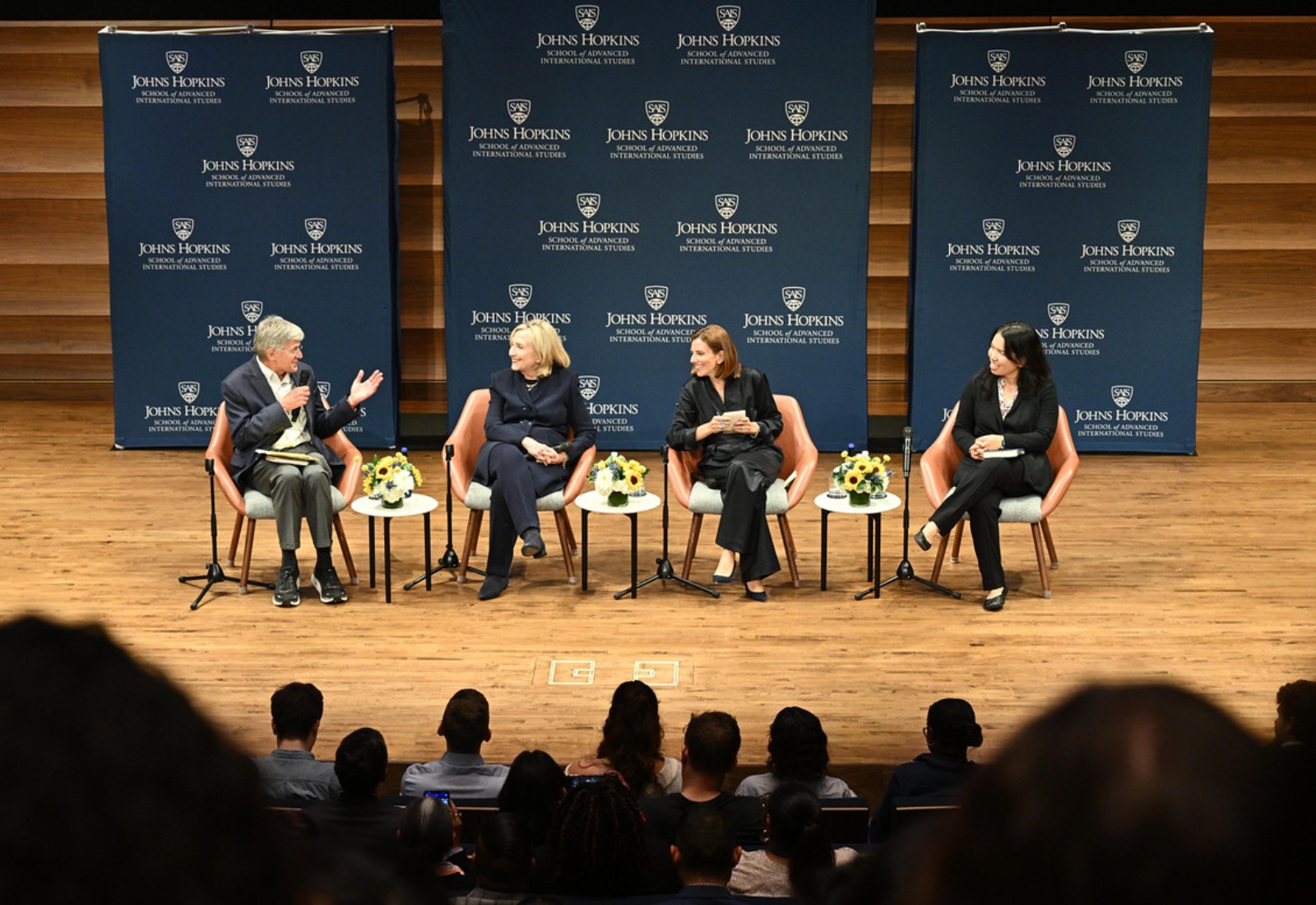
On Oct. 14, SAIS DC students were invited to a panel discussion featuring former U.S. Secretary of State Hillary Clinton; Keren Yarhi-Milo, dean of Columbia University’s School of International and Public Affairs (SIPA); and Jessica Chen Weiss, a scholar of China and Asia-Pacific studies, for a wide-ranging conversation on the challenges of global decision-making.
The discussion, moderated by SAIS Dean James Steinberg, pulled back the curtain on how leaders make decisions in moments of crisis.
Part of a larger project tied to Clinton and Yarhi-Milo’s newly released book, Inside the Situation Room, the event explored the psychology of leadership, the limits of rationality in foreign policy, and the often uneasy relationship between scholarship and statecraft.
Dean Steinberg opened the conversation by quoting Karl Marx: “Men make their own history, but they do not make it just as they please.” That tension, he said, sits at the heart of the new book—a project that aims to bridge theory and practice by bringing real-world experience into conversation with academic circles.
Clinton recalled how the partnership began after a mutual colleague, Lea Boulanger, encouraged her to meet SIPA’s new dean. “I had been in the Situation Room—and Keren had researched decision-making for years. We realized there was no book that really spoke to both sides—theory and the lived reality of leadership,” the secretary explained. The book is based on a class the two co-teach at Columbia SIPA, where Clinton joined the faculty in 2023.
Yarhi-Milo’s expansive research into presidential archives highlights the intensely human side of decisions about war and peace. “Leaders are human beings,” she said. “They face emotion, pressure, and moral weight. Understanding that is crucial if we want to understand how foreign policy actually happens.”
She pushed back against the realist notion that states simply maximize power. “As Robert Jervis taught us, psychology matters. Leaders don’t make perfectly rational choices. Behavioral biases, fear, pride—these shape outcomes as much as national interest.”
Clinton agreed, noting that prospect theory helps explain risky behavior by leaders who feel they are losing ground. “People in a domain of loss are much more willing to take risks,” she said. “That explains Putin more than anything—his sense of loss over the Soviet Union and over countries turning toward the West.”
She also reflected on figures such as diplomat Richard Holbrooke, whose blend of charm, confrontation, and manipulation sometimes succeeded and sometimes backfired. “There’s a spectrum of rationality,” Clinton said. “We need to understand the psychology behind these decisions, not just the policy outcomes.”
Yarhi-Milo also warned of the opposite trap—over-personalizing policy. She cautioned that relying solely on face-to-face diplomacy can magnify volatility. She said former President Donald Trump’s overuse of personal diplomacy produced unpredictability that harmed America’s credibility and the reputation of U.S. diplomacy.
Clinton insisted that personal diplomacy matters—but only with preparation. “I always did my homework,” she said. “Finding a moment of connection helps, but it can’t replace understanding the context.”
Weiss added perspective on coercive diplomacy, arguing that threats only work when they come with credible assurances. “Deterrence is about choice,” she said. “The other side must believe it still has one.” On Taiwan, she noted, Beijing’s caution has less to do with goodwill than with deterrence: if China feels cornered, it becomes more willing to take risks.
The discussion shifted to the current state of the Gaza cease-fire, understood through I. William Zartman’s theory of ripeness. “The circumstances of the events in the Middle East have changed. It wasn’t ripe for the Israelis. It wasn’t ripe for Hamas,” Clinton said. She believes that the forcing action that made it ripe was a poorly advised Israeli attack on Qatar—a strategic and moral error, she said, that diverted attention and eventually prompted U.S. intervention to bring the war to an end. As part of a long process, Clinton said it would be difficult to realize the proposed 20-point plan. However, as long as there is a cease-fire, people are returning home, aid is being provided, and hostages are being released, “it turns out to be ripe for an unusual, unpredictable reason.”
The evening ended on a note of concern. Clinton highlighted data showing that peace agreements are more durable when women are involved, and she warned that authoritarian leaders often target women first. “We see it everywhere—from Trump firing women in key roles to Milei in Argentina and Putin’s rollback of domestic violence laws.”
Asked what advice she would give to students considering public service, the secretary urged: “Stay as long as you can serve with integrity,” she said. “In these uncertain times, we need you.”
Edited by: Krithiga Narayanan