
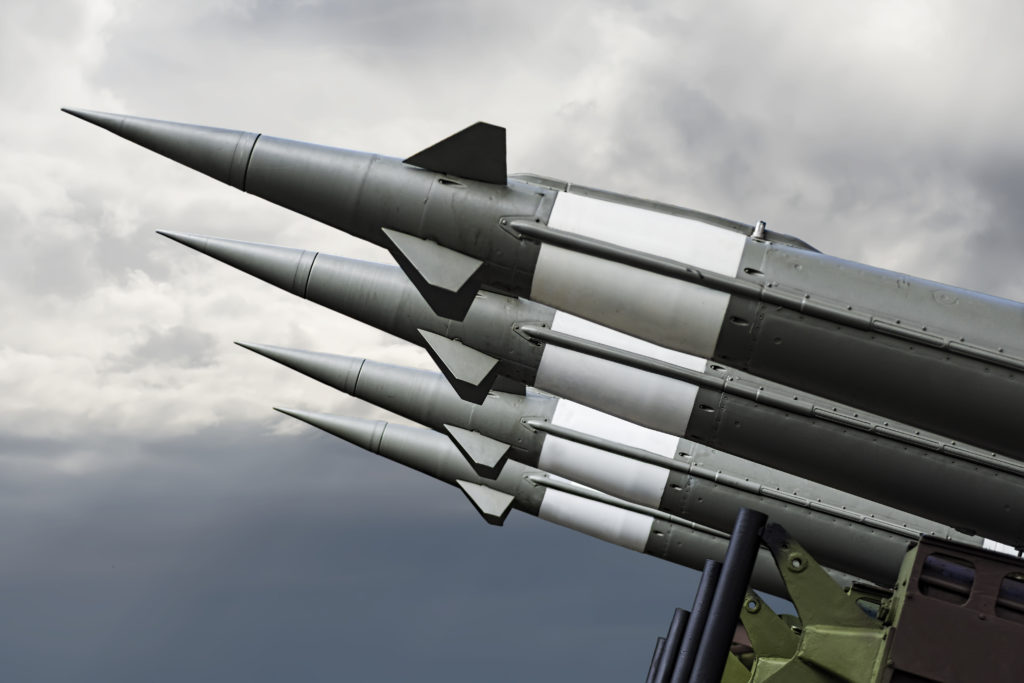
Extended deterrence, the promise of the United States to defend its democratic allies in Asia with nuclear weapons, has largely helped prevent proliferation in the region over the decades. It has also helped in arms control, peacebuilding and regional trust-building. One of the stated goals of U.S. nuclear weapons policy is to extend deterrence to over 30 U.S. “allies and partners” and assure these countries that the United States will come to their aid if they are attacked.
Extended deterrence worked well in a Cold War bipolar world, but in a multipolar world in global disorder, its limits are being tested. The promise of extended deterrence in Asia served a dual purpose: to prevent nuclear proliferation in the region and to sustain American strategic dominance in the region. But both are now under strain due to shifting geopolitics, and weakening of one undermines the other.
The foundation of extended deterrence is credibility: the strong belief that the U.S would risk nuclear escalation for its allies and protect them. This credibility is facing pressure from multiple sources. The U.S is facing multiple crises at once in different regions under varying scales—for instance, Ukraine and Gaza—that can make allies question American credibility. Congressional polarization can also hinder budget continuity for extended deterrence, and shifting U.S domestic politics also risks credibility.
North Korea’s tactical nuclear doctrine lowers the threshold for first use, making extended deterrence more complex. North Korea’s ICBM testing and South Korea’s precarious relations with the U.S. have shifted public perceptions in South Korea, where nearly 70% of citizens support independent nuclear deterrence. South Korea’s nuclear ambition is growing, and South Korean President Yoon Suk-yeol’s administration has also hinted at South Korean nuclear armament.
Japan is also reformulating its defense strategy. In 2022, Japan made a revision to its National Security Strategy (NSS), signaling a significant shift from “security pacifism,” under which it relied on the U.S. nuclear umbrella, towards building independent offensive counterstrike capabilities. Public debate around nuclear deterrence is also growing in Japan.
Japan also proposes to increase its defense budget to 2% of its current GDP. A 2024 Stimson Center report states that while the Japanese public is firmly opposed to Japan acquiring nuclear capabilities, new threats have given rise to mainstream discussions surrounding the U.S. nuclear umbrella. This is largely due to growing threats from China, North Korea and Russia, and credibility issues with the United States.
China is rapidly increasing its nuclear stockpile while also expanding its conventional deterrence. During the September 2025 China Victory Day parade, China showcased its nuclear-triad, hypersonic missiles, and other advanced military equipment, signalling to the U.S and its allies about its ambitions. This psychological intimidation tactic can change perceptions of shifting power among allies and consequently make them reassess the U.S nuclear umbrella.
Some threats might also be very real. Admiral Philip S. Davidson, a retired four-star officer of the United States Navy who served as Commander of U.S. Indo-Pacific Command (INDOPACOM), said in a U.S. Senate Committee testimony in 2021 that Taiwan might face threats from a Chinese attack within the next six years. But the U.S. position regarding Taiwan is still strategically ambiguous.
These evolving threats in the backdrop of geopolitical flux require the U.S to strengthen its credibility and institutional frameworks for extended deterrence. What strategies can the U.S. adopt to sustain its nuclear deterrence umbrella and prevent a nuclear breakout in Asia?
The United States possesses military superiority in both nuclear and conventional deterrence. Pairing this superiority with greater institutional trust can boost credibility. This can be achieved through strong institutional frameworks. Existing framework structures, such as the U.S.–ROK Nuclear Consultative Group (NCG) and the U.S.–Japan Extended Deterrence Dialogue, represent promising foundations but they need to evolve to reflect the evolving nature of threats.
More frequent joint exercises that build rapport and serve as a signal, permanent consultation bodies, and transparent communication mechanisms can help strengthen existing institutional frameworks, thus helping to transform deterrence promises to credible and tangible acts.
Credibility also relies on domestic politics. Embedding extended deterrence into annual defense reviews, congressional resolutions and statutory mandates with bipartisan support sends strong signals to allies that the U.S. nuclear umbrella is credible across different administrations. The strength of extended deterrence credibility also relies on the strength of American democratic ideals.
The U.S. has always been a champion of democracy, and its allies are also democracies. Hence, strengthening democracy locally is also vital to boost credibility and the moral foundations for extended deterrence because the countries posing threats to it are all authoritarian. Standing by and promoting democratic principles is a strong signal to the democratic allies of the United States that it will stand with them in the face of a threat from an authoritarian nation.
It is imperative that the United States strengthen its institutional and moral framework for extended deterrence because the trust allies place in the U.S. for extended deterrence is dynamic. This deterrence must therefore be renewed and reformed consistently to sustain credibility. Sustaining credibility does not have to mean expanding nuclear reliance, but rather deepening cooperative, democratic institutions that reduce the need for nuclear deterrence.
Editor: Connor Hartigan