
The so-called immigrant identity crisis impacts how I present myself to the world. When someone asks me where I am from, my answer may vary. Do I tell my whole life story, or do I keep it simple? I freeze sometimes. My answer may impact how I am perceived. My story is not simply defined by one place, but rather an intertwining of experiences in a range of locations. Settling on one place sometimes feels like hiding a part of myself. I am afraid of reducing myself to one instance, one location.


Baby Andrea and her paternal grandfather (passed away in April 2024), and maternal grandfather (passed away in August 2025)
My story begins with my birthplace: my family’s home country of Peru. Even while writing this, I wonder, am I too allowed to call it my home country? I know what my parents would say, my upbringing was essentially American. But their statement dismisses the intricacies of my childhood. It disregards my experiences in a Peruvian immigrant household. It dismisses my yearning to be accepted by my Peruvian roots despite not having grown up there. My younger self most definitely did not consider herself to be American, being fully aware of her birthplace, her parents’ culture, her first language (Spanish), and her citizenship status.
I was born in Peru, but a year later, my parents moved with me to Puerto Rico, following their career ambitions. We were only there for about three to four years. Though my time there was short, Puerto Rico was the beginning of my multicultural experience, a significant place for my early development. When my family moved to the United States, to Massachusetts, my primary language was still Spanish.


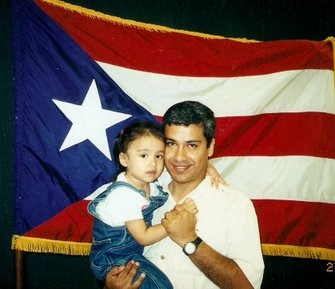
Andrea and her father in Puerto Rico; Andrea with her school group
I grew up in an international student community in Amherst, Massachusetts. There, my childhood friends were from Guatemala, Panama, El Savaldor, Puerto Rico, China, Cambodia, and more. From my neighbors, I learned Mandarin Chinese. At community gatherings, the rhythmic beating of the cajon, normally played by my father, evoked a sense of home away from home. At my elementary school, I was inspired by my Cambodian peers’ performance for Cambodian New Year.
For a while, Amherst was my hometown, until we moved again to Colorado, and finally Oklahoma. As I adapted to each new community, reintroducing myself eventually became a challenge. I only lived in Colorado for two years, and for the longest time, I felt out of place in Oklahoma. Having spent my formative years there, Amherst and its international community was the one place I was the most homesick for, though the people were long gone. As a result, I found myself struggling to define my hometown.
The “where are you from” question sparked conflicting feelings as I became more aware of the dichotomy of my identity. That question, though seemingly simple, has multiple layers to it depending on who asks. Are you asking for the last place I lived in, where I consider home, my family’s country of origin, or why I speak Spanish?


Childhood friends and a snapshot of the 2008 school yearbook
In a sense, this struggle to define myself has influenced my career journey. I was driven to international relations partly by my desire to incorporate my background into my future career. Perhaps it was my unconscious desire to prove myself as a Peruvian, my wish to learn more about my heritage, that sparked my curiosity for Peruvian affairs and Latin American development.
As distant relatives or family friends gasped in surprise at my Spanish and asked if I wanted to eat french fries, I felt my sense of identity being questioned. I loathed the assumptions, but I understood where they came from. After all, if you ask my younger brother where he is from, he will answer without a doubt, “I am American.” My answer varies because I always considered myself Peruvian from the start. In actuality, the “ni de aqui ni de alla” feeling has slowly been fading as I grow to accept the duality of my identity.
In 2022, I officially became a United States citizen in the same naturalization ceremony as my father. It is a privilege that I am grateful for, though I will always acknowledge my immigrant origins. My participation in the Miss Perú DMV Pageant for Fiesta DC this year was a result of my determination to challenge myself while proudly representing my home country. I did not win, but I stepped outside of my comfort zone to show how much being Peruvian means to me.
Edited By: Katie Jordan