
China’s unity, patriotism, and strong sense of national identity and culture are some of the things I admire most about China as an American looking in. The Chinese national holiday Golden Week commemorates the founding of the PRC on October 1, 1949. Every year, the shops of every street are adorned with hongqis, China’s flag, and the country seems to be teeming with more red than the falling autumnal leaves.
But as the nation reveled in patriotism, my experience over the holiday brought me to the realization that the authenticity of China’s architecture––a pillar of national identity––is not as strong as I thought. Beneath the pageantry, the buildings that once embodied China’s history are increasingly replaced or preserved solely for commercial purposes.
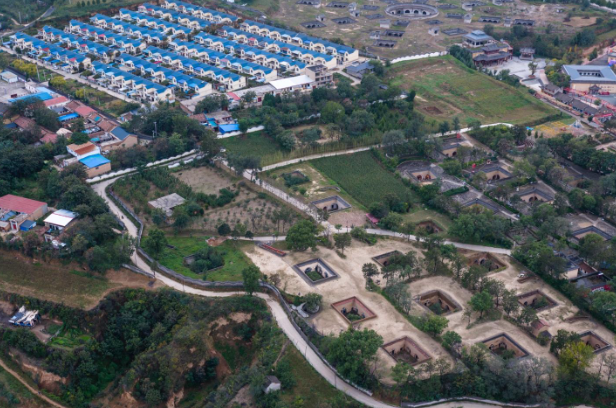
At the end of the holiday, I travelled to northeastern China to help my father, a professional photographer, with his fieldwork on China’s shifting population patterns. We first travelled to Sanmenxia in northeastern Henan, home to some of the best preserved dikengyuan, often translated as pit homes or sunken courtyards. The region’s soft, silty soil is not only conducive to excavation but also acts as an effective heat insulator from winter cold and summer heat. Rooms are carved out of the surrounding four walls, one side connecting to a ramp that gives access back to the surface. For centuries, these homes were ubiquitous in the villages of the Loess Plateau.

Caption: The former residence of an elderly villager in Sanmenxia. His new above-ground house is pictured in the background.
An elderly villager showed me the pit home that he and three generations of his family once called home. In the 1990s, the local government deemed the structure unsafe and prone to collapse. He now lives in a modest above-ground house built directly behind the sunken courtyard where he and his grandparents grew up. When I stepped closer to take a photo of the original residence, he urged me to move back because he feared the walls might give way.

Caption: The newly constructed housing development with blue roofs serve as the replacement for the former residents of the pit homes.
Today, nearly all the real pit homes sit abandoned and dilapidated in the village of Sanmenxia. Some are used only for storage or as chicken coops. Meanwhile, the best-preserved pit homes have been turned into an official tourist attraction, the Dikengyuan Folk-custom Cultural Park, where visitors walk through staged displays of traditional life.
This is a phenomenon I’ve seen frequently in my travels through China: historically significant architecture hollowed out and replaced with uniform residential blocks and office units. Even in areas where the government formally protects the old structures, like the Bund in Shanghai or the hutongs in Beijing, the result feels less like authentic preservation and more like a themed shopping district––a kind of hyper-commercialized stage set that could make even Disneyland feel authentic.
Plenty has been written about the uniformity of China’s urban planning and the soulless sprawl it produces; rapid development, policy incentives, and cost-efficiency tend to yield the same building templates over and over. What struck me on this trip though, was how deeply this uniformity has seeped into rural areas, too. It was disheartening to see such unique centuries-old forms of living replaced by materialist monotony. Even if the new homes of the former dikengyuan residents provide modern amenities like heating and running water, the shortcomings of China’s efforts to preserve cultural and architectural heritage were clear. Now, the architects of this heritage live in characterless, cookie cutter housing developments that look interchangeable with housing blocks anywhere in the world.
After a few days in Sanmenxia, my father, our driver Mr. Yang, and I drove to the village of Chiniugua in northern Shaanxi. The locals here took a similar approach to living in the Loess Plateau, but instead of digging into the ground, they constructed homes called yaodong by digging into the side of the surrounding hills. The village is a collection of excavated cave homes that was founded some 800 years ago during the Ming Dynasty, with around 350 households and 1600 people. In 2015, it was expanded into an official tourist destination and is now filled with hotels and restaurants.

Caption: An aerial view of the village of Chiniugua, Shaanxi. The new units currently being constructed are pictured on the left.
Farming families still occupy some of the homes on the bottom levels, which have been updated with modern comforts with the original character preserved. However, most cave homes have been turned into hotels and museum-like displays for Chinese tourists; the destination attracted over 200,000 visitors in 2024. The new units being built are not dug into the mountain, but instead are constructed on the outside before concrete is poured on top to mimic the appearance of the traditional dwellings. They function less as homes than as facades, built to give the impression of tradition rather than continue it.

Caption: Local farmers in the village of Chiniugua, Shaanxi, entering their cave homes. The silty soil of the Loess Plateau is ideal for excavation. Entrances are made of traditional-style wooden doors with paper windows under a short roof.
Today, Chiniugua has been Disneylandified to such an extent I have hardly any idea what life was like here before it opened for tourism just a decade ago. According to the local historian, only about 1/5 of the cave homes were constructed before the village opened for tourism in 2015. Many of the new homes are completely empty, serving tourists’ cameras rather than the people who once lived this way.
In my classes at the Hopkins–Nanjing Center, I often hear my professors point to China’s 5,000 years of civilization as a source of national pride. I’ve never doubted the depth of that history, but what strikes me is how little of it remains visible in everyday life. Many of China’s most famous temples and monuments were rebuilt within the past half century.
For example, Nanjing’s Yuejiang Tower was described to me by a classmate as an ancient Ming dynasty watchtower. But at the entrance, the pamphlet revealed it had been entirely reconstructed in 2001, including an elevator shaft no Ming official could have dreamed of. I’ve had the same experience at landmarks like Wuhan’s Yellow Crane Tower and Nanchang’s Pavilion of Prince Teng, both fully rebuilt in the 1980s.
Modernizing while preserving tangible cultural heritage poses a challenge for many countries; however, China has demonstrated it is certainly capable of doing so at times. Here in Nanjing, the government has done a remarkable job preserving the Ming Xiaoling Mausoleum built in the 1380s. The authenticity of the building and the original layout and materials have been maintained in accordance with UNESCO conservation rules. Unfortunately, the more common choice is a model of commercialization that prioritizes expedience, which has led to the steady erosion of Chinese historical architecture. It seems this unique and authentic aspect of China’s culture has been cast aside by its desire to modernize.

Caption: My father, George Steinmetz, and me during our travels through northeastern China this October.
All photos courtesy of George Steinmetz.
Edited By: Kyra Colbert