

The following is an abridged version for the Observer. For the extended version, see the article posted to Noah Munk’s Substack here.
Since his second inauguration, Trump has used economic sanctions on an unprecedented scale to advance US interests by exerting pressure on enemies and allies alike. April’s “Liberation Day” kicked off a back-and-forth between the US and China that escalated to tariffs of 145% and 125%, to which Beijing responded by implementing export controls on seven rare earth elements (REEs). The US then expanded their own controls on advanced semiconductors sent to China, a blow that forced both sides to convene at the negotiation table. The ensuing cooldown lasted until October, when China lashed out against US port fees and blacklisting with even more extensive REE restrictions. Increasingly vehement responses from both sides have left Southeast Asia caught in the crossfire—providing the background for Trump’s late October tour of Southeast Asia, including stops in South Korea, Japan, Vietnam, and Malaysia, which saw a smattering of economic, political, and military statements to fortify the US position—but would it be enough?
Though “Liberation Day” ultimately caused the most strife with China, it was a blow targeted at the entire world. Before the 90-day pause, Southeast Asia bore the brunt of the policy: Cambodia, Laos, and Vietnam were tariffed at near 50%, and even Japan and South Korea, the two strongest American allies in the Asia-Pacific, were hit with rates of 24% and 25%. China didn’t spare the region, either—Vietnam and Malaysia, despite having access to significant rare earths deposits, are wholly reliant on Chinese refining of the elements. Additionally, China’s application of foreign direct product rule (FDPR) limits export capabilities of countries using Chinese REEs. Supply chains all over the world bear the cost of China’s policy—not just those important to the United States.
Southeast Asian countries are forced to bear the collateral impact of the trade war, as the fists flying across the Pacific are also the hands that provide vital aid to the region. It was, critically, the US who first made the turn from fisticuffs to fraternity; Trump tending to the wounds his own trade war had inflicted on bystanders.

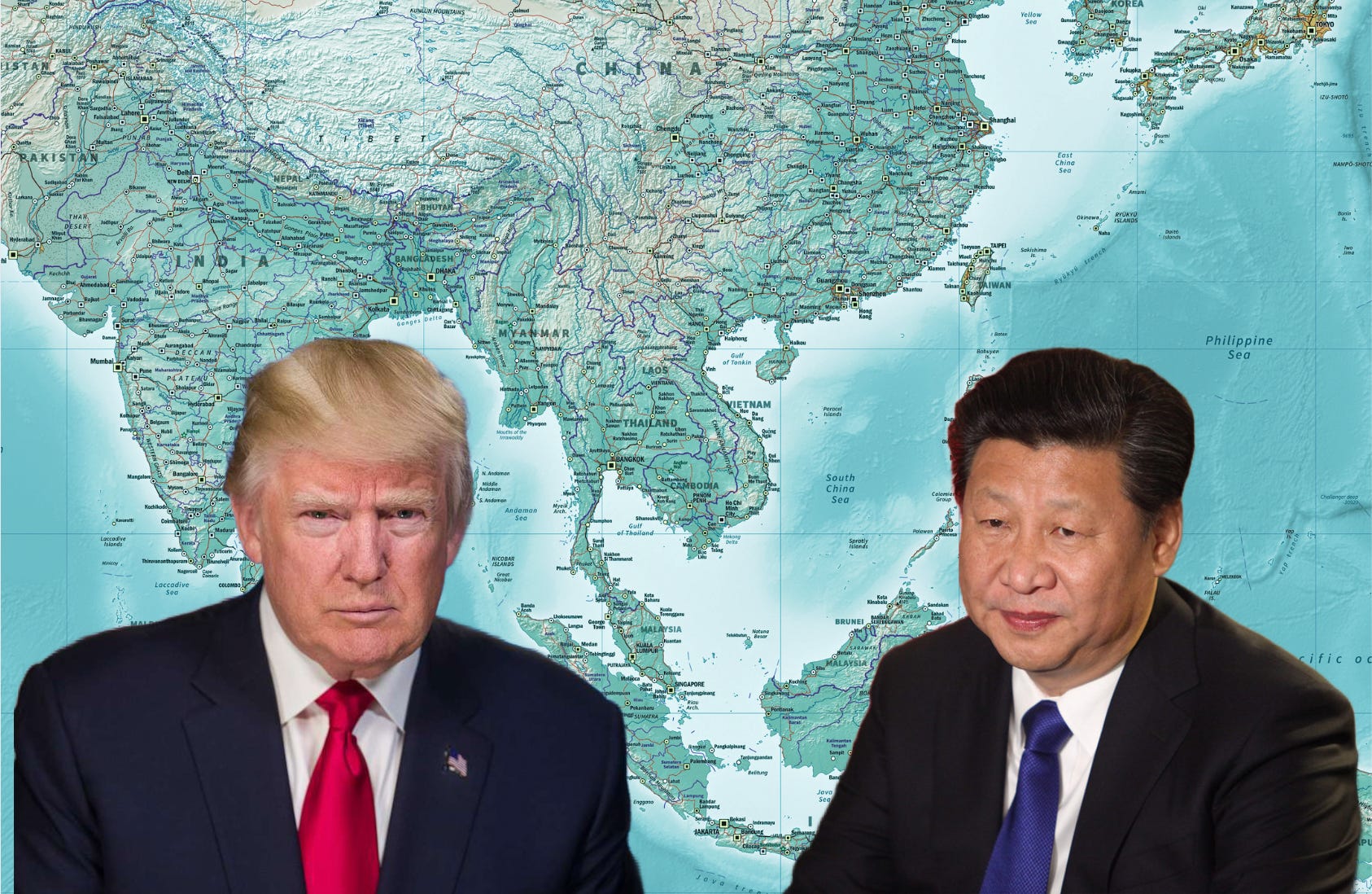
Image credit: Composite by Noah Munk using Xi Jinping (CC BY 2.0), Donald Trump (Public Domain), and East Asia map (CC BY-SA 4.0). Minor edits applied. Licensed under CC BY-SA 4.0.

The Tour
The delegation sent to Asia from the United States included Trump himself, Treasury Secretary Scott Bessent, and Defense Secretary Pete Hegseth representing the political, economic, and military arms of US foreign policy. The US agreed to strategic initiatives through coordination at the Association of Southeast Asian Nations (ASEAN) Summit, which is a strong rhetorical tool for coordination of efforts. However, more practically influential than the rhetoric of international agreements at ASEAN are the measurable agreements made with individual countries throughout the tour.
ASEAN Summit
The forum in Kuala Lumpur revealed several important things about the relationship between ASEAN, the US, and China. ASEAN’s eleven member states (Brunei, Cambodia, Indonesia, Laos, Malaysia, Myanmar, the Philippines, Singapore, Thailand, Vietnam, and East Timor) are bound by the ties of an economic organization similar in function to the European Union: focused on integration, fair and open trade, and connectivity. Despite historical trends of US involvement in ASEAN, China has recently become the leading trade, investment, and technology partner for all eleven countries in the association. However, China’s play at territorial expansion in areas such as the Scarborough Shoal and the Paracel and Spratly island chains has sparked unease throughout the region.
In light of ASEAN security concerns in the South China Sea, it is no surprise that the Chairman’s Statement from last week’s summit with the US emphasized “maintaining and promoting peace, security, stability, and prosperity in the region.” Yet such statements carry little weight without concrete follow-through.
Actions
Over the course of the tour, ASEAN countries and other regional powers took several concrete actions in coordination with American leaders. Trump and his team gathered political statements, which were fortified by substantive economic pacts, and Hegseth’s lead on defense agreements fully consolidated integration in favor of the US.
Political statements made over the course of Trump’s visit range from simple pandering to meaningful moves. The US president loves a boost to his ego, and the leaders of South Korea, Japan, and Cambodia were happy to provide one.
The most significant impact of the trade war is economic, and US action in this sphere was similar to Trump’s past practices: strike with tariffs, then pressure injured countries into “trade deals” and tout destruction as success. Over the course of the tour, the US signed deals with Cambodia, Japan, Malaysia, and South Korea, and preliminary frameworks with Thailand and Vietnam. The general trend among these deals is tariff reduction in exchange for expanded investment in the United States.
While US trade networks permeate the entire world, US military strategy is more particularly devoted to the Indo-Pacific. Trump and Hegseth’s emphasis on security policy during the tour, then, came as no surprise. The US took major steps on defense agreements with Cambodia, India, Japan, Malaysia, the Philippines, and South Korea. The agreements range from renewal and revival of old defense practices to advances in nuclear policy. Additionally, near the end of his tour, but just before meeting with President Xi, Trump announced that the US would immediately resume testing nuclear weapons “on an equal basis [with Russia and China].” The move demonstrated that the US would stand with Southeast Asia against Chinese expansion, strengthening cohesion in the lead-up to APEC.
Whether actions were taken and agreements signed as a genuine show of solidarity or simply a best alternative to continued tariffs, the fact remains the same: Trump substantially increased integration with eight of the strongest powers in China’s immediate vicinity. Although both the US and China caused harm in the region, the former effectively turned attention away from the harm it inflicted, shifting the gaze of blame toward China. Would it be enough to flip leverage on the sidelines of APEC?
APEC
As Trump and Xi walked into the negotiation room, smiles were a poor mask for tense body language and pent-up frustration. Trump came seeking concessions on rare earths, port fees, soybean imports, and potentially TikTok. Xi wanted ground to be given on tariffs, port fees, blacklisting, and may have even been contemplating a reach for Taiwan. The balance ought to have been in China’s favor—Trump’s economic cards measured in the hundreds of millions, but China’s rare earths alone carried trillion-dollar implications. But Trump had somehow scraped together eight countries’ worth of leverage in less than a week, effectively stopping Xi in his tracks.
Talks proved anticlimactic: both sides dropped port fees, China paused REE restrictions and bought US soybeans, while Washington eased blacklisting and cut the fentanyl tariff.
On the surface, this looks like an incredible success. China did not even mention Taiwan, and the threat of rare earths was lifted. US industry would remain intact, decoupling was prevented, and the bilateral relationship was preserved. Now the US would have a buffer to build its shipbuilding industry and establish alternate REE supply chains, taking strength away from China in the event that Beijing tries to leverage REEs again next year.
However, a more far-sighted analysis looks significantly more grim. All major issues on the table, from rare earths to soybeans to port fees, were issues essentially manufactured by China after the start of Trump’s second term. Though a crisis was averted, the US is slightly worse off than it was before the trade talks: China now has a trump card over the US in rare earths, Trump’s tariffs on China are as low as they’ve been in his second term, and China forced a concession on fentanyl tariffs—not just a number, but a major concession on Trump’s declared national security. This constitutes a critical blow to stability, sovereignty, and government function, struck by a rival and allowed by the US president.
Additionally, in order to get even such a dismal result, the US had to play virtually every card it had—giving up tariff leverage in rushed, often non-specific deals with its allies and others. Each of the countries with which Trump’s delegation signed economic and defense agreements is still deeply entrenched with China in trade, investment, and technology, including South Korea and Japan. While Xi may not have gotten a concession on Taiwan, Trump’s overreach may prove to be an even greater loss: weakened influence in the very region he sought to reclaim.
Edited by: Anya Acharya