
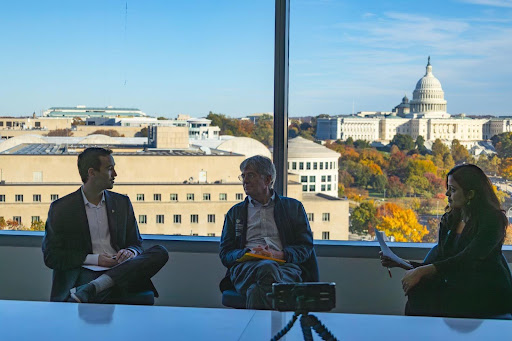
In early November 2025, Public Service Fellows Krithiga Narayanan and Eamon Burke sat down with SAIS Dean James B. Steinberg, former U.S. Deputy National Security Advisor and U.S. Deputy Secretary of State, for an in-depth conversation on public service, democratic resilience, and the evolving landscape of U.S. foreign policy at the SAIS Public Service Fellows Cohort Meeting.
The interview took place in the Bloomberg Center at 555 Pennsylvania Avenue, overlooking the U.S. Capitol, a setting that symbolizes the intersection of academic analysis and real-world policy. Alternating questions, Krithiga and Eamon spoke with Dean Steinberg about the values that have shaped his career, his influential concept of “strategic reassurance,” and the qualities the next generation of leaders will need to navigate an increasingly complex world.
The Interview
Q1. Krithiga Narayanan
You have had an extraordinary career spanning academia and diplomacy. What first inspired you to pursue a life in public service, and what early experiences shaped your path?
Dean Steinberg
I grew up in Boston in the 1960s, and President Kennedy was the first political figure I remember. His call to public service, “ask not what your country can do for you,” made a deep impression. I was also exposed early to the civil rights movement. My first job after high school was working for the first African American elected to the Boston City Council. Later, I worked for Mayor Kevin White during Boston’s desegregation crisis. Those experiences showed me what committed public servants can accomplish, even in turbulent times. That early sense of purpose guided me from local government to a public interest law firm and eventually to the Carter administration.
Q2. Eamon Burke
You have served as Deputy National Security Advisor and Deputy Secretary of State. How did your approach to policy differ between the Clinton and Obama administrations, and what lessons should future diplomats take from that?
Dean Steinberg
Working in all three branches of government taught me how each institution contributes differently to foreign policy. The National Security Council is small and close to the President, and it excels at coordination and rapid decision-making. The State Department has deep expertise, institutional memory, and a global presence. Effective policy requires blending the strengths of both rather than seeing issues from only one vantage point. A key lesson for future diplomats is the importance of making the whole system work together, including career officials, political leadership, and agencies.
Q3. Krithiga Narayanan
Across your decades of public service, you have navigated many difficult choices. What core values have guided your decision-making?
Dean Steinberg
Two sets of values matter. The first is purpose. Decisions should advance peace, prosperity, and respect for human rights. The second is the process. You need disciplined, rigorous decision-making. That means testing assumptions, evaluating evidence, listening to dissent, and challenging your own hypotheses. When I served at the National Security Council, much of my role involved ensuring that agencies applied this analytical discipline.
Q4. Eamon Burke
You coined the phrase “strategic reassurance” in U.S. China relations. How has that framework held up in the current era of great power competition?
Dean Steinberg
Strategic reassurance is rooted in Bob Jervis’s “spiral model,” which explains how misperceptions fuel mistrust. In U.S. China relations, the challenge is distinguishing real differences, which require firmness, from misperceptions, which require reassurance. For a time, we used structured dialogues to manage misperception. Eventually, both sides began assuming inevitable rivalry. China believed we sought to contain it, and the United States believed China aimed to overturn the international order. Once that mindset took hold, reassurance efforts broke down. I believe we have gone too far down that adversarial path, and there is now recognition that addressing misperception remains essential.
Q5. Krithiga Narayanan
The V Dem report shows democracy at its lowest point in 50 years. What role does public service play in strengthening democracy?
Dean Steinberg
Public service is fundamental. I believe the desire for a voice in one’s governance is universal, even though democracies take different institutional forms. But democracies must deliver. When people feel democratic systems are not producing results, trust erodes. Demonstrating that democratic governance can solve problems is essential for its global legitimacy.
Q6. Eamon Burke
One of the toughest challenges in national security is balancing long-term strategy with short-term crisis management. In your experience, how well is that balance maintained today?
Dean Steinberg
It is always difficult. Crises demand immediate attention, and modern media accelerates that pressure. That is why institutions such as the State Department’s Policy Planning Staff, the National Security Council’s policy planning unit, and the Pentagon’s J5 were created. Their purpose is to ensure long-term thinking is not lost in day-to-day decisions. Presidents often read history and reflect on legacy, which helps bring a long-term perspective into the room. But sustaining strategic thinking always requires conscious effort.
Q7. Krithiga Narayanan
What qualities does the next generation of public servants need to navigate polarized environments?
Dean Steinberg
Critical thinking is indispensable. You need to move debates away from emotional disagreements and toward questions such as: What assumptions are being used? What evidence supports them? What causal logic links proposed actions to expected outcomes? What uncertainties matter? Breaking arguments down analytically lowers the temperature and clarifies the real basis of disagreements.
Q8. Eamon Burke
Given institutional constraints at the State Department and USAID, what reforms would help U.S. foreign policy become more anticipatory rather than reactive?
Dean Steinberg
Prevention is ideal but politically difficult. You are asking governments to invest resources in crises that might happen. Prevention is most effective early, which is also when it is hardest to justify. One way forward is prioritizing the prevention of high-cost, high-impact outcomes even when probabilities are uncertain.
After the collapse of the Soviet Union, for example, we understood the danger of unsecured fissile material in places such as Kazakhstan and Ukraine. We could not be certain catastrophe would occur, but the consequences would be severe, and there were practical steps we could take. That justified a major investment in nuclear security.
By contrast, Rwanda illustrates how hard prevention can be. We devoted more preventive attention to Burundi, believing the risk of conflict was higher there. The genocide occurred in Rwanda instead. This shows the difficulty of judging where to focus limited preventive resources. Prevention will always require disciplined prioritization, humility, and political will.
Q9. Krithiga Narayanan
As the leader of this institution, what shapes your philosophy about preparing students for meaningful public service?
Dean Steinberg
Our goal is not to prepare you for your next job. It is to prepare you for the jobs you will hold five, ten, or twenty years from now. The world changes quickly. The issues of 2030 or 2050 will look very different from those of today.
You do not need us to fill your head with facts that you can look up and that may soon be outdated. What endures is a toolkit: critical reasoning, quantitative skills, an understanding of multiple disciplines, sound decision-making habits, and the ability to collaborate and bridge differences.
Language and cultural study are part of that. The point is not only whether you will use a particular language professionally but also the awareness of how language and culture shape perspectives. Our job is to equip you with capabilities that will serve across sectors and across generations of issues.
Q10. Eamon Burke
One final question before we close. What advice would you offer to SAIS students seeking to build careers defined by integrity, courage, and long-term impact?
Dean Steinberg
A life of public service can be lived in any sector. Your values matter as much in a corporation or law firm as they do in government or nonprofits. Be clear about your values and your red lines. In any organization you will not always get your way, even at senior levels. You cannot walk away every time you lose an argument, but there may be rare moments when a direction is so inconsistent with your principles that you cannot stay. Balancing effectiveness and integrity is essential. Set the bar high, but do not lose sight of the fact that some principles are non-negotiable.
Conclusion
From reflections on JFK’s call to service to lessons from U.S. China relations and the ethics of staying or leaving government, Dean Steinberg returned to a consistent theme. Rigor, humility, and purpose are the pillars of public leadership. For SAIS students preparing for careers in diplomacy, development, law, or the private sector, his message was clear. Effective decision making and meaningful service require critical thinking, a commitment to democratic values, and the courage to carry those values into every institution you join.
Edited by: Blake Uhlig