
During the first weeks of 2026, Iran was rocked by arguably the most serious popular uprising since the 1979 Revolution that brought the regime to power. While Iranians initially took to the streets over high inflation, the scope of the protests quickly broadened, as demonstrators demanded an end to the Islamist dictatorship that denies them basic rights. Many rallied around Crown Prince Reza Pahlavi, the son of the last Shah, overthrown in 1979, as a spiritual leader. The regime has responded with brutality, cutting off the internet and slaughtering protesters en masse, with experts estimating around 30,000 people killed.
The regime has managed to crush the protests in the streets, but the current state of de facto martial law is unsustainable, and the underlying causes remain unaddressed, meaning protests could resume soon. Still, the current opposition movement will need to undergo significant changes if it is going to actually overthrow the regime.
The opposition (understandably) failed to maintain nonviolent discipline
Nobody should seriously fault the protesters for fighting back in the face of an unprecedented massacre, but in a revolution, disciplined restraint when utilizing violence can be key to success. Political scientist Erika Chenworth found that nonviolent revolutions have a far higher chance of success than violent revolutions, because while violent revolutions tend to tighten the ranks of security forces who fear for their lives and are easy to delegitimize as terrorists, nonviolent revolutions are more likely to draw defectors from security forces and key actors who refuse to massacre people who do not fight back.
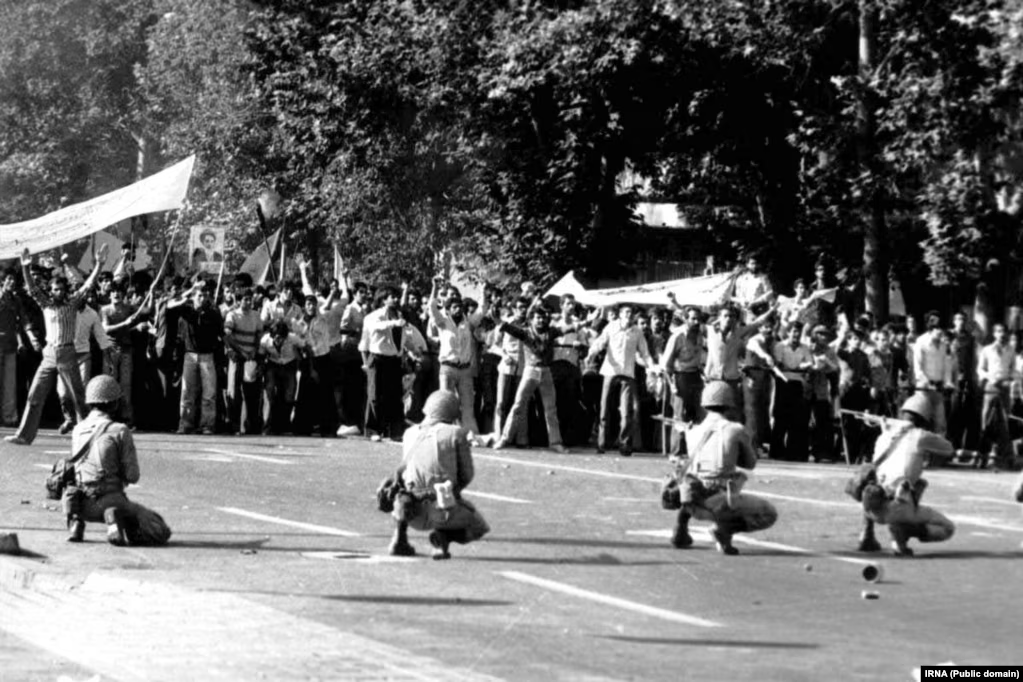
In 1979, the revolutionaries understood that violence should be used only when there was a genuine chance of overpowering security forces; they kept demonstrations primarily peaceful until a final push at the end. While the current regime is far more willing to stomach mass atrocities than the Shah’s regime, the opposition will need to remain nonviolent as long as they remain outgunned.
The opposition was unable to maintain momentum when mass marches were not an option
Revolutionaries have historically overinvested in mass marches, setting their movements up for failure when the marches are crushed. But protest marches are only one lever of revolution, and although they are the most visible, other important ones exist. This recent uprising is distinct from past ones because it included not only the liberal middle class but also the powerful bazaar merchants and the lower class, more conservative groups that were previously seen as bedrocks of pro-regime sentiment.
This gives the opposition economic leverage that it didn’t previously possess. In 1979, when they were unable to demonstrate in the streets, revolutionaries switched to mass strikes and boycotts that paralyzed the country and kept momentum. The bazaar merchants organized strikes during the protests, but the opposition movement did not fully leverage this tactic. If the movement successfully organizes strikes in other key industries, such as oil, especially in industries run by the Revolutionary Guards (the regime’s most powerful enforcers), and recognizes strikes as equally important to mass protests, they will be in a far better position to hit the regime in the wallet and make them reconsider the price of oppression.
The opposition lacked infrastructure and clear organization
While the Crown Prince is an effective spiritual leader of the opposition and his calls to protest have brought millions to the streets, the current opposition appears to lack the same organizational capacity as in 1979. In 1979, Khomeini, the leader of the revolution, relied on a robust network of clerics and mosques not only to organize demonstrations but also to exercise direct control over resource distribution, tactical coordination, and management of the post-revolutionary period. While the extent of Pahlavi’s on-the-ground capacity is unknown, a credible network will have to emerge for the revolution to succeed.
The opposition lacked a (public) plan to manage security force defections
The singlemost determinative factor in the success of a revolution is the loyalty of the security forces. The Iranian regime has a uniquely complex and revolution-proof system in which the ideological Revolutionary Guards and their plainclothes auxiliary have the most power, and the regime can call in foreign militias; they are still outnumbered by the regular army, who are made up of conscripts, and the police, which showed signs of defection during the protests.
However, defection is dangerous, and soldiers need assurances that they and their families will be safe. In 1979, Khomeini ordered protesters not to confront soldiers but to offer them a chance to defect. Revolutionaries set up networks to provide for defecting soldiers and their families, and the defection of the armed forces ultimately collapsed the Shah’s regime. Pahlavi claims to have an online network that coordinates defecting soldiers and police officers, but an on-the-ground counterpart is needed to provide the assurance necessary to inspire mass defections.
The opposition doubted their own power
After President Trump announced his intention to assist Iranian protesters, many believed that the United States was coming to finish off the regime. So far, help has not arrived, and it is uncertain if it ever will. Activist leaders and ordinary Iranians who place their faith in inconsistent foreign actors may be demoralized if it doesn’t arrive, when in truth, Iranians have the power to overthrow the regime themselves. Leaders would need to adopt a narrative similar to that of the Irish nationalist party Sinn Féin (Irish for “ourselves alone”), asserting that Iranians will free Iran, whether or not they are helped.
The Iranian opposition is down but not out. While the regime has shut off the internet, put tanks in the streets, and slaughtered tens of thousands, it is unwilling to address the problems that caused them in the first place, and even regime officials understand that holding an entire population in isolation is unsustainable. Protests will eventually re-emerge, and while the regime will fight back, ultimately the fate of Iran is in the hands of the Iranian people alone.
Edited by: Connor Hartigan