
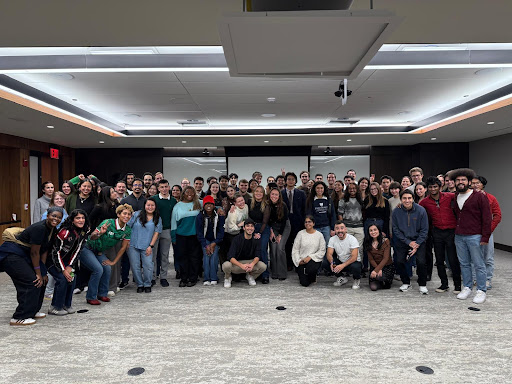
Last year began with renewed vitality across the SAIS “The Americas” community, the umbrella that brings together academic initiatives dedicated to Latin America and the Caribbean. This ecosystem rests on three complementary components. The Americas Focus Area anchors curricular direction. The Latin American Studies Initiative (LASI) serves as an analytical hub, producing scholarship and shaping debate. And the student-led clubs amplify cultural, professional and intellectual engagement.
During the 2024–2025 academic year, the ecosystem hosted 30 initiatives, eight led by students. This fall alone, we reached that same number in one semester, with 15 initiatives led by the Latin American Studies Club. Most events filled the room, and conversations extended well beyond their scheduled time. As club president, I want to reflect on what this collective journey meant for us.
An Approach to Collective Agency
After being elected, our three-person executive team made an early decision: we formed an 18-member board. This unusually large structure became our interpretation of agency in a moment when many Latin Americans, both across the region and in the diaspora, face uncertainty and the erosion of spaces that once sustained belonging.
Across the region, polarization and democratic erosion continue alongside persistent development challenges. At the individual level, immigrants and diaspora communities navigate complex questions of identity and belonging. Meanwhile, digital life increasingly unfolds in algorithm-governed systems that simulate connection without cultivating trust or shared responsibility.
Against this backdrop, we wanted the club to serve as a space where collaboration strengthens both ideas and relationships. The broader board allowed for rotating leadership tailored to each initiative while maintaining core roles for continuity. We organized our work around three pillars: academic depth grounded in practice, cultural presence and strategic networks, and community-building as deliberate praxis.
Pillar 1: Academic Depth With Real-World Purpose
Our first pillar sought to sharpen our understanding of the region while strengthening our ability to engage the spaces we inhabit.
We hosted contenders in Bolivia’s second-round elections, former President Tuto Quiroga and President-elect Rodrigo Paz, opening space to examine democratic trajectories firsthand. We followed major regional debates, including COP30 and political developments in Colombia, Brazil and Chile.
We also situated Latin America within broader geopolitical shifts. The Central America and the Changing Global Order Conference explored how smaller states navigate renewed great-power competition and shifting trade dynamics. The Future of Venezuela examined one of the hemisphere’s most complex political transitions. The Pre-Summit of the Americas on Cybersecurity and Technology addressed democratic resilience and digital governance challenges.
Together, these conversations reflected our commitment to connecting academic analysis with lived political realities.
Pillar 2: Cultural Presence and Strategic Networks
If the first pillar focused on interpretation, the second centered on participation. Promoting Latin American culture extends the region’s relevance while deepening ties to its social and political questions.
Our six-session Spanish language Tables invited students to experience language as a living cultural force. A screening of The Edge of Democracy prompted reflection on democratic rupture and civic imagination. At Taste of SAIS, Latin American gastronomy became a vehicle for cultural recognition. Two packed Happy Hours featured traditional dance and themed trivia, transforming culture into shared experience.
This pillar also emphasized network-building. Café con Leche sessions created small-group spaces for candid dialogue with faculty whose work centers on Latin America. Career panels and alumni receptions strengthened intergenerational connections among those committed to the region.
Beyond campus, we integrated SAIS into broader conversations across Washington. We participated in Georgetown University’s GU LATAM 2025 Conference and attended the Inter-American Democratic Charter Conference at the Organization of American States, featuring the secretary general and Nobel laureate Daron Acemoglu. Showing up in these spaces signaled our commitment not just to study the region, but to help shape its future.
Pillar 3: Community-Building as Counterculture
In a global environment that rewards confrontation and outrage, building community becomes a countercultural act. The Latin American Studies Club sought to cultivate social friendship as praxis, a deliberate alternative to individualism and hostility.
All initiatives contributed to this ethos, but two moments captured it most clearly. Our celebrations of Día de Muertos and Día de las Velitas brought intimate traditions into shared space. Students built altars, lit candles and shared stories, transforming cultural memory into collective ritual. During Día de las Velitas, the consul general of Colombia in Washington, Ana María Bermúdez Ríos, joined us and underscored the importance of sustaining such spaces abroad.
Notably, these events were not part of our original agenda. They emerged organically from board members who found in the club a platform to share their traditions. Their spontaneity revealed something powerful: community reproduces itself. Each gathering created conditions for the next, empowering new leaders to adapt and extend our model of collective action.
In that sense, tenderness became strength. The quiet practice of mutual care stood as a response to a political climate that often prizes division.
Looking Forward Together
This semester was possible because of a remarkable team that invested time and energy despite academic and professional demands. It was sustained by steady faculty and administrative leadership within The Americas and by the support of SAIS Student Affairs.
As we look toward the spring, our three pillars remain an open framework. They will evolve as new members join and contribute their perspectives. Our goal is to widen participation and continue shaping a space where academic rigor, professional engagement, strategic action and cultural presence coexist.
More than ever, strengthening community serves as a strategic anchor for the futures we hope to build.
Edited by: Krithiga Narayanan