
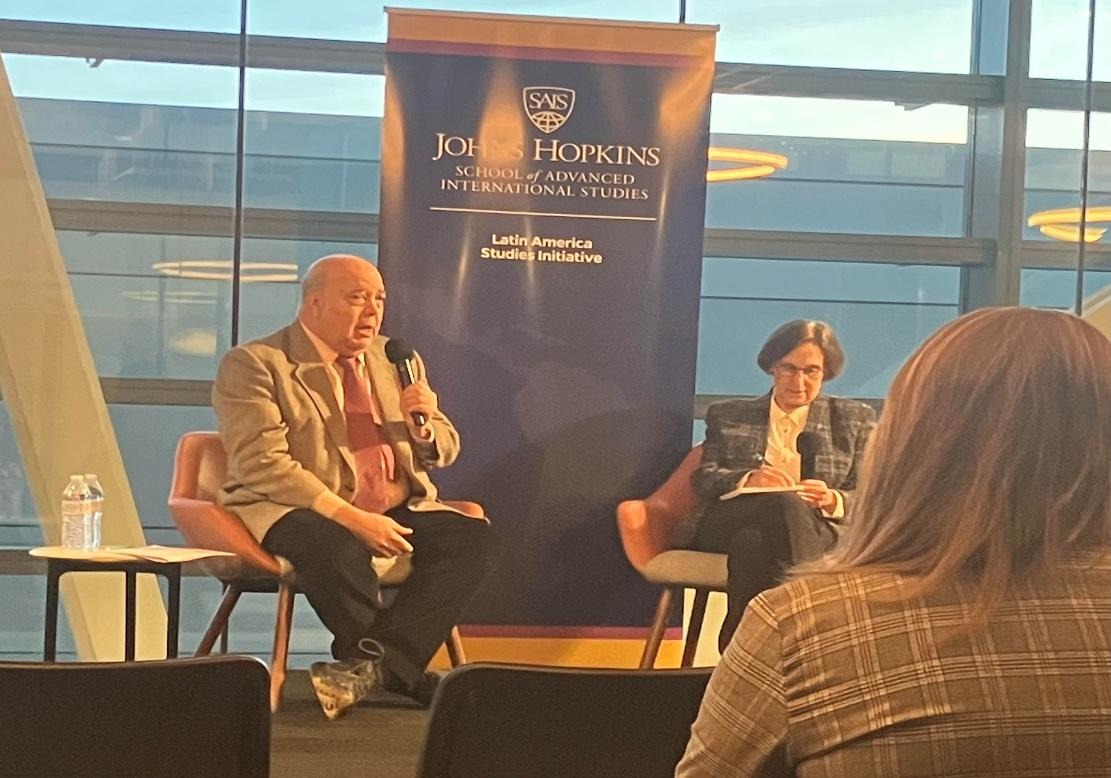
SAIS was recently granted an audience with Colombian Ambassador Daniel García-Peña, during which he sat down with students and faculty to discuss evolving U.S.-Colombian relations. As a child of Colombian immigrants, this examination of Colombia’s future enticed me to examine its past and how the nation has evolved in its relatively brief history.
Information is limited on Colombian history prior to Spanish colonization, but we know the land was home to various indigenous tribes, the remnants of which now make up a small percentage of Colombia’s current population, vastly outnumbered by the new demographics that have emerged since then. In any case, Spanish settlements led to the formation of various South American tribes after Simon Bolivar successfully led a revolt against Spain in the 19th century that allowed countries such as present-day Venezuela, Bolivia and Colombia the opportunity to evolve into their own independent nations.
This successful liberation caught the attention of the then-young United States, which began amicable relations between the two. Back in the early 19th century, when it was still known as Gran Colombia, both nations broke from the mold and recognized each other as independent legitimate powers, likely in part due to their shared history as new nations recently freed from a colonizing body. A relationship of trade and cooperation soon unfolded and even resulted in the signing of the Anderson–Gual Treaty, the first bilateral treaty the U.S. signed with another American state.

However, the fledgling nation would soon face issues of crime and corruption, exacerbated by outside nations seeking to take advantage of the country’s natural resources by inserting themselves into Colombian affairs when their national security or business interests were at stake.
This turmoil would soon escalate as Colombia became increasingly important on the international stage. Incidents such as the 1928 Banana Massacre or “La Violencia”, Colombia’s decade-long civil war in the 1950’s, all found the nation struggling against mass violence from both the government and its citizens, rapidly contributing to its instability. Actions such as these eventually led to the rise of Fuerzas Armadas Revolucionarias de Colombia (FARC), a far-left guerrilla movement that evolved from groups formed during the previous civil war and eventually grew into one of the largest guerrilla movements in the Western Hemisphere.
The destabilization of Colombia through crime and government upheaval, such as this, was also incidentally what led to my own parents choosing to leave the country and immigrate to the U.S. in 1988. My parents are somewhat of a typical immigrant story in their aspirations for better economic opportunity and a stable place to raise a family, the American Dream. A less glamorous detail worth noting, though, is the fact that leaving Colombia was a decision made less out of optimism and more so out of survival.
Colombia has had a long and tumultuous history filled with rampant corruption on a national level, which resulted in the death and suffering of countless innocents, including people very close to my family. This pushed them to make the difficult decision to immigrate, rather than force their children to suffer through more of the same. Nearly 40 years later, after decades of slowly building a life for my siblings and me here in the U.S., they’re still of the opinion that Colombia is not a prosperous nation, with much of the same crime and distrust in the government that existed back when they were my age in Medellín.

This brings us to where we are today, with Gustavo Petro. Petro breaks the trend of modern Colombian leaders as Colombia’s first leftist president, one who many claim illegitimately won the election through connections from his days with the M-19 Democratic Alliance. He quickly gained the ire of President Trump in early 2025 (six days into the new administration) when Trump attempted to deport immigrants to Colombia on a military plane, with Petro turning them away due to inhumane conditions.
This was a small part of a growing anti-immigration sentiment taking hold amongst several conservative groups in the U.S. since the beginning of Trump’s second term, and this rising tension further escalated with the bombing of Caracas and the capture of Venezuelan President Nicolás Maduro in early January, with Trump making insinuations that Petro could receive similar treatment.
Despite this seeming new animosity, Ambassador García-Peña emphasized to us that Petro’s meeting with Trump earlier this month, in which the two were said to have discussed options for cooperation between the two nations, is a very good sign. The ambassador further emphasized that he did not want to cause panic or alarm among citizens of either nation and that the goal of Petro’s administration is a new era of collaboration between Colombia and the United States.
“The idea that Colombia is worse than ever before is a misconception,” García-Peña stated. “Security and safety are much better than 20-30 years ago, and combat is no longer in the form of cartels against the military, but instead against each other.” (Peña also notes how they don’t want to minimize the issue, as they recognize that the danger is still very real but located in marginal areas of the country).
Where Colombia will go in the years to come is yet to be seen, but what can be seen is that the current administration is sincerely trying to evolve the nation beyond the place my parents chose to immigrate from all those years ago.