
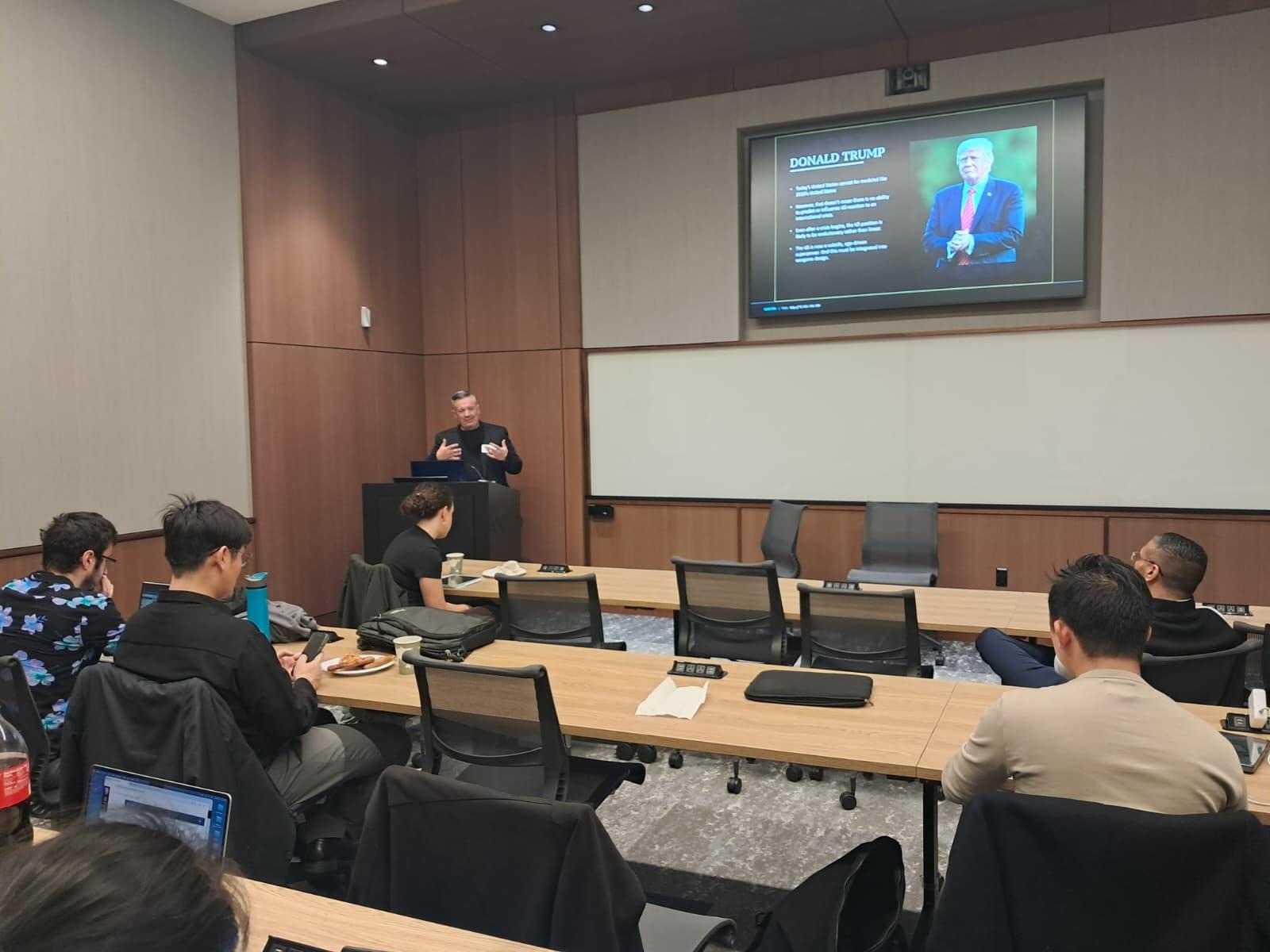
Creator of the famous tabletop war game Twilight Struggle, Jason Matthews, spoke to the SAIS Wargaming Club on Tuesday, examining Trump’s current international policy strategies and how they can be incorporated into new wargame models for the 21st century. Twilight Struggle: The Cold War 1945–1989 examines the conflict between the United States and the USSR, and is currently regarded as one of the highest-rated tabletop games of all time.
Matthews spoke before an eager audience of students from different programs, all interested in hearing about the creation of Twilight Struggle and how modern U.S. military strategy compares with that of the 1980’s.
When asked about his game design process, he explains how much of it comes down to personal preference.
“With Twilight Struggle, I sort of just stumbled into it. Nowadays, I enter it with specific designs. Right now, I’m working on a game called Twilight Struggle South Asian Monsoon, which examines South Asian struggles and their political landscape during the Cold War. There are a bunch of things when you’re dealing with those countries that you have to model, like the Non-Aligned Movement, or portraying decolonization in a more conscientious way, even though half the countries on the board aren’t even countries yet when the game starts. The U.S. sees it as a communist struggle, but those living on the ground in the midst of it, they could give a damn if it is the British or the French or the Dutch; they’re just trying to survive, and who could blame them? In the grand scheme of things, I design for myself, and if I think it’s good enough, then it’s good to go.”

Matthews was then asked about President Trump and the military strategy behind some of his recent decision-making, particularly regarding his fascination with Greenland.
“How do you model ADHD?” he remarked humorously. “This erratic behavior was true in the first administration and is still true now. In the case of Greenland, it is a tool that his own people can use to distract him from making a mistake. But the guardrails that were available back then are no longer there, waving the next shiny object for him to be distracted by.”
He further elaborates, “It is uncomfortable to compare our government with a monarchy, but it does fit in that there is a court of people who can influence the monarch in his decision-making. One macro problem with the U.S. becoming more nationalist and isolationist is that we are encouraging our allies to do the same thing, and it just does not seem like a good thing to encourage others to go down that same path.”
In explanation for his success in the field of board game making, Matthews explains how the game’s longevity is less due to historical accuracy and more so the feelings it invokes in the player. “There are many reasons why Twilight Struggle succeeded that don’t have to do with my genius,” he said to the laughter of the room. “We’ve hit this odd trend of nostalgia for when times were ‘oh so simpler’, so we tried to inject a semblance of paranoia in the game that the protagonist would have felt in the midst of the Cold War. While maybe not an accurate representation of the war itself, it’s a good representation of how people were feeling while it was happening. So, I think if you can make a half-decent game that triggers the memories of the people who remember these conflicts, it’s going to be a success.”
The event was well received, with both Matthews and Wargaming Club president Jakub Wozniak happily taking questions from the crowd. Another wonderful opportunity made available through Hopkins, a rousing examination of the creation of successful tabletop games and the real-life policy decisions the U.S. is making today that could influence future games.