
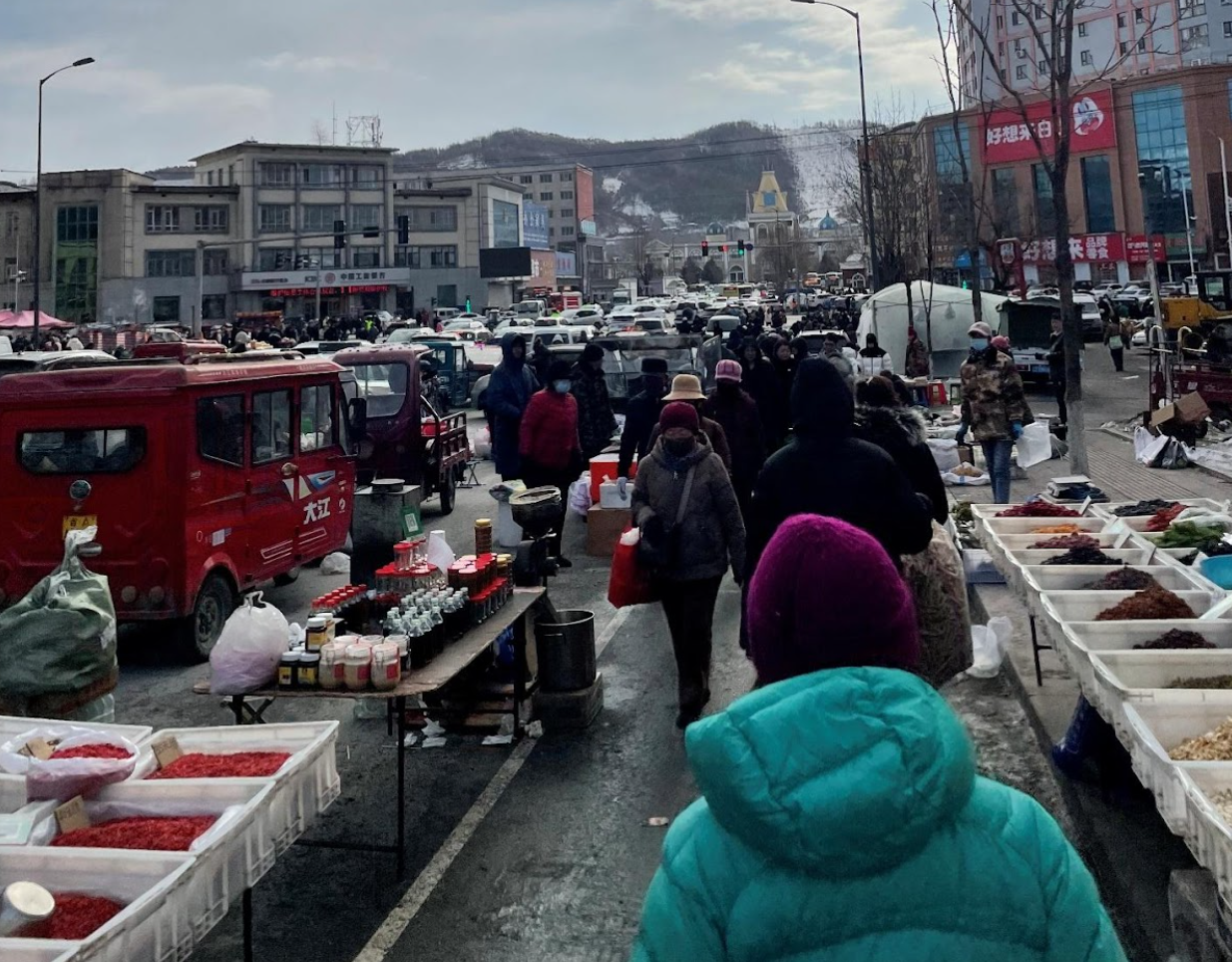
Every Spring Festival, millions of Chinese people return to their ancestral villages in the countryside to celebrate. It’s often advised not to travel in China during this time: prices are high, stores are closed, and train tickets are hard to come by. But the chance to experience this celebration firsthand was a once-in-a-lifetime opportunity. Free of class obligations during this break, we set out to see rural China in classic American fashion: on a road trip. Our three-week route crossed eight provinces, beginning in Harbin and ending 2,000 miles later in Xi’an.
Two Chinas
During the trip, we found ourselves making the same observation: it felt as if we were traveling through two different Chinas simultaneously.
The first China is prevalent in the now-mainstream discourse. With neon skylines and cutting-edge infrastructure, this China is a technological leader and emerging cultural powerhouse. Its homegrown products dominate domestic markets and are gaining influence abroad. It prides itself on safety, stability, and civility (in Chinese known as 文明 wénmíng—literally ‘civilization’), made possible by a governance system concentrated in the hands of pragmatic and efficient Chinese Communist Party (CCP) leadership. We refer to this China using the same language as the CCP when it declared the People’s Republic in 1949: “New China.” This is the China that the CCP has worked hard to cultivate and curate, a showcase of Chinese modernity and increasing parity with the West.
The second China is less frequently discussed but still exists in large swaths of the country. While not impoverished, it’s characterized by utilitarian practicality. Its cities are filled with unremarkable copy-paste apartment buildings that hardly reflect the image of a global superpower. State presence is less obvious here. Despite the apparent sterility, local customs are the dominant organizational force. We heuristically refer to this China as “Old China,” representative of the China that existed in the early days of Reform and Opening Up.
While most of the rural Northeast is distinctly Old China, we would occasionally find ourselves in pockets of New China, which seemed to be spreading across the region. In some areas, the two Chinas existed on top of each other, meshing as old gradually became new.
Time Traveling
Our most emblematic experience of Old China was in the small border city of Hunchun, located in Northeastern Jilin province. Sandwiched between the North Korean and Russian borders, Hunchun had a unique feel. On the outskirts of the city, gravel roads lead to rundown warehouses, garages, and slaughterhouses. It was unquestionably gritty, wholly lacking the lively pedestrian streets and manicured feel characteristic of even mid-size Chinese cities. As we explored, we were struck by a distinct feeling of remoteness and, for lack of a better word, freedom. A few locals reinforced this impression by inviting us to join them for dinner. After sitting down at their table of 15, our hosts told us we were the first Americans they had seen in Hunchun. We had a great night singing karaoke, setting off firecrackers, and toasting to their city.
The next day, we were jolted back to New China at the tri-point border’s sleek and modern checkpoint. As foreigners, we got a closer look during a routine questioning. The border officers knew about our past travels, asking our friend John about his presence in Chengdu a week earlier. A comprehensive list of our personal information was accessible on their phones. Sara recalls a guard flashing her “file” as he clarified one of her answers to his questions. Encountering China’s surveillance apparatus at the border shouldn’t have surprised us, but our experience the previous night made us forget about the extensive social stability measures widespread in New China.

Wutaishan, a sacred Buddhist peak with over a thousand years of history, was where we most clearly saw the two Chinas mesh. The peak’s massive parking lots, reminiscent of an American amusement park, were packed with visitors making traditional New Year’s offerings. Our homestay host, a native of the area, relentlessly undermined the area’s traffic protocols and parking bureaucracy. From the mountains, construction rattled in the valley below, alongside a Chagee and a KFC.
Yet just fifteen minutes away from the restaurants and the main cluster of pagodas, the crowds thin, and the temples’ persistent religious function becomes more visible. Paved roads give way to eroding pastures and meandering cows. Our lodgings were on the second floor of a sparsely decorated family home, where every table conveniently had an ashtray, one of which we had the pleasure of using as we shared a cigarette with our host. Traditions persisted even as the forces of modernity closed in.

We experienced many more surprising contrasts and odd integrations of the two Chinas during our trip. In Dandong, we saw New Year’s fireworks set off with complete disregard for public safety and regulations. The next day, we visited a propaganda-heavy Korean War museum. In Changzhi, a small city surrounded by dilapidated mines, we stopped at a mall that wouldn’t have stuck out in Shanghai. Two speeding tickets were texted directly to our phones, though we later learned most Chinese drivers circumvent these penalties through an illegal brokerage system. If Old China is marked by a patchwork of improvised systems, then New China is defined by the consolidation of those systems under the CCP.
Holding the Line
Witnessing the dual reality of China made us wonder why the divide between old and new exists at all. With plenty of time to discuss in the car, we narrowed in on two factors: the capacity of the CCP to effectively implement policies, and its adherence to the Mass Line principle.
Because large cities initially shaped our image of New China, we thought government capacity could be what separated them from Old China. It makes sense that provincial-level municipalities with higher revenues, like Tianjin and Shanghai, would be more effective at enforcing traffic regulations and launching social campaigns to discourage Old China practices. Yet this theory comes up short in the countryside, where local governments have a long history of effectively mobilizing the masses—sometimes excessively—in response to party campaigns.
So, if the CCP has the capacity to establish the modernized practices characteristic of New China in the countryside, why doesn’t it? One important factor, we decided, is the enduring influence of the Mass Line—a Maoist principle stating that the party’s policy initiatives should stem from the masses. Implicitly, the party avoids actions that would cause popular discontent, opting instead for phased programs, such as hukou reforms and local anti-pollution measures, rather than sudden, nationwide cultural campaigns. Many of the practices in rural China predate the rule of the CCP and are deeply rooted in the fabric of society; lighting fireworks to celebrate the New Year and making offerings at Buddhist temples date back centuries. Modern practices like smoking were already cemented by the time the CCP took power. We decided perhaps that the CCP adheres to the Mass Line by governing cultural traditions in the countryside from the margins, while allowing their most essential components to persist.
Despite this persistence, three weeks of travel through rural China showed a fading world. While the policies shaping New China have raised the standard of living and created the conditions necessary for sustained economic growth, we felt the core of Old China, marked by informal social practices and hospitality, was being lost in New China’s progression towards “civility” (文明). Across the country, we saw tension between this pursuit and the enduring practices of the Chinese people. Naturally, this raises the question: what happens when the will of the masses conflicts with the government’s agenda? No doubt, the CCP will delay answering this question as long as it can. In the meantime, it will continue to gradually implement policy at a publicly palatable rate. Should this strategy succeed, the chaotic, confusing, joyous, and rich version of China that still exists in the hinterlands will slowly become a relic of the past.
Whatever the future of the country’s development may be, we feel grateful to have glimpsed the practices and people that define Old China. It can’t be said whether future road trippers will have the same opportunity.