
When I first got my Chinese driver’s license, I expected driving 2,000 miles across China to be difficult. What I did not expect was parking to be the hardest part. During the three-week road trip from Harbin to Xi’an, I parked in all sorts of places: popular tourist attractions, cramped alleyways, sprawling underground complexes, and once in a field of mud. Despite seeing parked cars everywhere, parking routinely proved to be the most unpredictable part of the day. Private lots are uncommon and entrances to public lots are either impossible to find or completely full. Parking on a curb leaves the car exposed to immediate danger and underground garages are expensive. However, what initially seemed to us a system administered by pure chance and informal practices slowly revealed itself as actually co-governed by a high-level of surveillance along with chaos. A driver who wants to find a parking spot in China must know when to respect the government’s strict control of parking practices and when to embrace chaos and informality. But this knowledge can only get you so far, and sometimes you just need luck to be on your side.
In some circumstances, the government exercises surprisingly tight control over parking. After trying to park in a typically packed mall parking lot in Baishan, I was forced to exit down a cramped alleyway lined with cars. I hesitantly came to a stop in front of an apartment driveway. It immediately became clear that despite the other cars around, I was not in a proper spot. Several customers glared from the window of a street-side breakfast shop. A passing pedestrian swiveled her head as she gave me a pointed look. Even though we were only stopping briefly, the public shame had me opting to stay with the car while my travel companions ran to grab takeout lunch. My instincts proved right about three minutes later when a strange text message popped up on my phone. It was the local authorities warmly reminding me to move the car before a ticket was issued. I left to find a new spot before I found out what the next message might say.

Other times, chaos reigns. In Tianjin, we were fortunate enough to find a parking garage directly below our hotel with a plethora of immediately available spots. But when we returned the next day, we realized why the area had been available. Under the fluorescent lights, it became clear we had parked in a section now closed off behind an automatic gate arm (which, of course, turned out not to be automatic). After several failed attempts to find someone responsible for the area, we decided to take matters into our own hands. Using the foot of space in between the back of the car and the gate arm, we executed a skillful eight-point turn and navigated to the exit. Unfortunately, the exit gate was also non-operational. Deliberation ensued, and after a careful calculation of the car’s dimensions, we maneuvered around the defective gate and were back on the streets of Tianjin.
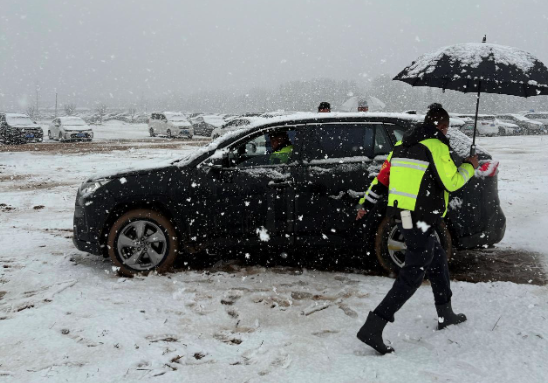
Sometimes luck goes both ways. Amid a blustery February blizzard, I found myself in need of some good luck as I turned into yet another full parking lot at the Terracotta Warriors, one of the largest tourist attractions in the entire country. Tourists wove through the melee of cars. Drivers uselessly slammed on the horn. Wandering tour guides searched for clients, gripping umbrellas to protect against the snow and rapping on the windows of cars stopped in traffic.
After nearly half an hour of queuing, the wheels of our Toyota SUV at last crunched onto one of the parking complex’s many overflow gravel lots. Finally spotting an open space, I hastily attempted to drive the car in a small semi-circle to pull in, lest the spot be taken at the last second. To my horror, the gravel only extended so far; the snow-covered ground gave way to a muddy swamp, quickly turning brown as the wheels spun out. No amount of pushing, reversing, or revving got us any closer to the traction of the gravel. Completely stuck, the only option was to call for help. Which, it turned out, was not an uncommon occurrence. Within five minutes of calling for help, a grinning group of security guards arrived and quickly took charge. Standing in the thick falling snow, I watched, mouth agape, as the guards pushed the SUV back onto solid ground.
No matter the city, the challenges of parking persisted. Navigating China’s contradictory parking system, with its hybrid mix of informal practices and seemingly ubiquitous surveillance, required constant adaptation. As a foreigner, parking in China reflects a larger truth: everyday systems in China are often so different than those of other countries that normally simple parts of daily life are a challenge, even after several months or years here. While things may seem lawless on the surface, state presence, selectively exercised through surveillance or bureaucracy, is impossible to shake. In this paradoxical system, sometimes improvisation is best; other times, simply following the rules is enough, if you can figure out what the rules are. It can be frustrating and nonsensical, but taking the chance to see China in all its unfeigned beauty has left me feeling distinctly grateful. The road trip may have ended in Xi’an, but it wasn’t truly over until the car was returned in one piece, with a considerable digital footprint and some mud still on the wheels.