
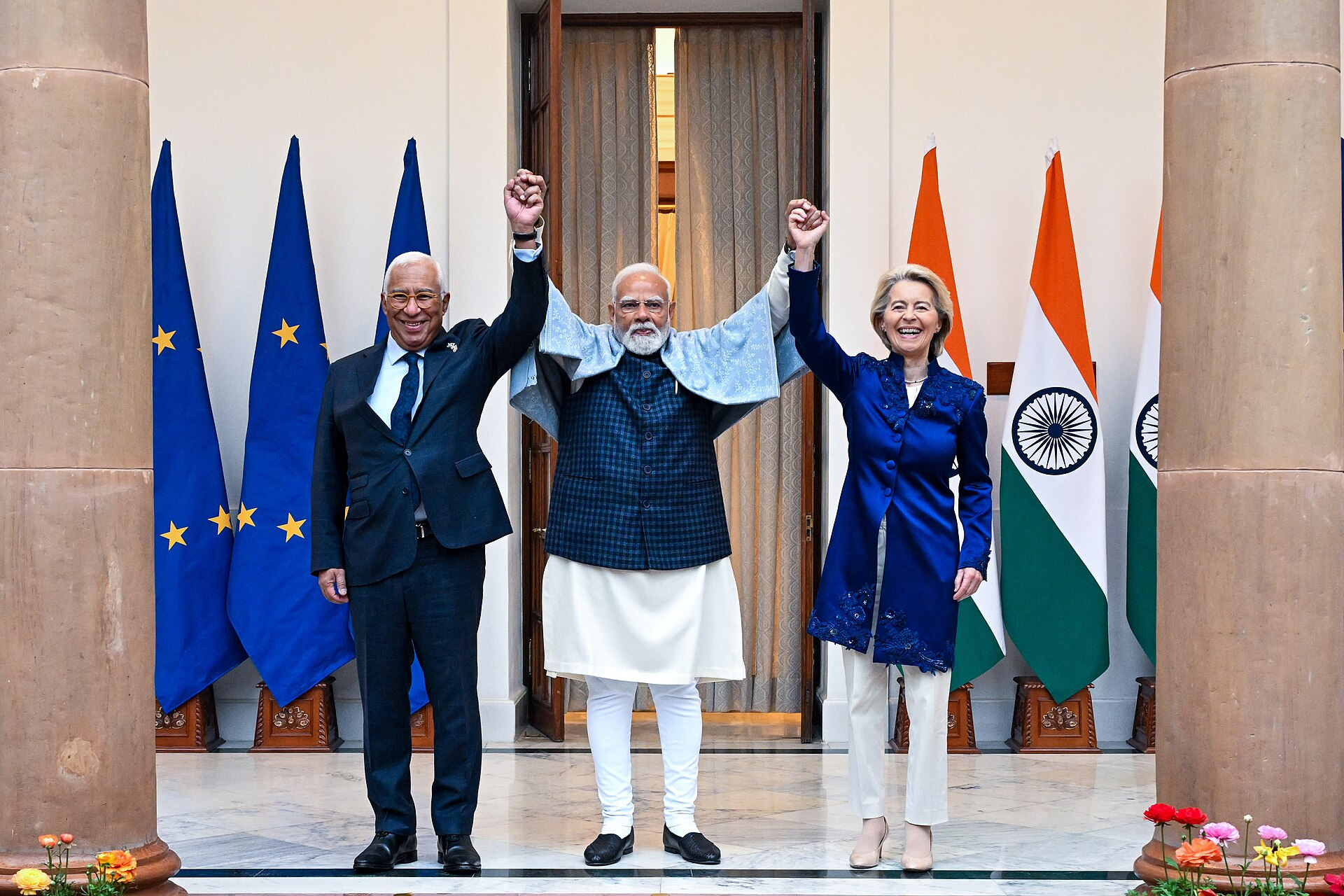
The negotiations for a free trade agreement between India and the European Union, commonly termed the “mother of all deals,” concluded on January 27th. European Commission President Ursula von der Leyen and European Council President António Costa traveled to Delhi to meet with Prime Minister Narendra Modi for the 16th EU-India Summit to finalize discussion on the free-trade agreement. The two European leaders were invited as chief guests for India’s 77th Republic Day parade. The formal signing and implementation will take place in 2026. This deal has been 20 years in the making and its conclusion is significant for three main reasons.
The first reason is the scale of the free trade agreement. The pact includes “two of the world’s largest economies, comprising 25% of global GDP and one third of global trade.” The partnership, consisting of around 2 billion people, highlights a significant shift towards “diversification…and deeper economic alignment, ” between these two large markets. A trade agreement of this scale has potential to serve as geopolitical leverage as both India and EU want to diversify their economic partnerships. In the long term, deeper integration could reconfigure global value chains by embedding India within European production networks. As a result, the deal has the potential not only to expand bilateral trade but to contribute to a broader diversification of global supply chains in an increasingly multipolar economic order.
The second reason involves the major trade and economic implications. India is the world’s fourth largest economy, has a growing labor force, and represents the EU’s ninth largest trading partner. India trades the most with the EU and the US. Both India and the EU have common interests when it comes to building distinct economic partnerships. Under the pact, India will “eliminate or reduce duties on 96.6 percent of EU goods exports.” The EU will “liberalise 99.5 percent of its tariff lines on goods imported from India over the next seven years.” The EU will have greater access to growing markets in India, which include food, industrial goods, and automobiles. Both sides have also reduced non-tariff barriers to ensure easier flow of certain goods. Some sectors such as India’s dairy and EU’s agriculture sector are excluded or protected from this agreement. The FTA also includes services access to various sectors such as professional services and IT services. There are measures to ensure easier mobility of people by allowing Indian professionals in certain sectors to provide services to the EU more easily and measures to increase student exchanges.
For India, “the agreement reduces overreliance on the United States and China, opening new avenues for exports, services and investments.” For the EU, it helps the union continue its mission to diversify its economic partnerships and “de-risk” its supply chains in certain sectors. For the EU, India represents an alternative production base and a rapidly growing consumer market. For India, deeper alignment with the EU provides access to capital, technology transfer, and regulatory credibility that could accelerate its development ambitions.
Other than the economic terms, the summit also included finalization of a Security and Defense Partnership which will bring national security gains. The defense element of the deal is important because both the EU and India have joint visions toward maintaining a rules-based international order and safeguarding maritime security especially in the Indo Pacific.
The third reason is the timing amidst the broader geopolitical environment. The EU and India started negotiating a free trade agreement in 2007. The talks were suspended in 2013 and relaunched in 2022. Trade between the EU and India has demonstrated sustained growth in recent years. The previous negotiations stalled and were suspended due to various reasons such as domestic political constraints and differing views on tariffs. Therefore, the agreement’s conclusion in this time period is significant and a reflection of EU and India’s priorities amidst the broader geopolitical environment and economic ecosystem. Until recently, the geopolitical urgency to conclude this free trade agreement was not as much of a priority, and the trade relationship was much below its true potential. India has also recently signed free trade agreements with various other countries such as with the UK, Australia, UAE, and most recently with the US.
EU – US relations have been facing tensions recently due to threats from the US both to Europe’s economy (through tariffs) and sovereignty (as in the case of Greenland). In addition to this, the EU has been attempting to decouple from Russia especially in its exports of oil, gas, and coal since 2022 and reduce its over-reliance on the Chinese market to “ protect its economy and promote competitiveness.” In this regard, India becomes not just a trade partner to the EU but a strategic hedge- offering market access, political alignment, and an alternative production base. During her speech in the World Economic Forum, Ursula von der Leyen discussed her vision for a “new Europe,” and that “Europe wants to do business with the growth centres of today and the economic powerhouses of this century, from Latin America to the Indo-Pacific and far beyond.”
The scale of the EU–India partnership, the timing of its revival after years of stagnation, and the geopolitical context revolving around the finalization of the deal suggest that this agreement is less a conventional trade deal than a strong indicator of how major economies are seeking economic alignment and deeper partnerships in an increasingly fragmented global order. Today,
The EU–India FTA matters more amidst the ongoing Iran war because it gives India a stable, diversified trade route at a moment when energy flows and shipping lanes are under stress.