
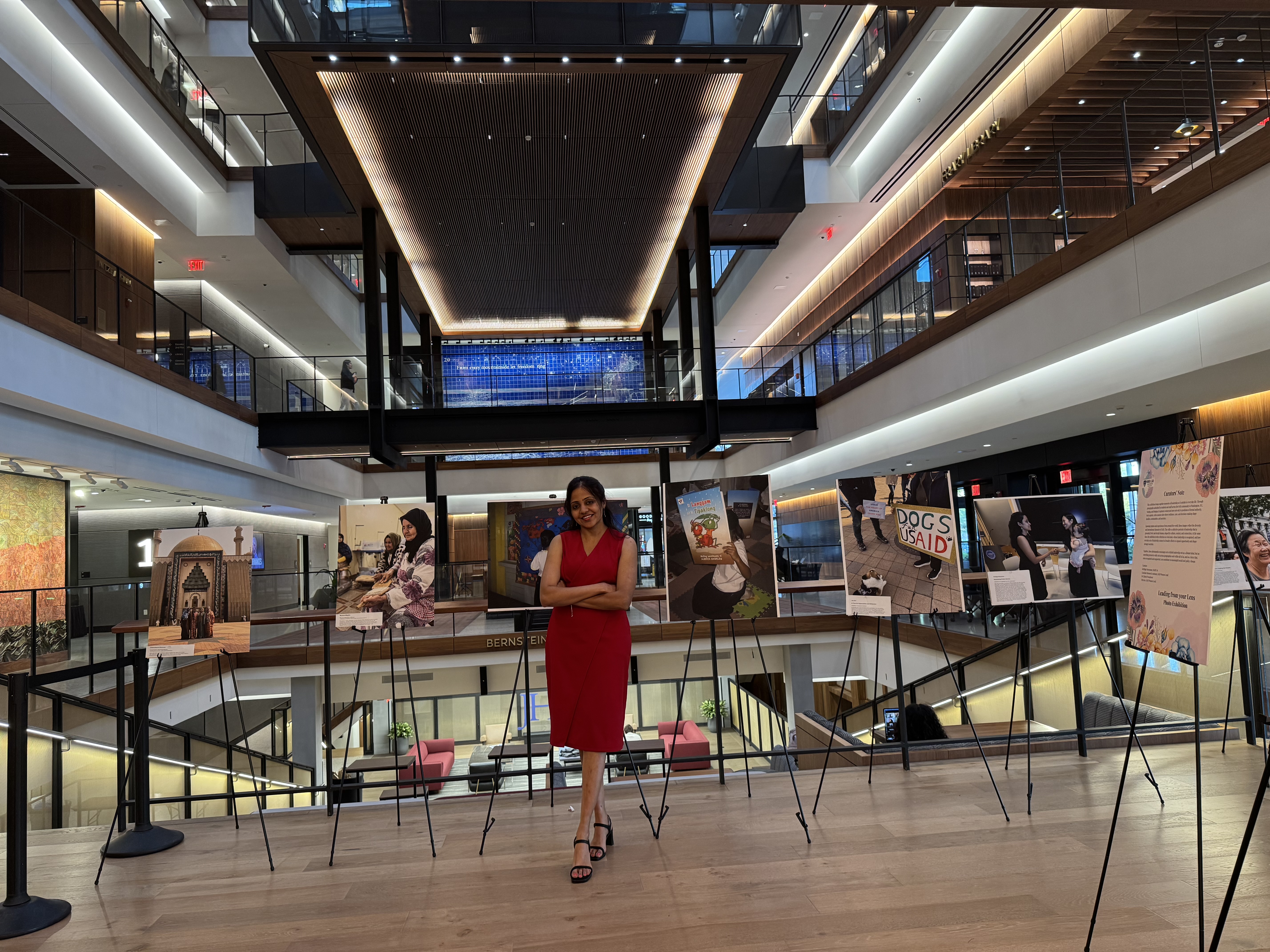
When we think about leadership, we often imagine formal titles, public authority, or people standing at the front of a room. But leadership also exists in quieter, everyday moments, in acts of care, resilience, decision-making, mentorship, community-building, and service.
That idea became the foundation for “Leading from Your Lens,” a photo exhibition I helped curate through my role as a Graduate Research Assistant for SAIS Women Lead, working with Vice Dean Chiedo Nwankwor. From the beginning, Vice Dean Nwankwor was instrumental in helping to shape the exhibition’s vision, encouraging me to think about leadership not only as formal authority but also as something lived, practiced, and witnessed in everyday life. My background in journalism, my passion for photography, and my work as a Social Media Ambassador for SAIS helped bring this idea to life.
The exhibition invited members of the SAIS community to submit photographs that captured women in leadership in daily life. The goal was to expand how we understand leadership, not only as something visible in institutions or formal positions, but as something present across families, communities, classrooms, workplaces, and societies.
I first helped organize the exhibition in Fall 2025 at the Kenney Link in the Johns Hopkins Bloomberg Center, with photojournalist Hailey Sadler and Dean Steinberg as guest speakers. It began as an effort to create a visual space where students, faculty, and staff could reflect on leadership through their own experiences and perspectives. Rather than defining leadership from the top down, we wanted the SAIS community to show us what leadership looked like through their own lens.
The response reflected the global character of SAIS. We received submissions from students, faculty, and staff across regions, with images representing different geographies, cultures, and lived experiences. Some photographs captured women in public-facing roles, while others showed leadership in more intimate and everyday settings, within families, communities, workplaces, and moments of collective care.
For me, this was one of the most meaningful parts of the exhibition. It showed that leadership is not always loud or distant. It can be grounded, lived, and deeply human. It can appear in the choices people make every day to support others, build community, challenge barriers, and create change.
The exhibition later became part of the SAIS Women Lead Global Leadership Summit at the Bloomberg Center, where it was displayed in the Breezeway alongside a broader conversation on leadership, governance, technology, and the future of human-centered change. Bringing the exhibition to the Summit allowed the photographs to become part of a larger dialogue about who leads, whose leadership is recognized, and how everyday acts of leadership connect to broader social and political transformation.
As reflected in the curators’ note, the exhibition brought together moments of leadership as they unfold in everyday life. Through photographs submitted by the SAIS community in Washington, D.C., Nanjing, and Bologna, it captured women and men not only in positions of formal authority, but in quieter spaces where resilience, care, and decision-making shape families, communities, and societies.
The exhibition was intentionally global. I wanted representation from all regions because leadership is experienced and expressed differently across contexts. A single image can carry a story about place, culture, responsibility, struggle, and possibility. Together, the photographs offered a collective portrait of leadership that was diverse, international, and deeply connected to the SAIS community.
Curating the exhibition also made me reflect on the importance of visibility. When we ask people to submit photographs of leadership from their own lives, we are also asking them to recognize leadership where it may have been overlooked. This is especially important when thinking about women’s leadership, which is often underrecognized when it does not fit traditional models of power or authority.
“Leading from Your Lens” was not just a photo exhibition. It was an invitation to rethink leadership itself. It asked us to consider who leads, whose leadership we notice, and how everyday acts of courage, care, and responsibility contribute to stronger communities and societies.
For SAIS Women Lead, the exhibition reflected a central part of its mission: to create spaces where leadership is studied, practiced, and reimagined. For me, helping to organize and curate this exhibition was a way to bring together storytelling, visual representation, and policy reflection. It showed how images can open conversations that words alone sometimes cannot.
Working with Vice Dean Nwankwor on this project also shaped how I understood the purpose of the exhibition. Her guidance helped me to see that leadership is not only about representation but also about recognition, recognizing the everyday forms of leadership that often go unseen, especially when they happen outside formal institutions or traditional spaces of power.
From Kenney Link to the Breezeway in the Bloomberg Center, “Leading from Your Lens” became a reminder that leadership is not only something we study in classrooms or discuss on panels. It is something we witness every day, across geographies, across generations, and within our own communities.
When recognized and supported, these everyday acts of leadership can contribute to meaningful social and policy change.
P.S.: A lot of people submitted pictures of their mothers for the photo exhibition, and I did too.


