
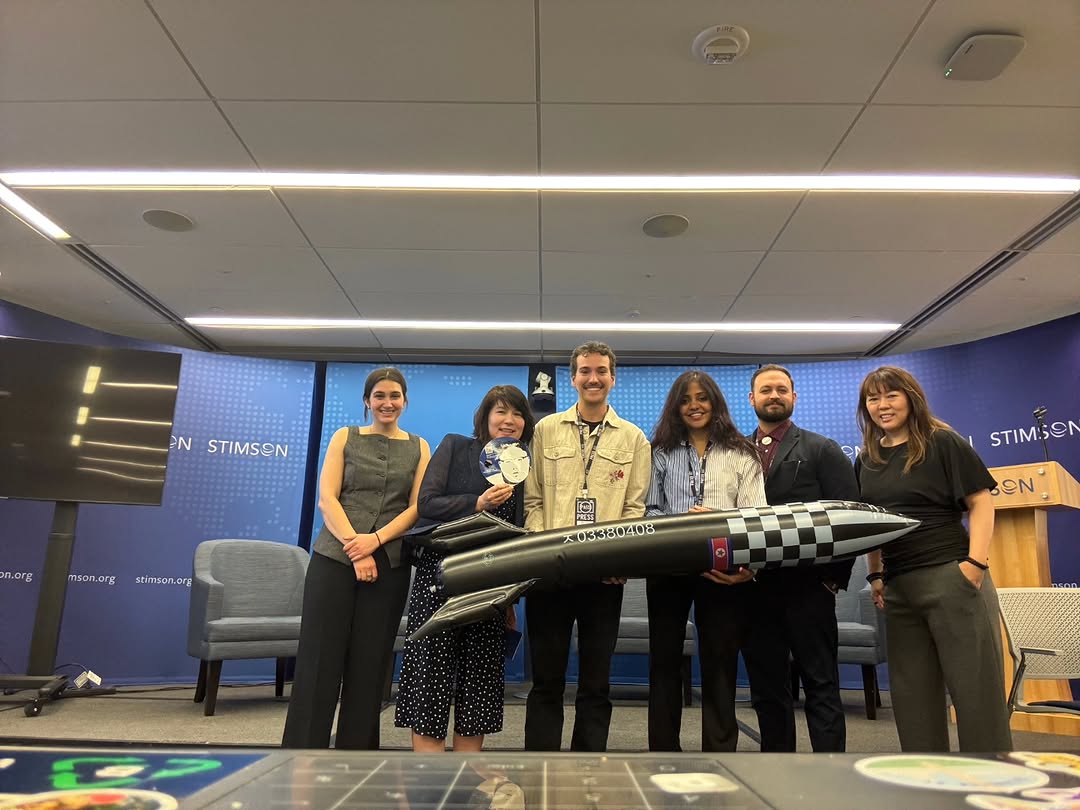
In Fall 2025, I took Nuclear Proliferation in Asia with Professor James Person. One of the most memorable class meetings that semester was a guest lecture by the Stimson Center’s Jenny Town, who also conducted a newsroom-style simulation on North Korea and nuclear crisis reporting.
That simulation stayed with me.
It was not just another classroom exercise. It placed us in the middle of a fast-moving geopolitical crisis and asked us to think like journalists: What do we know? What can we verify? What should we publish? How do we communicate uncertainty when the stakes are high?
As someone who came to SAIS with a background in journalism, the exercise resonated with me. Before SAIS, I was part of the CNN Climate Reporting Fellowship at CNN’s Abu Dhabi bureau, where we participated in a climate reporting newsroom simulation. That experience showed me how powerful simulations can be in helping students understand the pressure of reporting complex global issues in real time.
So when I experienced the Stimson Center simulation in Professor Person’s class, I saw an opportunity to bring these two worlds together: my journalism training and my policy education at SAIS.
That is how the idea for The SAIS Observer x Stimson Center Newsroom Simulation began.
As Editor-in-Chief of The SAIS Observer, I wanted to create a space where students could experience the challenges of crisis journalism firsthand. The goal was not only to practice reporting, but also to understand the responsibility that comes with communicating during moments of uncertainty.
The simulation placed participants inside a breaking-news scenario involving North Korea. Students were confronted with an escalating crisis that included an ICBM balloon from a “Pyongyang gift shop,” a simulated Twitter page, newsroom passes, breaking-news alerts, conflicting information, and fake news that had to be identified in real time. Working under pressure, participants had to decide what was credible, what needed verification, and how to report responsibly without amplifying misinformation.
These details made the exercise feel urgent and realistic. Participants had to act quickly, but not carelessly. They had to balance speed with accuracy, assess sources, think through framing, and make editorial decisions as new information emerged. It recreated the intensity of a newsroom, where journalists must often make decisions with incomplete information while understanding the public consequences of what they publish.
The event was facilitated by Jenny Town, Senior Fellow at the Stimson Center and Director of Stimson’s Korea Program and 38 North, along with Mizumi Dutcher, a senior journalist and DIA candidate at SAIS who had reported on the Hanoi Summits. Their guidance helped participants connect the practical demands of journalism with the policy complexity of nuclear risk, regional security, and crisis communication.
For me, the event showed what The SAIS Observer can do at its best: create learning experiences that connect the classroom with the world beyond. SAIS students study global crises every day, but this simulation gave them the opportunity to communicate one as it unfolded.
It also reinforced why journalism matters in democratic and policy spaces. Crisis reporting is not just about being first. It is about being accurate, responsible, and thoughtful when the stakes are high. In an age of misinformation, social media acceleration, and rising geopolitical uncertainty, the ability to communicate clearly and carefully is essential.
Bringing this simulation to The SAIS Observer was a way to combine my experiences as a journalist, student, and editor. It grew out of a SAIS classroom, was shaped by my CNN fellowship experience, and became a hands-on opportunity for students to understand the pressures and responsibilities of international reporting.
From Pyongyang to the press room, the simulation reminded us that journalism is not only about covering crises. It is about helping people make sense of them.


