
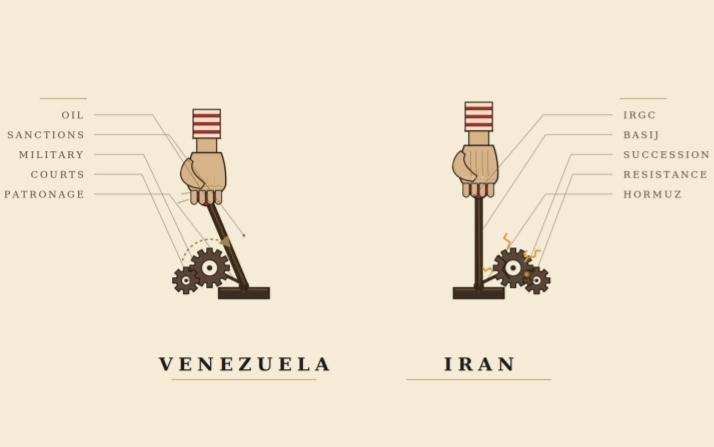
What separated progress in Venezuela from failure in Iran was never the pressure applied but the regime absorbing it.
You can tell what a regime fears most by what it builds. In Venezuela, Chavismo, Hugo Chávez’s revolutionary project and the apparatus Nicolás Maduro inherited, was built to consolidate power at home. Captured courts, patronage networks, and a propaganda machine broke the opposition‘s hold on the state. In Iran, the Islamic Republic, born out of the 1979 revolution that overthrew the Western-backed Shah, was built for external threats. Its parallel army, its naval forces anchored at the Strait of Hormuz, and its resistance economy were built to outlast Western pressure. Both sets of gears turned when Washington pulled this year. They pulled in opposite directions.
The Venezuela Lever
On April 30, American Airlines Flight 3599 lifted off from Miami and landed in Caracas three hours later, the first commercial flight between the two countries in seven years. The director of the U.S. National Energy Dominance Council was on board, scheduled to meet with Venezuelan oil executives. American Airlines staff handed passengers small Venezuelan flags at the gate.
Four months earlier, U.S. forces had captured Nicolás Maduro at his Caracas compound, flown him to New York, and walked him through the offices of the Drug Enforcement Administration in handcuffs. Vice President Delcy Rodríguez was sworn in as interim leader within seventy-two hours. Within three months, the Treasury removed Rodríguez from its sanctions list. By April, the embassy had reopened, more than six hundred political prisoners had been released, and Venezuela had rewritten its oil code to Trump’s preferences.
This is not a finished story. Elections have not been scheduled. Hundreds of political prisoners remain. The regime with which Washington is negotiating is the same regime that, in 2024, barred opposition leader María Corina Machado from the ballot and refused to recognize the 70% opposition victory the count showed. Trump told reporters she lacked “the support or respect” to govern, kept her Nobel Peace Prize medal as a gift, and kept Rodríguez as his negotiating partner. The administration’s stated goal in Caracas had nothing to do with democracy. It was oil access and a subordinate government, and on those metrics, Venezuela has so far delivered.
The Venezuela Logic
That partial advancement set a precedent in the mind of the Trump administration. If a head of state could be captured and his successor moved to the negotiating table within two weeks, decapitation was no longer a risky gamble but a reliable method.
For decades, neoconservative advisers had pitched American presidents on striking Iran’s leadership. Every president before Trump declined. Trump himself declined after the Soleimani assassination in 2020. By February 2026, the case had reassembled. Iran’s regional architecture was in ruins: Assad had fallen in Syria, Hezbollah’s leadership had been decimated, and the land bridge Iran had spent decades building was gone. At home, the picture was worse. The rial had collapsed. The largest protest wave since 1979 had spread across more than two hundred cities, met with a crackdown that killed thousands. The Islamic Republic looked like a regime ready to fall. Venezuela had just demonstrated that the United States could capture a head of state and have his successor cooperating within weeks.
On February 28, the United States and Israel launched Operation Epic Fury. The strikes killed Supreme Leader Ali Khamenei, IRGC commander Mohammad Pakpour, Defense Minister Aziz Nasirzadeh, and other senior officials. Trump told Iranians to “seize control of your destiny.” Two days earlier, Oman’s foreign minister had said a deal with Iran was “within reach” after constructive talks in Geneva.
What followed was not a collapse. Forty-seven years of resistance institution-building met one night of strikes, and the institutions held. Iran convened the Leadership Council prescribed by Article 111 of its constitution within hours. Mojtaba Khamenei, the slain leader’s son, was named Supreme Leader. One Khamenei was replaced with another. Mojtaba has not appeared publicly since.
Iran’s ace in the hole was never hidden in a bunker; it was drawn on the map. Washington could decapitate leaders, bomb facilities, and declare the regime vulnerable. But there was no way around the problem of Iranian control over the Strait of Hormuz, the narrow maritime artery through which roughly one-fifth of global seaborne oil passes. That geography gave Tehran a form of leverage Caracas never had. While Venezuela could bargain over oil access, Iran could threaten the arteries of the global economy. The Joint Chiefs had warned Trump before the strikes that an attack could prompt Iran to close the Strait. The administration treated the warning as a manageable risk. It was not.
The price of Brent crude oil crossed $100 a barrel within two weeks. The International Energy Agency called it the largest supply disruption in the history of the global oil market. American gas prices climbed more than thirty-five percent. Spain refused to allow the United States to use its bases.
On Easter Sunday, April 5, Trump posted on Truth Social: “Tuesday will be Power Plant Day, and Bridge Day, all wrapped up in one, in Iran. There will be nothing like it!!! Open the F***in’ Strait, you crazy bastards, or you’ll be living in Hell.” Tuesday came. So did a Pakistani-brokered ceasefire, announced eighty-eight minutes before his own deadline. Iran handed Pakistan a 10-point plan that Trump called a “feasible basis for negotiation.” Three days later, Vice President JD Vance led a delegation to Islamabad for the highest-level U.S.-Iran negotiation since 1979. After twenty-one hours, he left without a deal. The administration had softened its demand on enrichment from permanent to a twenty-year suspension; Iran offered five. By early May, the Pakistani channel was producing written proposals on weekends and rejections by Monday. Trump’s response to Iran’s May 10 counter-proposal: “a piece of garbage” he “didn’t even finish reading.” The ceasefire, in his own words, was on “massive life support… approximately a 1% chance of living.” Asked whether Americans’ financial pain affected his calculation, he said: “Not even a little bit.”
By late May, the Pakistani and Qatari channels had produced a memorandum of understanding that Trump announced as “largely negotiated.” Iran said the document contained no nuclear commitments at all, and Iranian sources reported that Mojtaba Khamenei had said enriched uranium “must stay in Iran.” Both governments described the same paper in irreconcilable terms because the war’s original objectives, halting enrichment, had been deferred to talks that had not yet begun. Meanwhile, Iran has formalized its grip on the waterway itself, building a tiered transit regime under IRGC management, charging vessels between $150,000 and $2 million to pass while extending preferential bilateral arrangements with allied countries. The U.S. naval blockade of Iranian ports remains fully enforced, the Strait of Hormuz is still contested, and American gas prices remain above $4.50. The Joint Chiefs were right.

Two Architectures, Two Outcomes
Why did the same coercive doctrine produce two outcomes that read like opposite endings of two different stories? The answer is in what each regime was built to do.
Geography alone did not produce the contrast. The Strait of Hormuz always gave Iran a stronger hand than Venezuela’s coastline ever could. But this position is not leveraged until a regime builds the architecture to use it. Iran did. Chavismo did not. The asset was on the map in both countries. The choice to weaponize it was only made in Tehran.
Chavismo built a loyalty infrastructure. Its institutions were engineered for internal entrenchment, not external defense: judicial capture, electoral manipulation, military patronage, and sanctioned officials enriched enough to defend the system. That architecture worked against the Venezuelan opposition for two decades. It had no answer for an external power that could capture the head of state on his own soil and offer his vice president sanctions relief, oil contracts, and recognition. Once Washington applied that pressure, the system folded into negotiation, because it had not been engineered to do anything else once the patron decided to leave.
The Islamic Republic built resistance infrastructure. Its institutions were engineered for exactly the scenario that played out in February. The IRGC operates as a parallel state with its own economic empire, deliberately decoupled from global finance. The Basij, the Artesh, and the IRGC overlap and check each other. The Guardian Council and the Assembly of Experts produce succession outcomes that do not require a charismatic leader. They produced one in February. Mojtaba Khamenei was named within hours and has not been seen since; real authority moved to the IRGC. The Strait of Hormuz was always understood as a strategic asset against precisely this kind of pressure. Forty-seven years of sanctions and isolation did not weaken these institutions. They built them.
Chavista anti-Americanism was rhetorical scaffolding around a patronage and enrichment project. Once Washington offered better terms than continued resistance, the rhetoric flipped, the deal was cut, and the regime survived by becoming subordinate. The Islamic Republic is far more beholden to its ideology. The revolutionaries of 1979 framed their takeover as a strike against American imperialism, and forty-seven years of chanting “Death to America” in state liturgies is not rhetoric that the regime can simply set aside. Anti-Americanism, anti-imperialism, self-reliance under siege: these are not mere foreign policy positions, but the regime’s constitutive identity. A regime that capitulates to Washington is not a weakened Islamic Republic. It is no longer the Islamic Republic. The men running it now will harden, retaliate, or outlast Washington. They will not become another Caracas.

No Hands on the Levers
Both the Venezuelan and the Iranian oppositions look impressive abroad and hollow at home. Machado has a robust political record: two decades in Venezuelan opposition politics, leader of a real coalition, and a Nobel laureate. Pahlavi has a royal title and a life in exile. Neither holds a lever. Not the army, not the courts, not the patronage networks. Machado has a party; he does not have the army. Pahlavi has neither.
Trump’s behavior tracked that reality. In Caracas, policy ran through Rodríguez. In Tehran, Trump told Reuters six weeks before the strikes that Pahlavi might be “very nice” but he was “unsure how he would resonate within his own nation.” On the night of Operation Epic Fury, his call for revolt was studiously generic: “seize control of your destiny,” no successor named, no transition figure offered. After the strikes, with the regime intact, he again voiced “a lack of enthusiasm” for installing Pahlavi at all. Even among the Iranian diaspora, his profile rose mostly by dividing it. Pahlavi cannot escape the legacy of his father, Mohammad Reza Pahlavi, the former Western-backed Shah of Iran, whose flight in 1979 cleared the way for the foundation of the Islamic Republic. The regime’s constitutive identity is the rejection of his family.
The administration’s actual transition plan, according to a bombshell report by The New York Times, ran not through Pahlavi but through former President Mahmoud Ahmadinejad. Ahmadinejad won Iran’s rigged 2009 presidential election, crushed the Green Movement protests that followed, called the Holocaust a myth, and governed during one of the nation’s most severe economic crises. For all his baggage, Ahmadinejad was an institutional insider and offered what Pahlavi could not: a figure who had lived within the Islamic Republic’s machinery and could plausibly govern in the aftermath of the strike.
The February 28 strikes were designed in part as a jailbreak operation, targeting the IRGC officers holding the former hardline president under house arrest, on the theory that he could be installed to govern in the aftermath. Ahmadinejad survived the strike, was injured, became disillusioned with the plan, and disappeared from public view within weeks. An associate of Ahmadinejad told The Times that Americans saw him as Iran’s potential Delcy Rodríguez: a regime insider who could hold the state together after its leader was removed.
However, Tehran did not produce a Rodríguez because the Islamic Republic was not built to survive subordination. It was built to resist exactly that kind of outside imposition. Conversely, Venezuela’s machinery could produce a subordinate survivor because Chavismo’s highest principle was staying in power. What separates the cases is not the opposition. It is what each regime was built to do once the opposition was out of the picture.
Same Pressure, Different Gears
American pressure produces whatever the target regime’s architecture and ideology allow it to produce. Caracas folded because Chavismo was built to entrench itself at home, not to outlast its enemies abroad. Tehran did not, because the Islamic Republic was built for nothing else.
Both regimes had levers of power. Both sets of gears have turned this year. The gears in Venezuela turned toward Washington because that is where the patronage system pointed once the patron changed. The gears in Iran turned against Washington because that is what they were built to do. Washington pulled both levers. One regime bent. The other bit back. The table is no longer empty, but Washington came expecting Caracas and found Tehran instead. Its hand is now bandaged. Pressure forced talks, but it did not control the terms. What each regime was built to do, it has done.