
China today is the second-largest economy in the world, and consequently, the course it decides to take has increasingly global ramifications. Understanding this was indeed part of my reason for choosing SAIS. However, one thing I have persistently noticed in China analysis is how decontextualized and non-holistic it can feel. Absent is the long historical background that Chinese elites see themselves as the inheritors of (something readily visible in their continued invocation of chengyu, sayings which originate from classical Chinese texts). Absent, too, is a sense of grounding to analysis of China. Most of policy discussion regarding the country centers on nebulous concepts of grand strategy, perhaps at times missing the trees for the forest. Hence, I decided to take advantage of the Hopkins-Nanjing Center, SAIS’s China campus, to spend a year in the country, getting to experience life on the ground firsthand. In this article, I would like to share one such experience, of getting to travel to and immerse myself deeply in the historical sites and narratives of six different Chinese cities over my winter break.
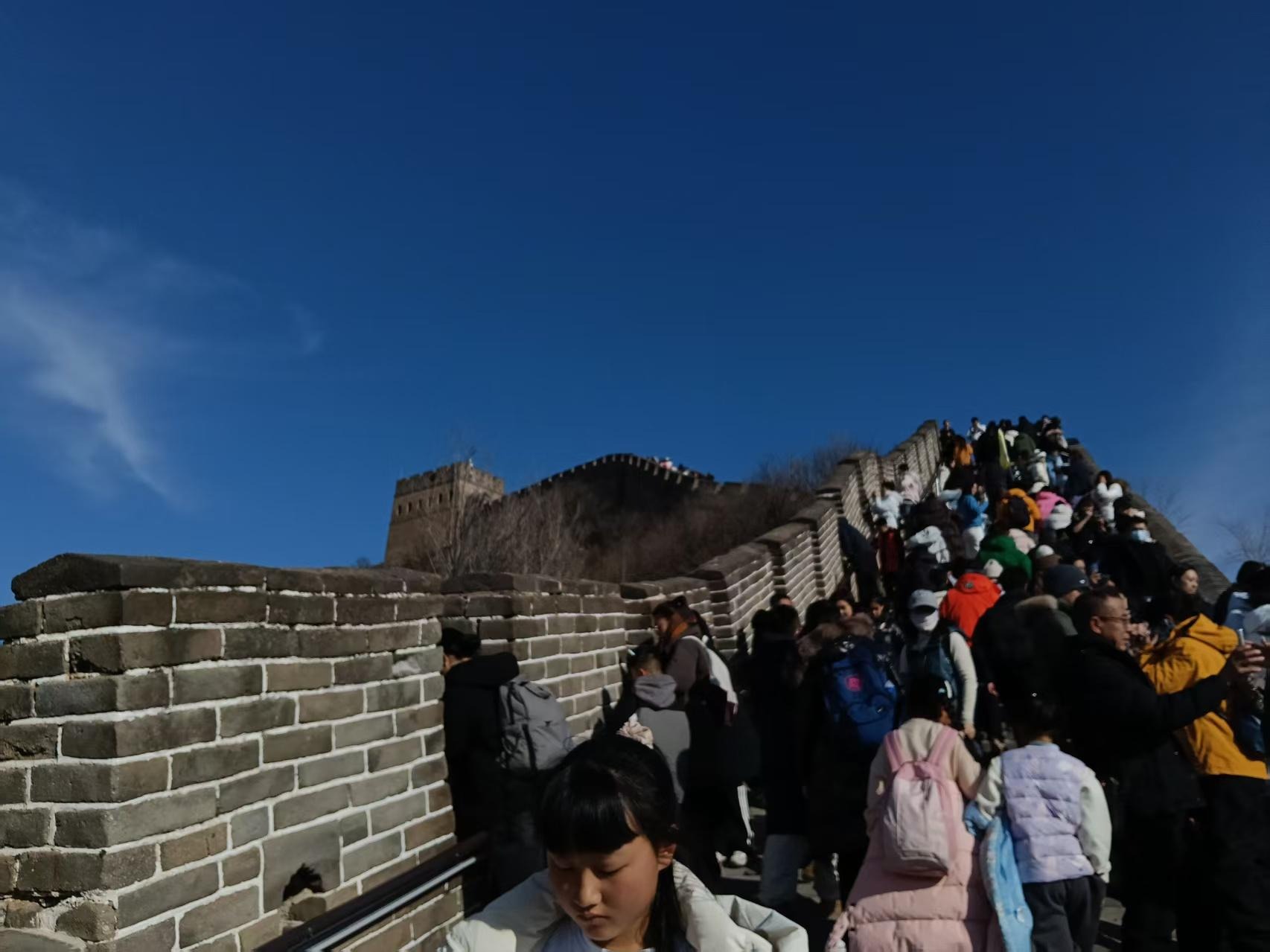
Great Wall (Badaling in Beijing) taken by Edward Yoon.
When people think of China, they tend to think of its grandest architectural feat: the Great Wall. The Great Wall has a nickname in Chinese “Wanli Changcheng (万里长城)”, which roughly translates to the “10,000-li-long wall” (li being a unit of measurement that is approximately .3 miles). Upon climbing the wall, I was first mesmerized by the sheer number of tourists. Once a mighty bulwark against invasions from the north, the Great Wall now faces a different kind of siege: domestic tourism. The steep slope of the wall as it scaled the mountains also caught me off guard, and at points lacking stairs, I had to rely on the central handrails to keep going. Some sections were so unbearably steep that crawling took the place of hiking. This was intentional as, when the Ming Dynasty built this section of the Great Wall, they chose a very steep and rugged location to protect their capital, Beijing. Climbing on such a historical site, I truly could feel the division between imperial China and the northern peoples that this wall was intended to create.
Terracotta Museum in Xi’an. Taken by Edward Yoon.

Another popular landmark I travelled to was the Terracotta Museum in Xi’an. This site features the renowned terracotta army, a group of thousands of clay (terracotta) statues representing Chinese soldiers of the period. The exceptional quantity of terracotta figures—amounting to nearly 8000—as well as their quality, took me by surprise. Each figure has a unique face and an outfit that matches their respective rank in the infantry—a fact that challenges assumptions about the past when one realizes that they were made in the 3rd century BCE. More surprisingly, such an impressive creation was unrecorded in any written history and hence unknown to humanity for 2 millennia until an accidental discovery in 1974, adding to its mystique.
Beyond the external features of the terracotta army, another question arises: what is their purpose? Simply put, they were created under the order of the First Emperor of the Qin Dynasty, Shi Huangdi/Qin Shi Huang. He sought to have an army in his underground palace, believing this would protect him in the afterlife. In Chinese history, the burial practices of people of higher social status often included burying their servants alive alongside them, so that the servants can continue to serve their masters in the afterlife, a practice called xunzang (殉葬). In the case of the Qin Shi Huang, he opted to use these fake soldiers instead of real ones. Despite Qin Shi Huang’s negative contemporary appraisal, this action would have been considered a progressive move in his time and showcases his pragmatism in not wishing to have his soldiers buried with him, an act which otherwise certainly would have weakened the martial capacity of the newly established Qin dynasty.
Wuhou Temple in Chengdu taken by Edward Yoon.

The Three Kingdoms period has long captured my interest, making Chengdu—the former capital of Shu Han—an essential stop on my itinerary. Consequently, for this leg, I booked my hotel near Wuhou Temple, dedicated to Zhuge Liang (a famous chancellor of Shu Han) and home to the mausoleum of Liu Bei (the first emperor of Shu Han). Even my hotel, the “Hanshi Hotel,” reflected this historical theme, with its name referencing the Han Dynasty, which Shu Han claimed to continue. The experience of staying there was immersive, complete with historical decor and even books (though my Chinese proficiency was not quite sufficient to fully engage with them).
Visiting Wuhou Temple itself was the highlight of my itinerary in Chengdu. Beyond the tomb of Liu Bei and the shrine to Zhuge Liang, the site features tributes to many key figures of the Shu Han state. One of my main takeaways was how deeply history is embedded in Chinese cultural identity. Despite the Three Kingdoms period lasting only around 50 years, it plays a defining role in Chengdu’s historical narrative. More broadly, this reflects a pattern across China: different regions derive identity from specific historical periods, enabled by the country’s long and diverse past.
Dali Bai Autonomous Prefecture, Yunnan taken by Edward Yoon.

Dali is an autonomous prefecture of the Bai people, an ethnic minority group in Southwestern China. It was also the capital of a historical state of Bai people called the Dali Kingdom, which is naturally the namesake of the current town as well. When I planned my visit there, I was particularly interested in the local history not attributed to the Han Chinese people. Hence, I visited multiple historical sites of the Dali Kingdom. Among the sites I visited, Chongsheng Temple stood out, especially for its iconic Three Pagodas arranged in a formation of an equilateral triangle.
The significance of this historical state by a people now considered an ethnic minority in China raises questions about how the ethnic minorities are identified and regarded. In recent years, the People’s Republic of China (PRC) has mostly focused on establishing a unifying “Chinese Nation (中华民族)” instead of recognizing its 56 different ethnicities as fully distinct nations on their own. In particular, the bedrock of this concept comes from “Many Origins, One Entity (多元一体)” an idea developed by a renowned anthropologist Fei Xiaotong (费孝通) and which has since served as the main framework used by the PRC to attempt to unite the diverse peoples of China. That obviously brings the question whether the Bai people are also part of the Chinese nation, which is then closely connected to whether the Dali Kingdom, a state of the Bai people, was a Chinese state. While this might sound like some pure propaganda of the Chinese government, it must be asserted that what entails a Chinese state has been a more blurry, spectral matter rather than a clear-cut answer. The reason is that many neighbouring states ruled by non-Han peoples often adopted Chinese-style institutions to a large degree, and some, like the Liao Dynasty ruled by the Khitan people, claimed legitimacy as rulers of China itself. For the Dali Kingdom, it more or less existed as a foreign power within the Chinese tributary sphere rather than a state contending to be China.
This trip across China offered me something that no class discussion or academic paper was quite able to: a sense of China as a living, layered place. While China historically emphasizes the concept of da yi tong, or unity, visiting different locations shows how diverse the country truly is, and how the Chinese government tries to write and homogenize that history for modern political aims. For those seeking to understand China, there is no substitute for standing inside it, and I count myself fortunate to have been able to spend my first year at SAIS at the HNC.
Edited by Anya Acharya