
“This is a battle for the future of our civilization.”
These were the fiery words of Nigel Farage, leader of the far-right British party Reform UK, in a video message posted on social media after over 50,000 people crossed the border between Morocco and the Spanish exclave of Ceuta on July 30. Other European politicians followed suit as the border-crossers circumvented Spanish guards, running over land or swimming through breakwaters off the beach, and sought refuge in the 7-square-mile city. Santiago Abascal, leader of Spain’s VOX party, referred to the surge as an “invasion.” Alice Weidel, co-chairwoman of Germany’s AfD, claimed without evidence that “Germany is the likely destination”—a dire warning echoed by Farage in Britain, who warned, likewise without evidence, that the immigrants were “coming to our country.” Much of the political right in Europe—backed up by powerful allies in the United States—blamed Spanish Prime Minister Pedro Sánchez for the crisis, alleging that his welcoming stance towards immigrants and refugees in Spain signaled a limitless invitation to cross Spanish borders.
Even if every person who crossed the border into Ceuta on July 30 had remained in the city (as of this writing, almost all have returned to Morocco), they would have been stranded in an exclave on the African continent. Nativist fears that last week’s events represent the beginning of a process in which Europe is “swamped” by immigrants are difficult to square with the geographic reality of Ceuta’s separation from mainland Europe. Notably, Farage, Abascal and Weidel’s rhetoric extended no compassion to the (at least) 72 people who drowned, or were crushed, while attempting to cross the border; eschewing any empathy for the real people who died, they instead stoked lurid fears of an imagined future.
There has been no evidence to support the claim that the people who arrived in Ceuta last Thursday constituted an invading army. Interviews with immigrants who recount being directed toward the border by Moroccan guards suggest that the people who entered Ceuta might have been manipulated into doing so by the Moroccan government. Some analysts have speculated that Morocco orchestrated the surge in retaliation for Spain’s recent rapprochement with longtime Moroccan rival Algeria, cynically exploiting tens of thousands of desperate people in order to embarrass Spain.
Yet our reaction should not be focused there.
We should be thinking about Dikra, a 20-year-old Moroccan woman who has been in Ceuta since last week and has no idea where her next meal will come from. We should be thinking about Hamsa, a 12-year-old boy separated from his parents, hoping to reach his mother in Spain. We should be thinking about Soufiane ez-Znafry, a 26-year-old man who told The New York Times that he had not eaten in two days.
It is easy to lose sight of the individual lives behind the abstraction of “50,000 to 60,000 migrants.” Reducing the people who crossed the border at Ceuta to a faceless collective, a five-figure number attached to the abstract category of “migrant,” allows xenophobic politicians to reduce human beings to alien hordes. It is far harder to demonize them when we remember that they have names, faces, ages, families and personal stories—that their names are Dikra, Hamsa or Soufiane. The most important story in the Ceuta crisis is not the history of Spanish relations with Morocco or Algeria; still less is it the imagined specter of an “invasion” of Europe. It is the story of suffering human beings, different from us only by accident of birthplace, who are desperate for relief from poverty, hunger and persecution.
While it is difficult to swallow demagoguery about Ceuta from politicians at a relative remove in the U.K. or Germany, it is true that the people of Ceuta found themselves in an unpleasant predicament. We should not minimize the difficulty that the city’s residents faced when tens of thousands of people showed up at once. Ceutans did not choose to be caught up in a crisis with potential geopolitical ramifications, just as the people who entered the city did not ask to be placed in the abject circumstances that compelled them to do so. (Many residents of Ceuta have also objected to the far right’s instrumentalization of their city, and have protested the visits of far-right Spanish politicians over the past several days.)
There is no contradiction in extending compassion both to Ceutans and to immigrants. As a practicing Roman Catholic whose view of international affairs is formed by the Church’s social teaching, I follow Pope Leo XIV’s articulation of the principle of solidarity in his encyclical letter Magnifica Humanitas: it is “the concrete recognition that the future of each individual is connected to the future of all; indeed, ‘no one is saved alone.’” Our response to humanitarian tragedies cannot be to pit one group of people against another because, as Leo notes, solidarity is not zero-sum but mutual. We must therefore extend as much compassion to the people who risked their lives for a chance to escape poverty or violence (or, as in the case of Hamsa, to reunite with their families) as it rightly extends to the people who bore the brunt of the chaotic circumstances.
Miami Archbishop Thomas Wenski frequently employs a turn of phrase that we should take to heart after Ceuta: “No human being is a problem.” As Archbishop Wenski said in his 2025 homily at the Florida Culture of Life Conference, “The culture of death has a reductive understanding of the human person and reduces people or classes of people to being just problems. Such reductive thinking offends the dignity of man created in the image and likeness of God.” Thus “the immigrant is not [a problem]: he or she is a brother or sister.”
Too many political reactions to the Ceuta crisis have treated immigrants as problems to be cast out rather than people to be cared for, and have focused on attributing blame: blaming Sánchez for his immigration policy, Moroccan authorities for their alleged involvement with the surge or the immigrants themselves for mounting a purported “invasion.” The impulse to assign blame is of a piece with the tendency to see human beings as problems. But not all difficult situations have culprits in need of punishment. Some have only victims in need of help.
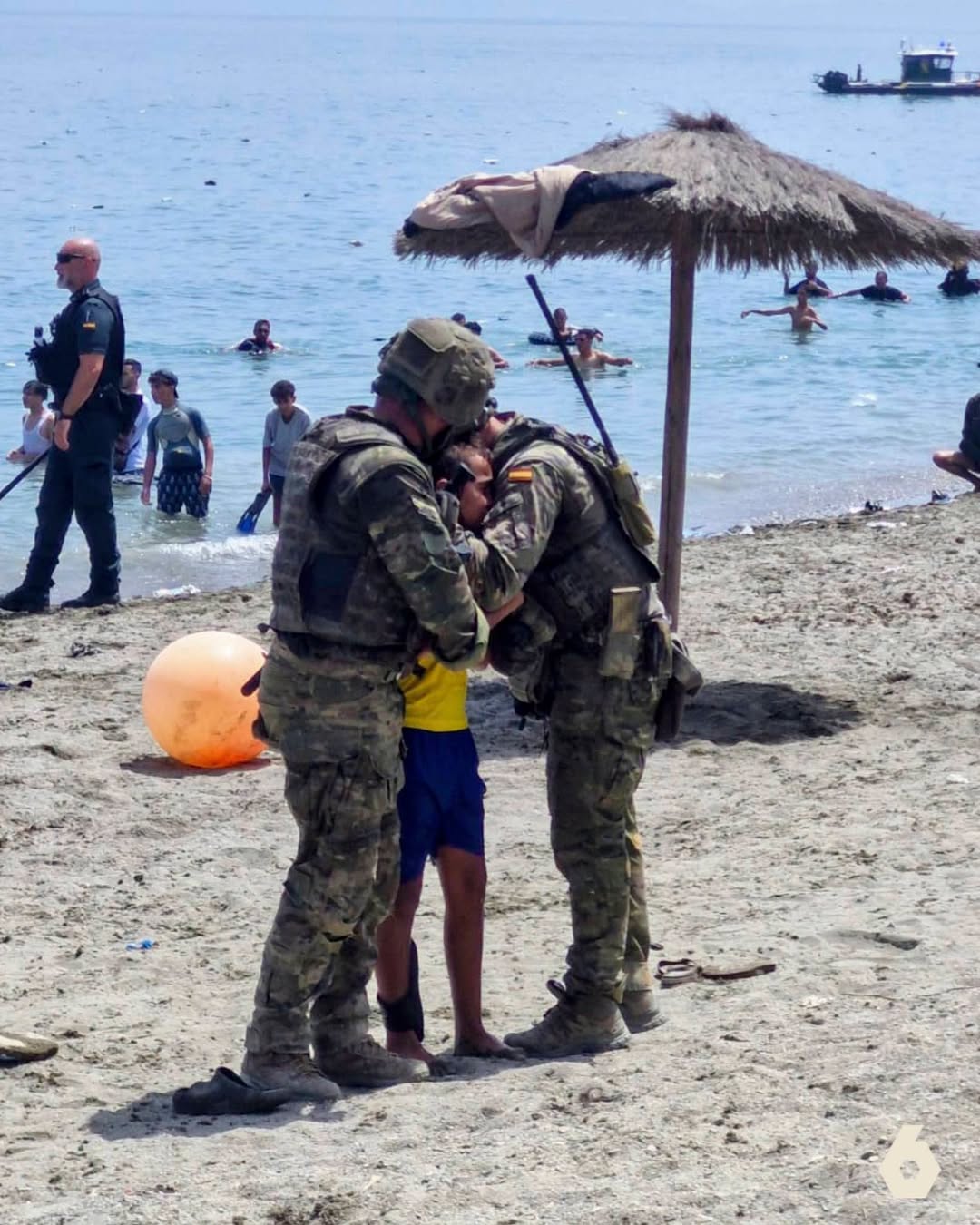
If we replaced our impulse to blame with an impulse to care, we would not immediately resolve the political tension between Spain and Morocco or break the cycles of systemic poverty that send millions of immigrants per year on perilous journeys to Europe. Even amid the suffering in Ceuta, small rays of hope for a compassionate approach to immigration shone through, as in the widely circulated photograph (above) of Spanish soldiers embracing an exhausted immigrant boy. If the compassion on display in this image were reflected in our political responses to immigration, our societies might recover some of the humanity that we lose when we vilify desperate people as “invaders.”
Farage may be correct that the future of our civilization is at stake in Ceuta. The test that we face is whether we still have the ability to welcome the stranger with mercy and compassion. If our primary reaction is to demonize immigrants and stoke hatred and fear of them, our civilization may well be lost.