
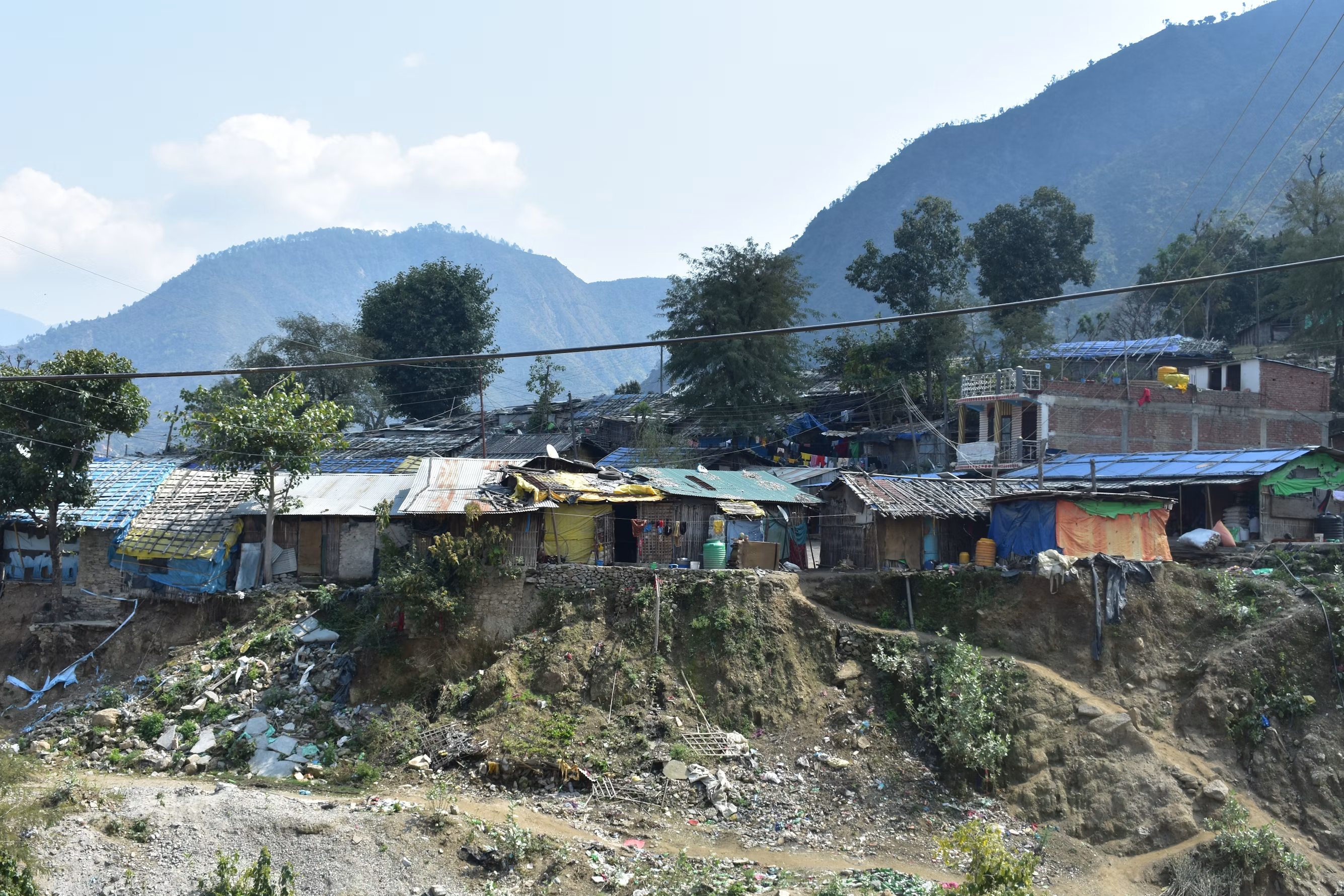
As of August 27, 2026, flash floods in Nepal have claimed nearly 400 lives and left thousands more missing. These are not just numbers, but real people who died through no fault of their own. Where were the national early-warning systems? What happened to the institutions that predict such natural disasters? How did they fail to raise alarms and call for emergency evacuation? Many questions have remained, and will unfortunately remain, unanswered. Families have been left thunderstruck, homes have been destroyed, and whole communities ravaged by walls of water that swept away countless lives in seconds.
On August 26, 2026, a hydro calamity through the Bhotekhoshi river in the Rasuwa district, the northernmost region of Nepal along the Tibetan border, caused unprecedented havoc. Scientists have yet to identify the trigger; as of now a number of theories are doing the rounds from glacier lake outburst, rock ice avalanche that blocked the river and released or another high altitude cryospheric event. Previously, in 2025 it was confirmed that the same river system was struck by a confirmed glacial lake outburst overwhelming an entire river corridor.
This catastrophe was by no means an ordinary one. It appears to have sent out a strong message to all of mankind. Our mountains at high ranges such as the Himalayas are simply reacting to human actions over the years. We have been trespassing, extracting and really disturbing the natural resources for industrial ambitions. A hazard of this scale knows no borders, originating from Tibet (China) and flowing through both Bhotekoshi and Trishuli river valleys as massive debris rushed into the Lende Khola river which fed downstream into the above-mentioned natural water bodies directly crossing the border into northern Nepal.
An international case of cataclysm of this nature acted as a stifling wake-up call due to rapidly evolving climate change. The steep slopes of the Himalayas (highest in the world), home to Mount Everest stretching over 1800 miles and situated across Asia, separating the Indian subcontinent from the Tibetan Plateau – are mostly vulnerable during the monsoon season.Rising global temperatures are the reason for fast melting Himalayan glaciers, causing destabilization at an absurdly accelerated rate, weakening the rock and ice.
1) Accurate early-warning systems
A robust inter-institutional network is required to coordinate, for example: the Department of Hydrology and Meteorology (DHM) could monitor rainfall patterns, rising levels of rivers, including all hydrological situations. Next, the International Centre for Integrated Mountain Development (ICIMOD) can carry out satellite-based analysis on what’s happening on glaciers, lakes, snow and other high peak trends. The Department of Mines and Geology (DMG) should hire distinguished scientists to contribute through their expertise on landslides, unstable slopes, rockfalls and other hazards of geological nature. Such observations should turn into danger-assessment systems spearheaded by DHM, enabling the country to be alarmed weeks prior to the likely event. The National Disaster Risk Reduction and Management Authority (NDRRMA) in Nepal, led by Executive Chief Dr. Dharmaraj may work alongside DHM as well as the Ministry of Home Affairs to help translate technical readings into national matters of concern. This way risk is mitigated and evacuation efforts implemented swiftly and effectively.
2. Strengthen local populations’ ability to respond
The second step must hone in on expansion of warning alerts through nation-wide broadcasting, SMS, loud and far-reaching sirens FM radios, police deployments as well as ward officials. Only depending on social media information, or having full access to the Internet would not help. Evacuation routes need to be mapped out for fragile regions surrounding the mountains and river tributaries that pass through these communities. Preparedness can prevent mass casualties if safer sports on higher grounds are made easily accessible to the public. Create more shelters for times of emergency by training residents with realistic drills and exercises. Simultaneously, all national, local and district defense task forces must brace for impact way ahead of time and not wait for the disaster to strike. For instance, the Nepal Police, the Armed Police Force (APF), Nepal Army and Nepal Red Cross must establish early-action duties to prevent people from getting hurt. These duties could include but should not be limited to rapid evacuation, rescue, medical assistance and relief. Instead of waiting for Kathmandu’s word, the NDRRMA and the National Emergency Operations Centre (NEOC) should collaboratively coordinate national support, which means the government then needs to lend local bodies that kind of authority, equipment and training to respond instantaneously.
3. Foster cooperation among Himalayan nations
This particular 2026 incident has shown the transnational nature of the debacle of our shared ecosystems, the consequences of which, are shared too. The existing multilateral organization International Centre for Integrated Mountain Development (ICIMOD) ought to reform its ways of taking action. As a regional scientific platform, create sound knowledge-sharing systems wherein intel received from upstream areas could give Nepal extra time to activate its national warning system, while Nepal could share downstream risk information with India. Apply the same logic for neighboring nations in the region prone to disasters. Moreover, it is advisable for DHM and NDRRMA to establish regular technical and crisis communication with relevant agencies in China and India. The objective should be to produce actionable outcomes through clear protocols for exchanging data about extreme rainfall, sudden river-level changes, landslides, glacial-lake instability and possible flood waves — all at the speed of lightning, much before any of these hit our homes, again.
All in all, calling this merely a flash flood or landslide would be a great understatement. The tragedy that locals and foreign tourists faced alike in Nepal, is bigger than all of us combined. It was an actual wrath of Mother Nature sending out a message for mankind to behave, and get our acts together. A message from God’s own sacred mountains that humbled many hopefully now, as an aftermath of this great blunder.