
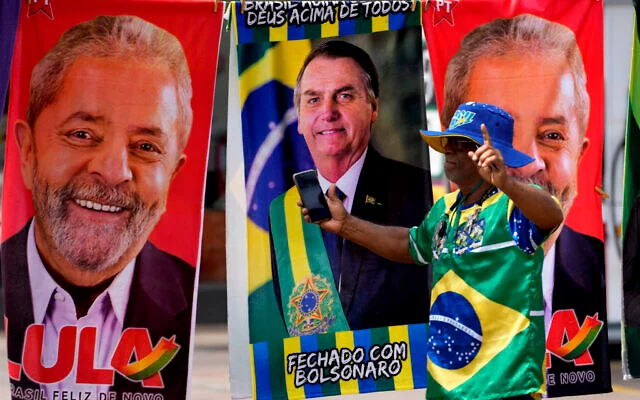
The first time I ever bought a Brazilian flag was in 2021, when I left Brazil for the first time. I was starting college in the United States and wanted something to remind me of my country. But for the previous four years, I would never have bought one. In the U.S., by carrying a Brazilian flag, I would be seen as just another international student who misses home. I could wave my country’s flag abroad free of political connotation, but not at home. In Brazil, I would be seen as a supporter of Jair Bolsonaro, the far-right president from 2019 to 2023. This is not just about the flag itself, but about who gets to claim it, and the democratic cost of letting patriotism become partisan.
In the 2018 elections, Bolsonaro adopted the Brazilian soccer jersey as a symbol of his campaign. He used the slogan “Brazil above everything, God above everyone,” tying patriotism and conservatism to his movement. Even Independence Day became a day used by the right to demonstrate political strength and support for Bolsonaro. Slowly, I watched bolsonaristas take the green and yellow colors for themselves, something not new in our history. The last regime that used national symbols as propaganda was the military dictatorship, which ruled from 1964 to 1985. Its slogan was “Brasil, ame-o ou deixe-o” (“Brazil, love it or leave it”). Almost 50 years later, the Brazilian flag started becoming a symbol of the far right again. Like me, thousands of Brazilians who did not identify with that side of the political spectrum stopped using the Brazilian jersey.
When national symbols become partisan, democracy itself is endangered. The monopolization of the Brazilian flag by the far-right creates a dangerous addition to the country’s already accentuated political polarization. If the flag and patriotism belong to one side, the other becomes “un‑Brazilian.” This dynamic delegitimizes democratic opposition and builds a narrative not just of “us versus them,” but of “Brazilians versus un‑Brazilians.” A healthy democracy requires a shared national identity—one that has been called into question in Brazil.
For years, the left watched the right claim green and yellow and did nothing to prevent it. This hesitation is understandable, given the scar from the military period, but I argue that the left took too long to start reclaiming the flag. Beginning slowly in 2021 and more intensively in 2022, left-wing leaders, including current President Luiz Inácio Lula da Silva, began incorporating the flag into rallies, clothing, and campaign materials to dissociate it from exclusive right-wing ownership. Still, red remained the left’s main symbol.
Jan. 8, 2023, marked a turning point. When nearly 4,000 Bolsonaro supporters draped in national flags violently attacked the Brazilian Congress, the notion of “fake patriotism” entered mainstream debate. Many on the left accused the attackers of being fake patriots, citing the contradiction between using national symbols while engaging in actions seen as anti-national, including an attempted coup. This was not just an event. It was a moment when symbols and democracy collided, creating a war of narratives.
After all, what does it mean to be a patriot in Brazil? One side identifies itself as “true Brazilians” and labels the other “un‑Brazilian.” The other side fires back, accusing them of “fake patriotism.” Simple love for the country has become polarized and no longer unites. The perceptions each side holds of the other now shape the meaning of patriotism and are being used to push both further apart.
If patriotism remains partisan, democracy remains fragile. This fragility is built on perceptions, and the good news is that perceptions can be changed over time.
2026 is not only an election year but a World Cup year. As Brazilian streets turned green and yellow, and people across the country wore the jersey to cheer together, it became a moment of symbolic opportunity. Brazilian society is beginning to dissociate the flag from the right, but it must be careful not to end up tying it with the left and creating the same problem again. Both sides need to rethink patriotism and allow it to be claimed by the people, independently of partisan affiliation. And I invite Brazilians to wear green and yellow, both to cheer for the national soccer team and to vote, no matter the candidate. The flag should not belong to any politician in particular, but to us Brazilians.