
It is often said that when one possesses a hammer, all problems begin to resemble nails. It can likewise be said that once one has studied the history of religion, it becomes all too easy to see a religious dimension in any issue, even if it may be imaginary.
I hold this line of criticism in mind throughout this essay, but I would remind instinctive doubters of the difficulty of discussing religion in our own profoundly irreligious age. It is not the prevalence of atheism in modern society that is impeding this discussion; I myself am firmly agnostic. The impediment lies in liberal societies’ relegation of religious motivations to an anachronistic category, to a curiosity as abstract and relevant to us as the ruins of the Colosseum or the fable of Atlantis.
A philosophical view of religion as an outdated, laughable or illogical motivator for political action is not necessarily incorrect; however, those who hold this view should be made aware of the intellectual blind spot that they are imposing upon themselves. The downstream consequence of viewing religious motivations with a performative, paternalistic or moralising attitude is that one assumes a sense of superiority to those motivations and the people that hold them.
We are all guilty of this. Assuming that a variance in opinion is a result of a variance of intellect is human nature. We naturally assume our own views on issues are superior because if we didn’t think our opinions were correct – well, they wouldn’t be our opinions. It is especially easy to develop a sense of intellectual superiority on moral issues where arguments often rest on fundamental emotional convictions that cannot be resolved empirically. We take comfort in our superiority, sitting atop our towers of moral certitude, confident in the moral invincibility of our beliefs as we discard those contradictory views as illogical, dated or just plain stupid.
Why have I launched into an unrequested lecture on the moral complacency of the liberal West? Because in our self-admiration, in our disregard of alternative views, we have forgotten the sophistication, the attractiveness, and the power of these dismissed ideas. We have forgotten that despite our own dismissal of these beliefs, they continue to exist and they continue to exert influence.
Before 2022, liberalism had encountered plenty of religiously motivated, violent political movements, and dealt with them with aplomb. The IRA, UVF, Christian Identity, the Ku Klux Klan and al-Qaeda were morally shoved aside with ease. Their social and political backwardness, their barbaric methods and their crude resources all served to simply reinforce our comforting sense of moral superiority. For how could people who lynch African Americans, bomb pubs and fly planes into buildings really pose an intellectual or moral threat to liberalism? The struggle for civil rights in America, for peace in Northern Ireland and victory in Afghanistan may have been hard and bloody, but there was never doubt about liberalism’s eventual triumph.
This sense of superiority has left us unprepared to analyse, let alone understand, a war motivated by an esoteric and apocalyptic religious movement. A war occurring not in Afghanistan or some other faraway country, but in Europe. A war fought with undeniable sophistication, as well as brutality. A war conducted not by a terrorist group, but by one of the great nation-states of the Eurasian continent. A war that, despite its incredible cost in blood and treasure, maintains popular support. A war that, according to our most sophisticated analysis of international affairs, should never have happened.
In summation, there exists a violent religious movement that we cannot dismiss as merely illogical, anachronistic or stupid. The religious ideology propelling Russia and Ukraine into destruction emerged in the arrogant shadow of the West’s towering moral certitude. It is time to descend from our moral towers and honestly consider: what is this ideology’s appeal and power? Hold your nose if you must, but do not fool yourself into thinking that continued ignorance is the answer.
The ideology alluded to is the Russkiy Mir or the Russian World ideology. Institutionally endorsed by Vladimir Putin in 2007 with the creation of the Russkiy Mir Foundation, it proposes a deeply religious view of Russian history, language, and ethnicity.
The Russian Orthodox Church is elevated to a role of global messianic purpose. Orthodoxy grants Russia a “unique civilizational space” and a “historical destiny”. Russia is the Third Rome in the sense that it is the spiritual successor to the Orthodox Empires of Rome and Constantinople. Russia inherited their divine purpose: to be a “God-bearing people,” to be “Holy Russia.” This destiny is a “historical truth,” and to deny it is to sin.
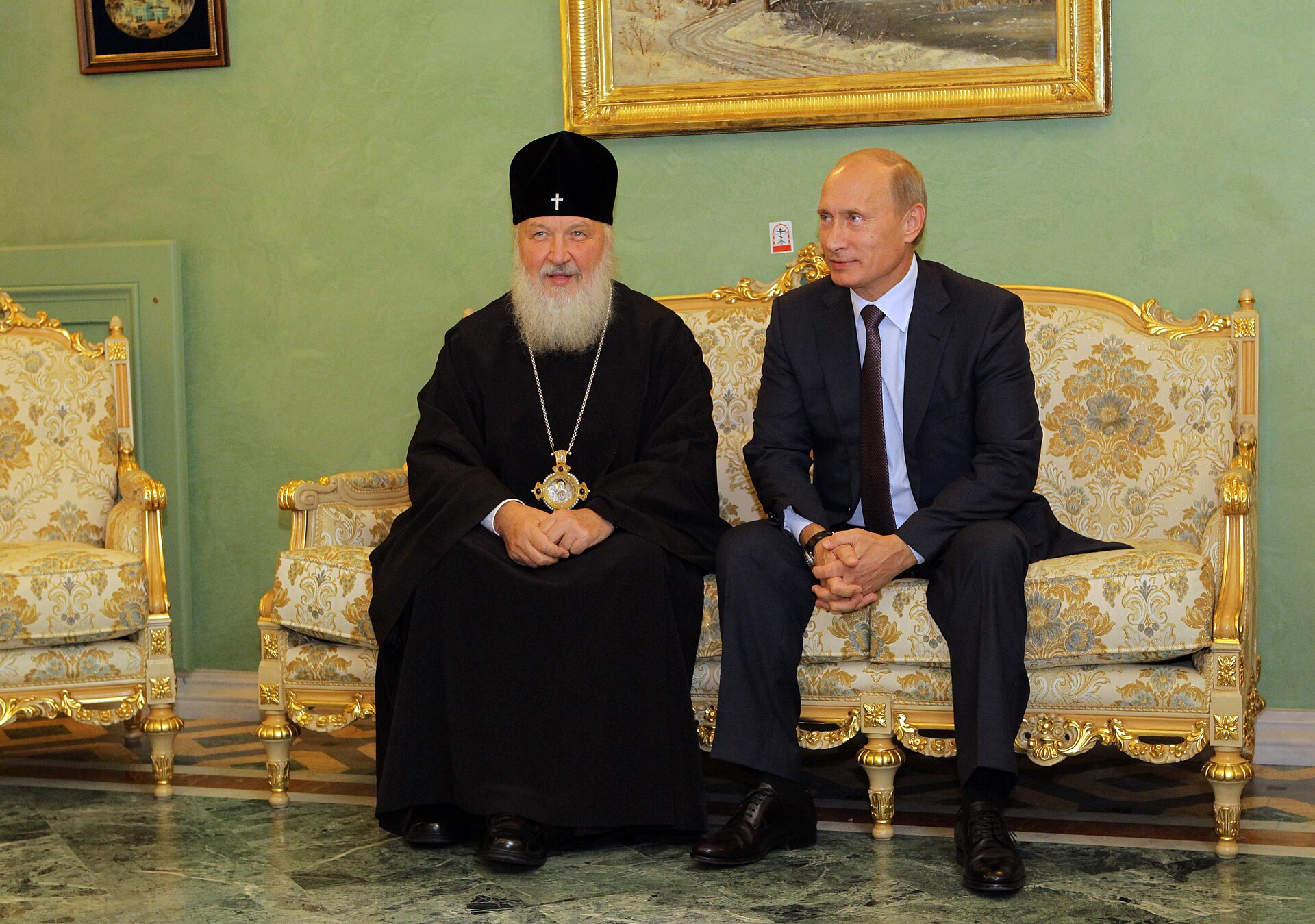
Russia has borne witness to such sin before, when Russia denied its divine purpose by embracing the atheism of the Soviet Union. The result of such an act of “national apostasy” was the Great Patriotic War. Patriarch Kirill of Moscow, a figure close to Putin, explicitly described the twenty-five million casualties of the invasion of the Soviet Union as the necessary sacrifice placed upon the “altar of victory,” so that all Russia would be cleansed of its sin. A sacrifice sufficient that the “Lord washed away this untruth, evil, and human suffering with our blood, with the blood of our fathers”. The sacralisation of violence as a redemptive act is common in the Russkiy Mir ideology. In 2024, Patriarch Kirill would honour the ongoing invasion of Ukraine as a “Holy War,” highlighting the role of this ideology in prompting the invasion.
Kirill’s and Putin’s use of the Orthodox Church to identify the “civilisational space” of Russia explicitly denies the independence of other Orthodox cultures, most notably that of the Belarusians and the Ukrainians. Putin’s own essay, “On the Historical Unity of Russians and Ukrainians,” encapsulates this idea that Russia and Ukraine share “spiritual, human and civilisational ties,” substantiated through the historical “unity with the Moscow Patriarchate.” There exists within the Russkiy Mir ideology a “doctrine of the trinity of the Russian People” which includes the “Great Russians, Little Russians and Belarussians”. Rather than the latter two representing distinct ethnic or cultural groups, they are merely “sub-ethnic groups” of a greater Russian identity.
The title of this piece refers to the Apocalypse, and it is here that Russkiy Mir ideology becomes most fantastical to our irreligious ears. Dostoevsky once wrote that “Moscow has not yet become the third Rome, but the prophecy must be fulfilled, because ‘a fourth Rome there shall not be,’ and the world cannot do without Rome”. Here he refers to the idea of the Katechon, a concept from the Second Letter of the Thessalonians. The Katechon is a “power which restrains” the arrival of the Antichrist. This idea, which may seem to us absurd, is of central importance to the Russkiy Mir ideology as it presents the Russian Orthodox Church as this restraining power that prevents apocalypse. It is this philosophy that underpins the belief in the redemptive quality of violence and the historic unity of Orthodox peoples.
Russian Orthodoxy is believed to be involved in spiritual combat with the Antichrist, a metaphysical conflict that is playing out in a very material war in Ukraine. When Patriarch Kirill described the Russian Invasion of Ukraine as a “Holy War,” he justified his statement as being from a “spiritual and moral perspective.” Russia is “defending the unified spiritual space of Holy Rus” in order to “fulfil the mission of the ‘Restrainer,’ protecting the world from the onslaught of globalism and the victory of the West, which has fallen into Satanism.” The War in Ukraine is conceived as being just a single engagement of an eternal, divine and cosmic war against the forces of evil. Represented in the twenty-first century by an ecliptic mix of progressive forces that Kirill loosely terms ‘globalism’.
In short, the Russiky Mir ideology is the encapsulation of Russia’s “spiritual mission” to remain the “global ‘restrainer’, protecting the world from evil.” It is the intellectual and moral foundation of the largest war fought in Europe since 1945.
These concepts, terms and ideas in isolation may seem to have been pulled from some deranged online manifesto, but these ideas contribute to the operating ideology of a nuclear power. The West discarded religion and assumed that by pontificating on its backwards nature and crude methods it would be relegated to the dustbin of history. We assumed that our own moral certitude was contagious, that history itself was as progressive as ourselves. The millions of casualties in the ongoing Russo-Ukrainian war should stand as an immortal warning of the risks of such certainty that liberalism or the West is morally destined for victory. We should reflect on what exactly the attraction of modern progressivism is, because for too long its popularity, its support, and even more fundamentally its progress have been assumed.