
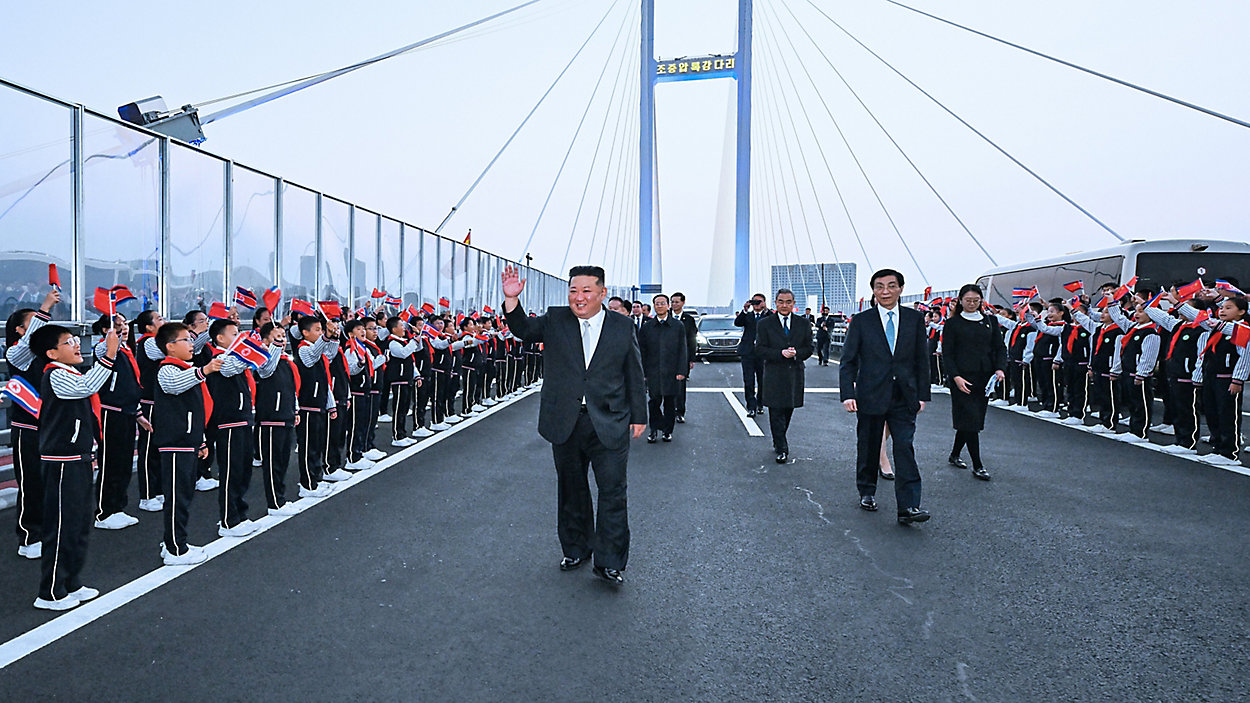
On October 24th, Kim Jong Un crossed the Yalu River for a one-day visit to Dandong, the Chinese border city facing North Korea’s Sinuiju. It was his sixth trip to China since taking power and his first in just over a year. This marks a break with past form, suggesting Mr. Kim is rebalancing towards Beijing after leaning on Moscow in recent years and preparing for another round of diplomacy with Donald Trump.
A Visit without Xi
The stated purpose was to mark the 76th anniversary of China’s entry into the Korean War. Mr. Kim laid a wreath at Dandong’s memorial hall for the Chinese People’s Volunteers, the troops China sent to fight alongside North Korea in the Korean War. He also presented a photo panel of his grandfather, Kim Il Sung, and toured a local vehicle factory. Mr. Kim then called the relationship “forged in blood” and pledged to carry it forward across generations. Such a prominent tribute to China’s wartime role, made on Chinese soil, is rare for him.
Xi Jinping was not there. With the Communist Party’s Fifth Plenum opening in Beijing on October 26th, Mr. Xi sent Wang Huning, the party’s fourth-ranked leader, with Foreign Minister Wang Yi alongside him. On all five of Mr. Kim’s earlier trips to China, he had met Mr. Xi in person. The two last met in June, when Mr. Xi visited Pyongyang for the first time in seven years. At its October 26th briefing, China’s Foreign Ministry confirmed Wang Huning’s role in the relationship and said Beijing was committed to developing China-DPRK ties.
The mode of travel changed too. Instead of his armored train, Mr. Kim was driven across the river in a Mercedes-Maybach limousine, over a brand-new bridge, a symbol of deepening economic ties.
The Bridge and the Russia Factor
The four-lane New Yalu River Bridge, about 3km long, links Dandong with Sinuiju, the main trading hubs between the two countries. Construction finished in 2014, but the opening stalled for over a decade, in part after Mr. Kim executed his uncle, Jang Song Thaek, who had championed the project and was seen as too close to Beijing. The bridge finally opened on October 15th.
The timing sends a signal to Moscow. Since Russia’s invasion of Ukraine, Mr. Kim has sent Moscow troops, shells, and missiles in exchange for fuel, food, and military technology. The two countries signed a mutual-defense treaty in 2024 and opened their own road bridge in September. Analysts warn the payoff is already visible: ASPI’s Strategist argued on October 27th that Russian assistance makes North Korea’s recent missile tests more worrying.
Beijing still has more leverage. China accounts for more than 90% of North Korea’s trade, and it has been easing cross-border restrictions and upgrading transport links. Passenger rail between Beijing and Pyongyang resumed in March. Official bilateral trade reached $2.3bn in the first nine months of 2026, up from $1.9bn a year earlier. China might have the upper hand, but it is working hard to keep Pyongyang close.
The American Angle
There is precedent for reading the trip as a prelude to talks with Washington. Mr. Trump met Mr. Kim three times in his first term, and before two of those summits Mr. Kim traveled to China weeks in advance to consult Mr. Xi. Mr. Trump has said he would like to meet Mr. Kim again, possibly around the APEC leaders’ summit in Shenzhen on November 18th-19th. A South Korean lawmaker, Youn Kun-young, told the New York Times the visit could signal openness to a new summit.
American officials have since downplayed the idea. But some Chinese government advisers say Mr. Xi is keen to broker a meeting, both to reassert his influence over Pyongyang and to keep China at the table in any deal. CSIS devoted a live episode of its Impossible State podcast to the crossing on October 27th, a sign of how closely Korea-watchers are reading it.
Whatever happens in Shenzhen, the Dandong visit reminded Beijing that it still matters without costing Mr. Kim anything in Moscow. Playing his patrons off against each other remains his best card.
What to Watch
The real test comes in Shenzhen. If Mr. Kim appears at APEC on November 18th-19th, or slips into a side meeting with Mr. Trump, Dandong will look less like a commemoration than a dress rehearsal, with Mr. Xi cast as host and broker. If he stays home, Beijing’s courtship will have bought goodwill but not leverage.
Either way, the contest for Mr. Kim’s attention will be fought less in summit halls than on the border. Every lorry that rolls across the new bridge strengthens China’s hand, and every missile that flies with Russian help is a reminder that Moscow is still bidding.
Edited by Nate Iglehart