
By: Jay Figg
Edited by: Alexander Nash
I hadn’t slept the night before flying to Tibet. I was functionally dead until a flight attendant woke me up for the descent into Lhasa Gongga Airport. Blinking, I slid up the window blind and took in the enormous expanse of mountains. Like tall piles, the color of wet sand. I resigned myself to four days of finding the subtle shifts of hues in so much brown landscape. Then I saw the Yarlung Tsangpo, a river sliding over the land like a glaze of milky blue paint, marbled into the dusty brown. I’ve not edited any of the pictures I took during this trip because I don’t need to.
Originally, I had seen the trip as an unmissable experience because of its location: when else would I be in China with so much time to spare? When else would I have a visa and special permits? When else would I be able to go on a trip with all these people? But over the course of the week we spent there, a new reason emerged: when else would I get to see all this majesty—all these colors—amid the mountains at the top of the world?

View from Drepung Monastery hillside (above)
View of the Potala Palace at nighttime (below)


Red wall of the Potala Palace against a reaching blue sky (above)
An extremely good boy at the Sera Monastery (below)

We wandered through the Sera Monastery, casting glances over to the dogs which trotted on by with bits of food in their mouths. Monks passed us the other way, eyeing us on one hand, and using the other to flick through their phones. “Why do they all have iPhone 15s?” one member of our group finally asked. Tibet is ranked lowest in China on the Human Development Index, so none of us was expecting to see so many people waving around the latest Apple products. Although domestic-brand phones like Huawei and Xiaomi are ubiquitous in China, our guide explained that it’s hard for Tibetans to use Chinese phones because they don’t support the Tibetan language. They did for one or two years, but not anymore. Apple, on the other hand, does let you change the interface to Tibetan, he explained. It seemed like such a small thing.

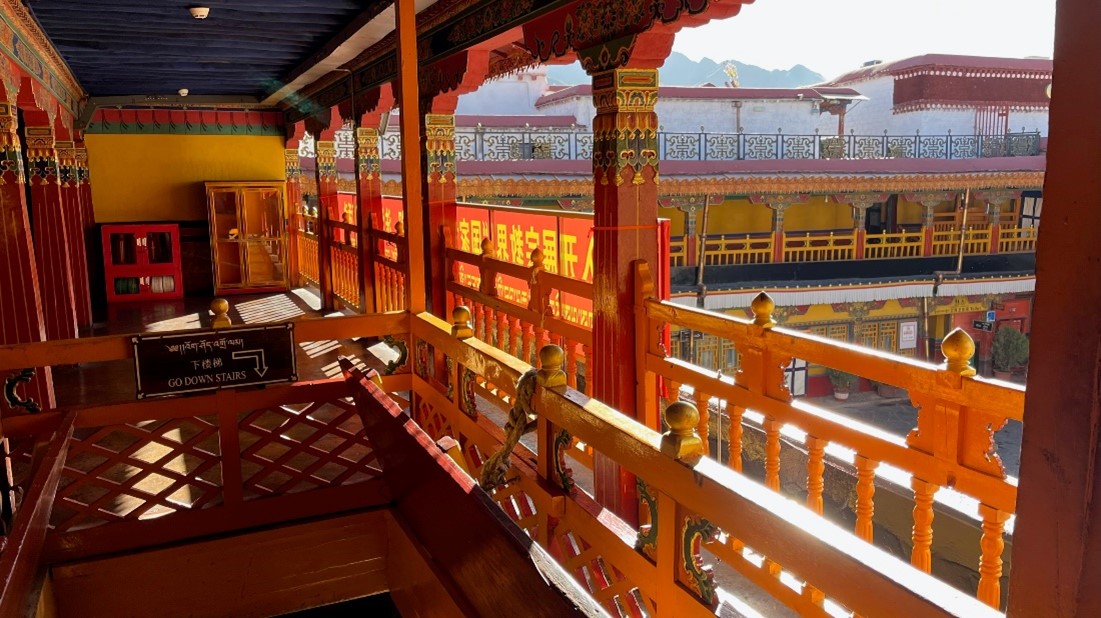
The second floor of Jokhang Temple, Lhasa (above)
The Potala Palace is repainted every year, our guide told us. Only later did we learn that not just the palace, but all the major monasteries are repainted annually. They’d done it just a few weeks before we arrived, and amidst the white buildings, there were buttercup yellows, rich reds, and eyewatering oranges splashed with deep cobalt blue. Photography inside most monasteries is forbidden for religious reasons, so I jotted notes as we wandered through. Colors everywhere. Green. Red, orange. There is one room where the hard light diffuses in through thin sheets of orange cloth, casting a yellow glow. Food offerings are stacked everywhere. Somehow the temple preserves symmetry while being chock full of towering statues, intricate Mandalas—miniature palaces of gold, rows of yak-butter candles, and hangings of every color.

A small courtyard on the second floor of Norbulingka, the former residence of Dalai Lamas (above)
Details of the awnings above the courtyard (below)

We passed by dozens of gold-painted figures. A monk usually sits in each room, arms pulled into his rich burgundy robe and clutching a packet of prayers he was reciting.

Yamdrok Lake from an altitude of 4,998 (‘Basically 5,000’) meters (above)
Yak (below)

On the final day, we visited Yamdrok Lake. It could put the sky to shame with how blue it is. Our faces were dry and burning in the sun. “Hey look!” someone called, pointing up far over the lake. There was a single wisp of cloud, almost invisible, hovering at peak height over the lake. That was the only cloud I remember seeing that entire trip. When we looked back after a few minutes, it was gone.
Doorways within doorways at Norbulingka (below)
