
By: Elizabeth Cherchia
Edited By: Aakrith Harikumar
A free, fair, and transparent election goes as well as anyone could have hoped.
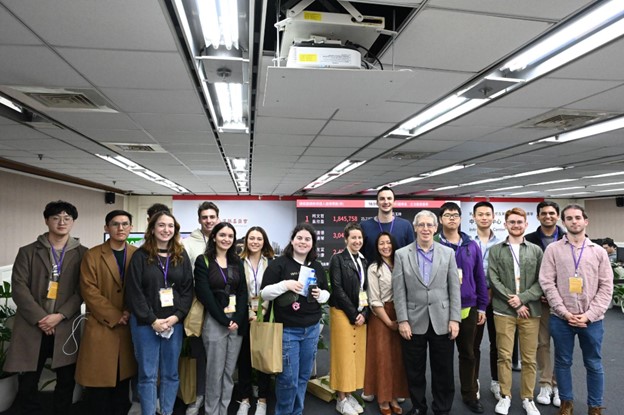
In early January 2024, 16 SAIS students traveled to Taiwan for a front-row seat at the presidential election. Over a whirlwind week, students met with both major political parties, attended rallies, visited civil society organizations and think tanks, called on American and Taiwanese diplomats, spoke to government officials, toured the legislature, and somehow still found time to sample the delicious snacks at Taipei’s night markets.
And at the end of it, the taste left in most students’ mouths was…hope?
“They call this the most dangerous place on earth?” marveled Allie Klein, a second-year MAIR student.
For many students, the most meaningful part of the trip was watching the vote counting at an elementary school in Taipei. Because a well-resourced neighbor with a strong interest in the election outcome looms across the strait, transparency and trust are paramount. In Taiwanese elections, voting is a completely analog process. Paper ballots are counted and tallied by hand in a highly choreographed and mesmerizing dance of call-and-response designed to eliminate any trace of doubt in the outcome. An audience of reverent observers, including members of the press, officials, and ordinary citizens, look on. The effect of the ritual is deeply moving.

A poll worker demonstrates to observers that a ballot box is empty
For the Americans on the trip, it was impossible to observe the Taiwanese election without reflecting, with some pain and discomfort, on the state of our democracy. Tony Gong was struck by the feeling of “deep respect for the democratic process.”
For some students, including second-year MAIR student Mira Anderson, attending the rallies, and especially Lai’s victory speech, left the deepest impression. “We were right there in the action, surrounded by people who are so passionate,” she recalled. Jackson Martin, another second-year MAIR, was deeply moved by a speech made by Chen Chun-han, a DPP Legislative Yuan candidate. Chen, who uses a wheelchair, spoke about the importance of Taiwan’s democracy for human rights because it enabled people from marginalized groups to take part in protecting and expanding the rights of those groups. For Martin, this was “a perfect example of why Taiwan’s democracy is worth protecting.”
All the while, the specter of PRC interference and disinformation hung over the election. Several students on the trip, including second-year MAIR student Claire Crane, have chosen to make election interference and disinformation the subject of their research. The PRC is often accused of attempting to influence Taiwanese elections in favor of their preferred party, the KMT. But for Crane, after speaking to experts on the ground, the situation became more complicated than she initially thought. “While there does seem to be evidence of PRC attempts to skew the election in favor of the KMT, it was far less clear-cut than I expected,” she says, “Efforts in the last few years to bolster media literacy and promote awareness around disinformation have helped make people aware of the danger.” But she explains that this heightened awareness is a double-edged sword – bringing the issue into the public consciousness so dramatically has made it easy for politicians to label anything their opponents say as “fake news.” For her, this trend is just as worrying as actual election interfence – it not only increases polarization, but also undermines trust in Taiwan’s political institutions.
Certainly, there is political polarization in Taiwan. The campaigns were chaotic, and the candidates’ rhetoric was hyperbolic. There is disillusionment, especially among young people, many of whom are tired of the two establishment parties—the Democratic Progressive Party (DPP) and the Nationalist Party (KMT). Many of them have abandoned the DPP and KMT for the Taiwan People’s Party (TPP). Some feel the DPP and KMT over-emphasize cross-strait issues at the expense of those closer to home, like wage stagnation and health insurance. Others are just ready for a fresh party to shake the cobwebs out of the political establishment.
But beneath the noise of the election, students found more similarities than differences between the two main parties (and even the upstart third party, the TPP). Both the KMT and DPP candidates sought to reassure both foreign and domestic audiences that they would take a measured approach to cross-strait relations. DPP candidate William Lai walked back prior pro-independence statements, while KMT candidate Hou You-yi expressed strong support for defense measures and cooperation with the United States. While the specifics of the final picture and how to get there might differ, all parties share similar visions for a strong, free, prosperous Taiwan.
At the end of the election – which had been framed by the PRC as an existential choice between war and peace, and by candidates as one between democracy and authoritarianism – nothing dramatic happened. No one refused to concede, no one declared the election stolen. Even the response from Beijing – which did not manage to sway the election to their preferred candidate – was muted. All three parties had something to celebrate. While the DPP managed to hang on to the presidency, the KMT edged them out in the Legislative Yuan. Even the TPP managed to take over 25% of the vote and will play a pivotal role in the legislature over the coming term.
The two superpowers on either side of the Pacific Ocean cast long shadows over Taiwan. This election did not answer any fundamental questions about the future of this island. But Taiwan proved itself, once more, to be a beacon in a world of democratic backsliding. The SAIS students who had the privilege to watch this election came away with deep respect for the Taiwanese system and hope for the future. Second-year student Ameya Joshi summed up feelings they all shared about the experience: “Playing both tourist and researcher in Taiwan made me realize the distinct Taiwanese flavor in everything that matters to its people: the island’s natural beauty and myriad cultural confluences, its successful transition from authoritarianism to a vibrant democracy, its international status and contemporary economic resilience, and, most importantly, its free, fair, and transparent elections.”