
By: Lila Anderson and Edu Kenedi
Edited By: Elizabeth Cherchia
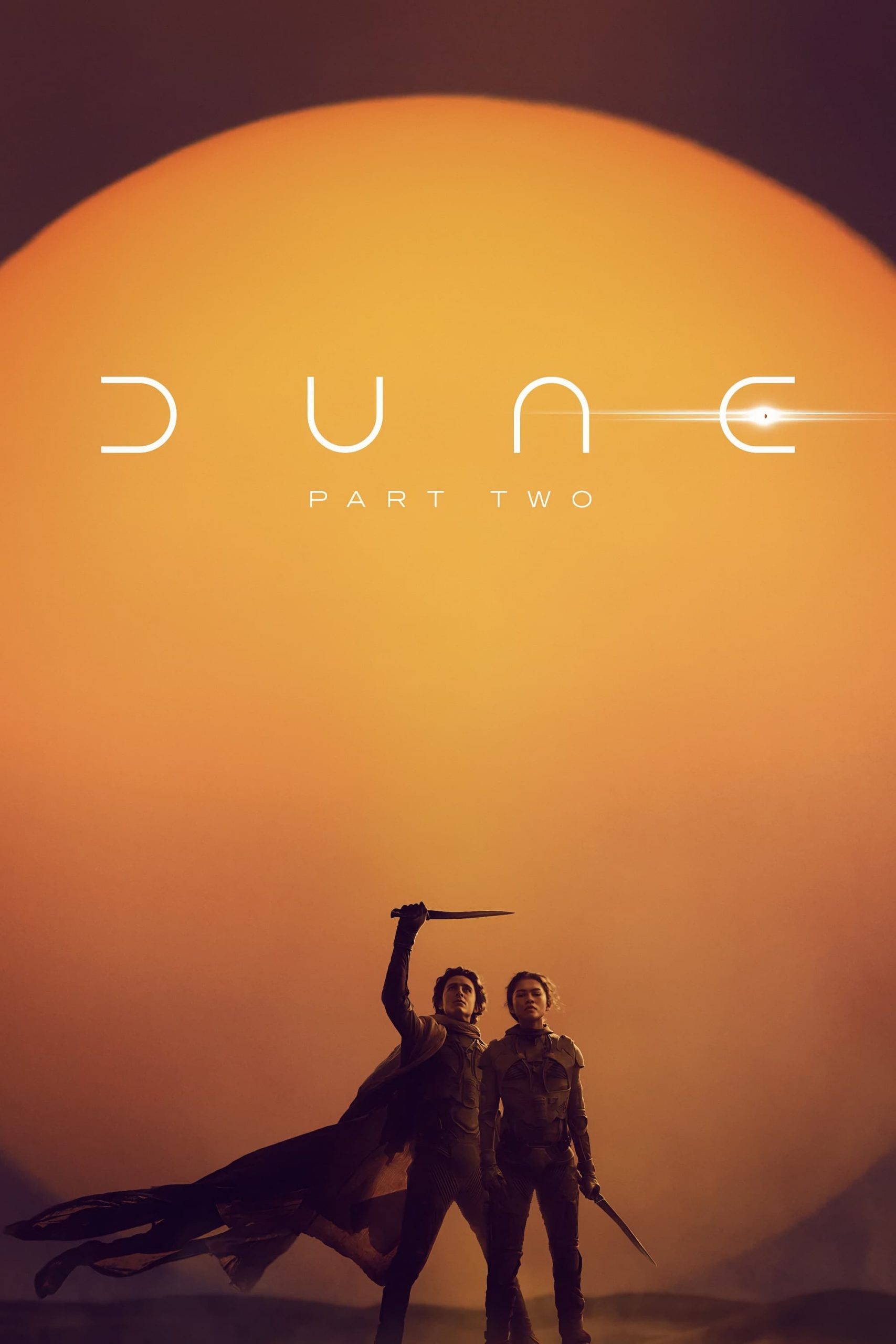
Last week your two humble critics went to watch the biggest movie of the year so far, Dune 2. The film picks up where the previous one left off, following Paul Atreides (Timothy Chalamet) as he learns the way of the Fremen to liberate Arrakis from the Harkonnens and avenge his family, while also grappling with his role as their Messiah. Once again, we offer two takes, one from a hardcore dunehead book reader and one from a casual movie-going fan.
Edu’s Take: It took me to paradise…
I absolutely adored this film! I loved the scope, visuals, performances, story, world-building, and scope. I did not think it was possible to render Frank Herbert’s book on the big screen, but I am amazed at how director Denis Villeneuve rose to the challenge and exceeded all of my expectations.
Technically speaking, this film is iconic and a masterpiece. From the creative stylistic choices, such as rendering the Harkonnen’s planet in black and white, to ingenious shots of Paul and Chani framed against the desert’s expanse, Villeneuve and his cinematographer Grieg Fraser have pulled out all the stops. Add to that the amazing set and costume design, as well as Hans Zimmer’s booming score, and the result is an immersive, well-thought-out Sci-Fi world. And we haven’t even gotten into the breakneck action, gripping story, or wonderful performances. Villeneuve has really outdone himself, transferring and capturing the big ideas from the book onto the screen. Dune 2 deftly threads the needle between asking the viewer questions about the morality of its protagonist, the role of religion in society, the white saviour complex at the core of the story, and being an engrossing, rip roaring, action epic.
All the performances of what is a star-studded cast are outstanding. The young guard of stars get to flex their abilities, especially when pitted against an experienced, older cast of Hollywood staples. Timothy Chalamet perfectly portrays the internal struggles Paul Atreides faces and delivers an iconic and captivating speech at the beginning of the third act. Zendaya imbues Chani with more depth than her role in the book and while she doesn’t speak very much, her emotive face captures the essence of her character. Austin Butler’s deranged performance as Feyd-Rautha Harkonnen, our primary antagonist, not only chews up scenes, but he even manages to adapt his voice to match Baron Harkonnen’s weird accent. Only Florence Pugh’s Princess Irulan is short-thrifted as her character is relegated to exposition duty, though her unique outfits are more than memorable.
Acting against these young stars, the supporting cast of Rebbecah Ferguson, Josh Brolin, and Javier Bardem still manage to stand out. Ferguson fully sells the complex performance of Lady Jessica, Brolin’s Gurney Halleck makes the most of his limited screen time, and Bardem manages to inject some dry levity into Stilgar, a religious fanatic.
But what of the naysayers, those who do not believe the prophecy of the Lisan al Gaib? While some may think an almost three-hour movie is boring, Dune 2 is a well-paced, engrossing, action-packed epic that never once slows down. Zealous book readers may fear rumours of the adaptive choices, but I found that these choices actually improved the story, cutting away excess narrative and adding depth to otherwise one-dimensional characters like Chani. Ultimately, I think that Dune 2 is a masterwork of cinema, worth seeing on the biggest screen possible. And I, for one, cannot wait for Villeneuve’s third film to continue the story of Paul Muad’Dib Atreides.
Lila’s Take: We will make them all believe…
That Dune 1 was kinda boring is an unoriginal gripe. Until I saw Dune 2, I found it unfair as a non-Dune-reader that I was supposed to buy that this first movie, and the 2-and-a-half year wait until the next one, were justified by the arc of an unmade series. What other franchise has told on itself by calling its inaugural film a mere world-building ramp-up? Then I saw Dune 2 and understood that the anticipation, which I felt I had been made to endure, was for my own good. The wait just made it that much better.
My illustrious colleague has already elucidated the ways in which Dune delivers epic. Despite its sparse setting on two minimalistically decorated planets far, far away in space and time, in smaller ways, the movie gives us the intricate detail we deserve for pouring our attention and our dollars into an epic franchise. For instance, Frank Herbert’s Fremen language includes consciously appropriated Arabic etymologies, and one can only imagine the fun that linguists had concocting the rest of the language, spoken in extended scenes onscreen. On a similarly detailed level, the gorgeous and gritty costumes in Dune deserve a full reckoning.
Even more striking to me were some of the political elements of the movie. I understand that Dune is a relatively faithful adaptation in the spirit of the novel, and deviating from that would cause Villeneuve to take his life into his own hands by triggering an angry mob of source-material loyalist Edus. Of course. However, adaptations are only made in welcoming climates. I, therefore, found some of the sexual politics of Dune 2 surprising.
For one thing, the Bene Gesserit played by Lea Seydoux. Declaring [Austin Butler] “sexually vulnerable,” she proceeds to use an unwitting villain to further her own family line. More interesting is the unborn Anya-Taylor Joy baby, who is portrayed as possessed of a full-on intellect. You could imagine a world in which Hollywood would reject a talking fetus. Third, Paul Atreides’ decision to jilt Chani in favour of a worthy marriage to Princess Irulan [Florence Pugh]. Together with a conspicuous lack of smartphones in the year like 10,000, I couldn’t help but wonder: is Dune trad?
In the end, I concluded that the patriarchy of Dune is pretty apolitical. This is not a Republican movie, but it’s honestly refreshing that we don’t have to do somersaults to make the romantic and maternal relationship structures that conform to our modern openness when that would interfere with the integrity of the plot of a world that is already tribal and violent. On the other hand, it’s not that . Women characters are developed and their emotional reactions are studied onscreen with compassion. It’s a fantasy and the elements that make its women characters complicated and conventional cannot be extricated from the plot.