
By Chris Hankin
Edited by Alec Nash
The Runt of the NEV Litter
Stepping into the smog outside the Dalian airport in Liaoning, the southernmost of China’s three Northeastern provinces, I was greeted by an unfamiliar sight: a long line of taxis, all sputtering out emissions in the frigid January air. Anyone who has visited major Chinese cities since COVID-19 control measures were lifted in 2023 has become accustomed to the ubiquitous green license plates on taxis indicating that they are battery electrics. In Nanjing, where the Hopkins-Nanjing Center is based, finding a gas-burning taxi is practically impossible. But in spite of China’s rapid progress on new-energy vehicle (NEV) market penetration, Northeastern China lags behind.
During 2023, China sold 21.1 million passenger cars, 7.24 million of which were NEVs. That represents a modest 6.2% year-on-year growth for all vehicles, but 38.2% growth for NEVs, pushing them to nearly 35% market share. Brands like BYD, NIO, and dozens of others are becoming one of the dominant modes of transportation for Chinese people.
The picture in Northeastern China is different. Over the course of 2023, the three provinces which make up the region, often called Dongbei (东北) – Liaoning, Jilin, and Heilongjiang – collectively sold 300,000 NEVs, representing only 4% of nationwide sales for the year. In addition to low total sales volume, NEV market penetration is stuck below a middling 5%. Dongbei’s sluggish NEV growth is a product of economic and geographic factors, as well as a thorny infrastructure problem. In spite of these headwinds, policymakers in Dongbei and Zhongnanhai are hoping that a combination of policy measures and technology breakthroughs can stimulate NEV consumption. At this point, it’s unclear if they will succeed.

The author with a charging station in China in Foshan, Guangdong Province.
The Factors Behind Dongbei’s Slow Start
Dongbei isn’t just lagging behind the rest of the country in NEV consumption; its economy as a whole is less developed than that of the southern provinces. Publicly available data shows that as of year-end 2023, Dongbei’s collective GDP climbed to just shy of RMB 6 billion (USD 830 million), approximately 4% of China’s national GDP. More concerning are the three provinces’ growth trajectories. In 2023, Liaoning grew by just 4.09%, Jilin grew by 3.41%, and Heilongjiang’s economy even contracted by 0.11%. These figures are all considerably lower than the national growth rate of 5.2% for 2023.
Given this context, depressed demand for NEVs is understandable as consumers cut back on what is essentially a luxury good. But that explanation alone is insufficient. Guangxi province, for example, is similarly economically underdeveloped, but boasts the third-highest NEV penetration rate in the country at 45% for 2023 car sales.
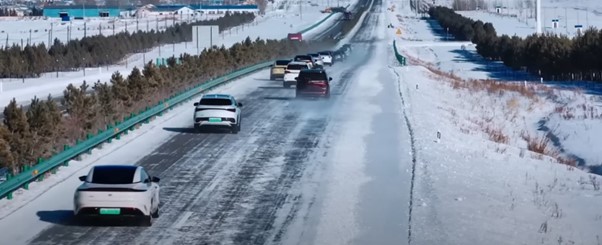
Dongbei’s frigid climate is crucial to understanding why the NEV market share rate remains so low. Throughout my recent travels, I routinely saw sub-zero Fahrenheit weather, and essentially no days where the high exceeded freezing. Cab drivers across the region frequently cited the cold as the reason that they were reluctant to buy an NEV. Anyone who has seen their cell phone go dark after a day of wintertime use knows how cold weather impacts batteries. Cold temperatures slow the speed of chemical reactions. Because the lithium-ion batteries which power most NEVs rely on chemical reactions to create a charge, in cold weather, batteries charge and discharge slower. More specifically, decreased battery performance in cold weather stems from the fact that liquid electrolyte has different physical properties below its freezing point, which slows the kinetics of the electrochemical reactions. In practical terms, this slows down charging speed and can significantly reduce capacity.
Additionally, extended periods in the cold can cause permanent damage to a battery’s capacity. In cold weather, components within the battery contract, which makes it difficult for electrons to transfer between the electrodes. This can cause lithium plating, which can ultimately lead to battery failure. If an NEV is used regularly, the heat generated by normal operation usually prevents this process. But, if left idle for a long time, cold temperature can seriously harm an NEV’s battery.
The other issue that drivers face is that in an NEV, every single function in the car pulls energy from one source: the battery. That means that playing music, running the windshield wipers, and heating and cooling all deplete the power source that also drives the vehicle. On a cold day, the first thing a driver does is crank up the heat. Bringing the car’s internal temperature from sub-zero temperatures up to something comfortable places a significant drain on the battery.
The upshot is that on cold days, drivers quickly drain their battery by heating the interior, and they find that it takes significantly longer to fully recharge. More drivers using slower chargers leads to long lines of angry people at charging stations. If charging infrastructure is sufficient to accommodate this cold-weather demand surge, the low temperature shouldn’t cause a problem. But in Dongbei, as in most of the world, that is not yet the reality.
The third factor behind the Northeast’s slow NEV rollout is that Dongbei’s charging infrastructure lags behind other parts of China. As of December 2023, China had installed a total of 2.726 million public charging stations. For context, as of December 2023, the United States reported roughly 165,000 public chargers, though many Americans charge in their homes rather than at public ports. All the same, the gap is enormous. Anecdotally, in my travels I have found that Chinese highway rest stops are frequently outfitted with chargers, and in many cities they are ubiquitous.
Unfortunately, this dense network is concentrated in a few provinces, primarily on China’s wealthier Eastern Seaboard. Of the roughly 2.7 million public chargers in the country, more than 70% are concentrated in just 10 provinces. Guangdong alone has roughly 20% of the total share, with 560,000. The story in Dongbei is quite different. Liaoning, Jilin, and Heilongjiang have just 22,056, 10,901, and 11,204 public charging piles, respectively. Together, the three northeastern provinces account for less than 2% of the public chargers in the whole country.
To anyone familiar with China’s system of governance, this seems like a non-issue. China’s SOEs have a seemingly boundless appetite for infrastructure development, and have stepped in to build out high-speed train lines and freeways, even in cases where they are not profitable. NEV charging infrastructure is different. Unlike other types of infrastructure, NEV charger development in China has been led by the private sector. As an example, State Grid, the SOE responsible for the most public sector installations, has installed just over 7% of China’s charging piles. The result is that the field is more susceptible to market forces, and private companies are not willing or able to swallow losses indefinitely in order to stimulate the market.
The resulting “chicken and egg” dilemma is part of what is keeping Dongbei’s NEV industry in its infancy. Consumers are hesitant to purchase NEVs because the charging network is still relatively underdeveloped, among other reasons, but private sector actors don’t want to develop the charging network because demand is still too low. The cycle repeats.
Cutting the Gordian Knot
Beijing has identified NEVs as one of the “New Three” exports, along with lithium-ion batteries and solar cells, which are experiencing rapid growth and are part of China’s emphasis on high quality, rather high speed, economic development. In 2023, New Three exports jumped by nearly 30% amid a much smaller 0.6% increase for total exports. That news has not been well received in Western nations who are worried that China will flood their markets with artificially cheap NEVs, hurting local brands. These concerns over Chinese overcapacity and unfair trade practices will likely make Western markets increasingly difficult to access, so increasing domestic consumption in regions like Dongbei where NEVs have not yet become mainstream is an important strategic goal. This means that for leaders in Liaoning, Jilin, and Heilongjiang, as well as in Beijing, the question is not whether central and local policymakers will try to stimulate consumption, but how.
One potential solution is to build sodium-ion EV batteries, rather than the lithium-ion batteries which currently dominate the market. Sodium-ion batteries are attractive in part because of price savings. Lithium carbonate prices are very volatile: the spot price in China was RMB 40,000 per ton in 2021, soared to RMB 500,000 per ton in late 2022, and has now come down to RMB 95,000 per ton. Sodium is much cheaper, and in addition, sodium-ion batteries don’t need cobalt, nickel, or manganese, while lithium-ion batteries do.

Lithium carbonate prices over the past 5 years. (Source: Trading Economics)
In addition to these cost savings, battery industry representatives also claim that sodium-ion batteries can operate at almost full capacity in temperatures as low as minus 30 degrees celsius, which would make them a potential solution for consumers in China’s northern reaches. This performance claim has yet to be verified with operational experience, however, as academic research on this topic is ongoing.
One downside is that in their current iteration, sodium-ion batteries have a lower energy density than lithium-ion batteries do. That means the battery needs to be heavier in order to reach the same range, but a heavier car means decreased range. In addition, while China and other countries have developed mature supply chains for lithium-ion batteries, sodium-ion batteries are still in their industrial infancy. BYD recently broke ground on a sodium-ion battery facility, but it remains unclear when the batteries will go to market. For these reasons, this tech breakthrough seems unlikely to move the needle in the short term.
Other provinces have found success using policy mandates to increase NEV penetration. One example is Jiangsu, where in 2020, the provincial government released “Guiding Opinions on Updating Passenger Taxis.” This regulation mandates that all taxi companies renew their vehicles every seven years, and that at least 80% of all renews province-wide be NEVs. Anecdotally, as of the time of writing, finding a gas-powered taxi in Nanjing feels next to impossible.
This sort of policy has a number of knock-on effects that can stimulate NEV consumption. The fleet of NEV taxis boosts demand for chargers, which accelerates infrastructure development. Additionally, the imperative to replace cars every seven years, short of the typical lifespan of an NEV, effectively creates a secondhand market where consumers can buy NEVs at more economical prices.
Provincial governments in China’s Northeast seem to be taking a similar tack. In 2023, the Liaoning Department of Transportation published “Key Points of Ecological Civilization Construction and Environmental Protection Work” in which it announced that cities will have to install an EV charger every 500 meters in the city center, and that already 14 cities had cleared that hurdle. In addition, the document states that by year-end 2025, all public vehicles and taxis must be carbon free.
Heilongjiang set more modest goals across two 2023 documents, “Outline for Building a Powerful Transportation Nation” and “Outline for National Comprehensive Three-Dimensional Transportation Network Planning.” In these two documents, the province mandated that in urban areas with permanent populations of over one million, NEVs will account for 72% of buses, 35% of taxis, and 20% of logistics vehicles by year-end 2025.
In February 2024, the Jilin provincial government issued an implementation plan for developing a “High-Quality Charging and Swapping Infrastructure System,” which calls for reaching a total of 12,000 installed charging stations and 200 battery swapping stations, as well as “basically realizing” full coverage of urban areas, highways, and rural areas by 2030.
In the long term, looking abroad for applicable lessons might provide a path to stimulate NEV consumption in spite of the weather. Norway is an example of a country with both high NEV penetration—one of four cars on the road in Norway is a battery electric vehicle—and bitterly cold weather. Drivers there report that while winters are a challenge, a better charging port-to-EV ratio means that even in cold spikes, the infrastructure can absorb the additional demand. Drivers in Norway can also use built-in software to pre-heat their vehicles while they are still on the charger. That helps them avoid the initial battery drain when they enter their ice-cold vehicle and crank up the heat. In the shorter term, more direct state intervention seems unavoidable. A mixture of carrots (in the form of consumer-side subsidies) and sticks (in the form of policy mandates) could create a virtuous cycle of growth in charging infrastructure and NEVs.