
Talking to China amidst rising tensions: student reflections on 2024 capstone trip
By Aaron Dane and Kateryna Halstead
Less than 30 hours after boarding a plane at Dulles, we hiked to the top of the Great Wall of China and looked out over the skyline of Beijing in the distance. There, we would spend the next three days meeting with Chinese government agencies, state-owned enterprises, and universities to support research for our capstone projects. Afterwards, we would travel to Kunming, Yunnan Province to better understand the local impacts of China’s global economic engagement. In the piece below, we reflect on our meetings and how they impacted our understanding of China and its relationship with the United States.

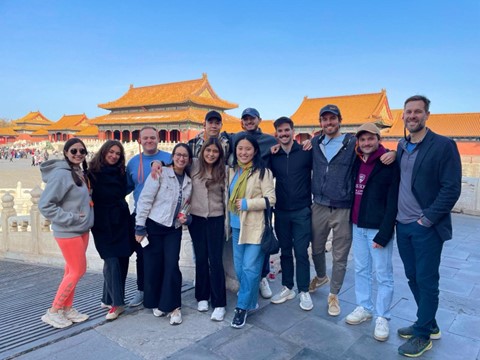
The capstone team at the Forbidden City after landing in Beijing.
Aaron Dane: Opportunities for collaboration on green finance, but tensions in other areas
It was my first time traveling to China, and I was thrilled about the opportunity to hear first-hand from officials and industry leaders about their approaches to global economic engagement. However, given the deteriorating relationship between our countries, I was nervous about how productive the meetings could be.
Our group met mixed results.
On the one hand, agencies and firms we met with were thrilled to meet with a delegation from SAIS. All expressed a genuine belief that people-to-people exchanges, especially amongst young people, are important for a stronger relationship.
Interests aligned over aspirations to support sustainable, green development around the globe. Many agencies evoked the U.N. sustainable development goals (SDGs) as foundational principles in driving their overseas economic engagement. In one meeting, our interlocutors were curious about how U.S. firms and agencies have supported ESG goals.
Chinese energy and environmental investment groups were particularly insightful. Whether they are state-owned or private, the firms we met with (including CECEP, where SAIS alumni greeted us, and Yunnan Energy Investment Group) were frank about the challenges and successes they’ve had in pursuing innovative new projects while maintaining global creditworthiness.
Yet, throughout our trip, evidence of tension in the U.S.-China relationship bubbled beneath the surface of talks. Our interlocutors frequently reminded us to be distrustful of western media and academic materials. The phrase “fake news” was thrown around frequently. When one student asked an official about lack of follow-up on investment MOUs in Latin America, an official reminded us that while “CNN or PBS” may tell us that there are problems, the reality is somewhat different.
Many officials lobbed blame at the U.S. for inflaming tensions. Some accused the U.S. of taking supply chain securitization too far, citing local content requirements on electric vehicles and attempts by U.S. elected officials to restrict garlic imports. Others made far more incendiary and off-base remarks. In one dumbfounding moment, a scholar lectured us on how the U.S. passing the Smoot-Hawley Act caused World War II, how “socialist China saved capitalist America” in the wake of the global financial crisis, and how U.S. interest rates were indebting African countries. The scholar was on camera and may therefore have felt compelled to vilify the United States for propaganda material, but this offers little reassurance about the health of the relationship.
While there was indeed unproductive criticism, we also heard genuine concern about how the relationship may deteriorate further. Students and officials repeatedly asked us what we think the outcome of the election will be and whether we think Trump, if elected, will indeed enact 60% tariffs on Chinese goods. We also heard various concerns about the looming ban on TikTok and what it might imply for the future of Chinese firms looking to invest in America.
Fortunately, such tensions seemed to disappear when talking to Chinese citizens individually outside of meetings. Over fried chicken and milk tea in the Beijing University dining hall (apparently one of the largest such dining halls in Asia), a local student and I talked openly and cordially about tensions in the Middle East. In a conversation with one of our hosts, I expressed concern about how quickly things seemed to be moving in the relationship, and they offered me some wisdom that I believe captures the importance of slowing down and making room for dialogue: 退一步海阔天空 (tuì yībù hǎikuòtiānkōng). Take a step back and the sky will be brighter.
Kateryna Halstead
Unprecedented growth, development and digital innovation still has a gulf of challenges to overcome in attracting young American scholars during a time of heightened U.S.-China tension, and perhaps the answer won’t be decided through hawkish policy but rather through people-to-people relationships.
For myself, this was a return to China, after a summer sojourn for language study in 2013. The array of changes immediately perceptible in Beijing was dizzying. The digitization which had taken place over the decade was everywhere, in fact over 943 million people actively use mobile payment systems in China. On the first morning after we landed, I saw an unfamiliar sight over the Forbidden City, an azure sky. Following the 2014 announcement of a “war against pollution,” there have been tangible results, with a 42% reduction in pollution between 2013 and2021., but particle pollution remains one of the five greatest threats to human health in China.
The economic inequality and domestic economic challenges also presented themselves in very concrete ways. The array of luxury vehicles in display windows, from powder blue Rolls-Royces, to candy green Lamborghinis, made an interesting juxtaposition with the economic picture coming out of China. This includes a youth unemployment rate of over twenty-five percent and a real estate crisis, the analysis of which is made all the more challenging by the CCP’s active obfuscation of data in times of economic crisis. This sentiment was reinforced when my direct questions to the Center for International Knowledge on Development (a government think tank in Beijing) regarding the economic downturn in China were deflected.
A refrain we heard throughout our visit was the desire for increased “people to people” exchanges, and specifically to dramatically increase the number of young American scholars studying in China. Late last year, President Xi Jinping announced a policy to be implemented over the next five years (a favorite policy-making timeline for the CCP), to invite 50,000 American students to study in China. Over the previous year there were only approximately 350, with our delegation adding almost a solid 2%. In practice, this can prove challenging for China. A disconnect exists between publicly announced policy objectives and actual implementation. This could be due to several reasons, including inner-ministry tensions and competing priorities.

The capstone team visits the Ministry of Foreign Affairs
While the desire to invite more students from the U.S. exists, the viability of bridging the gap between 350 to 50,000 remains in question. For one, China’s surveillance state extends to classrooms, even monitoring subtleties such as student expressions, and we witnessed this during a lecture series with Beijing University (Bei Da). As a nation in which our institutions of higher learning encourage free speech, thought, and critical analysis, it is difficult not to imagine American university students chafing against such policies.
Interestingly, I learned from my one-on-one exchange with a Bei Da student counterpart that for many sectors, foreign degrees are actually considered more employable than domestic ones. He expressed enthusiasm at the prospect of studying abroad, and particularly in the United States, and shared a genuine interest in engaging further with me as an American student counterpart. Against the backdrop of great power competition, the power of advancing people-to-people relations may indeed reside in the cafeterias, restaurants and bars, providing the backdrop to genuine human interaction, and not in the halls of Beijing’s policy making bodies.