
By: Edu Kenedi and Lila Anderson
Edited By: Mustafa Ahmad
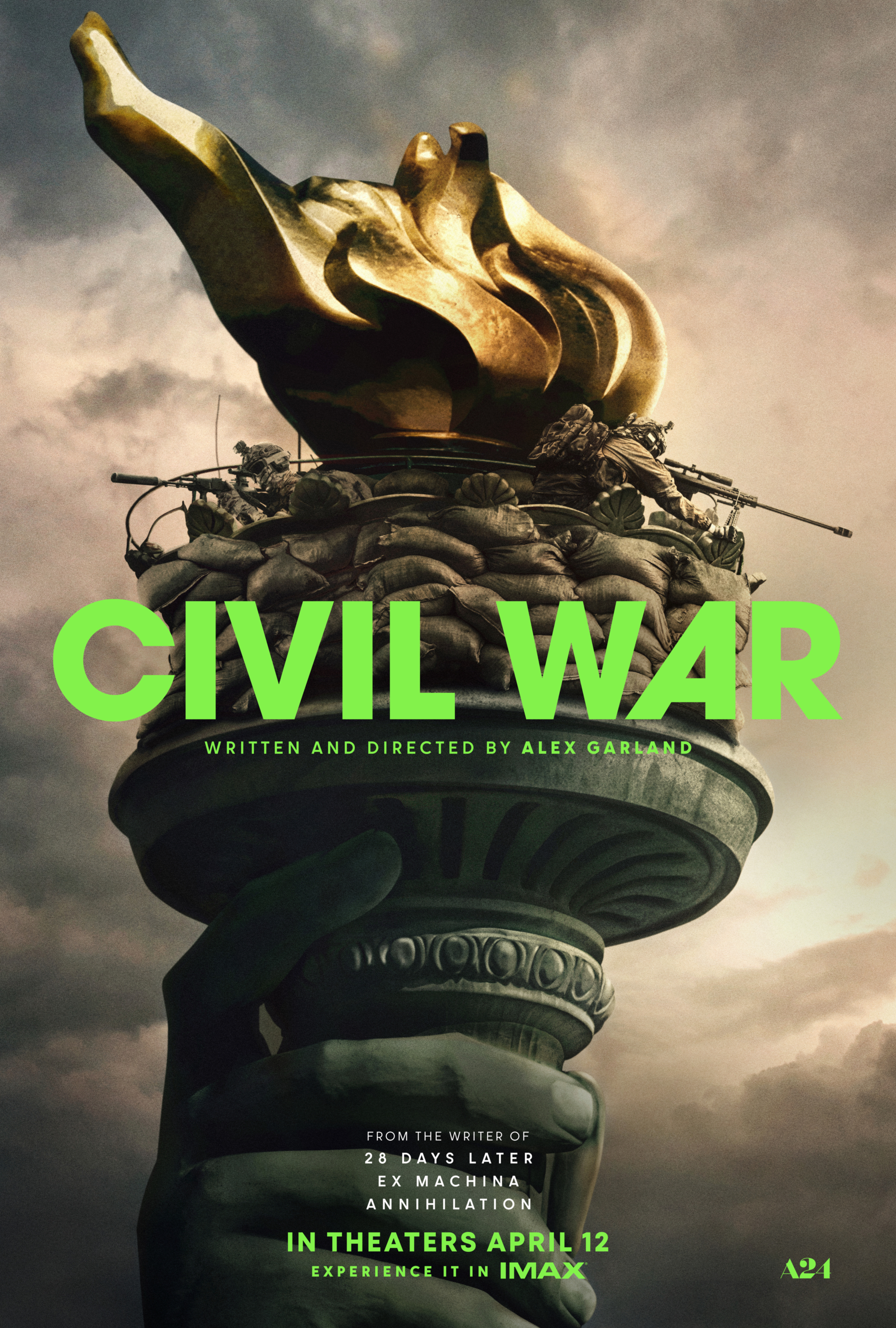
This week, your humble critics, Texas and California, who (inexplicably) have joined forces, bring you their takes on director Alex Garland’s Civil War. The film, set in a dystopian near future where a multi-faction civil war has torn apart the US, follows a group of journalists as they try to make it to DC to get a last interview with the President before the rebels capture and kill him. Veteran photojournalist Lee (Kirsten Dunst) is joined by two older colleagues, Sammy (Stephen McKinley Henderson), and Joel (Wagner Moura), as well as the young photographer Jessie (Cailee Spaeny) on this desolate road trip through the dystopian Eastern US.
Edu’s Take: Damn, I kinda want to be a photojournalist…
I found Civil War to be a riveting, shocking time at the movies that not only took my breath away, but also gave me lots to think about. Alex Garland’s directorial talent shines, be it in cinematography, sound design, or editing. He manages to balance engrossing action set-pieces with beautiful vistas of what a war-torn US would probably look like. The editing is also stellar, jolting us from peaceful nighttime chats to the middle of a warzone. I also enjoyed how Garland sprinkled in photos to show what our two photojournalists are capturing on the job. These silent stills provide a welcome reprieve from the cacophonous warzones our protagonists find themselves in. More broadly, the Civil War’s sound editing is also outstanding. From deafening explosions and gunfire that reflect what fighting street-by-street and house-by-house probably sounds like to long spans of silence when our characters are in shock, the sound design is not only immersive but ratchets the tension to take your breath away.
The performances in Civil War are good, though instead of snappy dialogue the actors shine through their physical acting. Kirsten Dunst is particularly convincing as a veteran photographer who has seen it all and is simply trying to bottle her trauma up. Her facial expression conveys more than her lines which often felt clunky and expositional. The rest of our motley crew of journalists are also written as one-dimensional characters and neither Wagner Moura nor Stephen McKinley Henderson are able to match Dunst’s performance. Cailee Spaeny’s character has the most growth, and her performance ranges from scared, to traumatised, to obsessed. The real standouts were the supporting cast. I wanted to spend more time with Nick Offerman’s President and the amazingly terrifying Jesse Plemons who steals the whole movie in a single scene.
I have also heard some of the push back against Civil War, particularly from those who say the film lacks ideas, especially in terms of its world building. Initially, my IR brain did wonder how this multi-group civil war broke out. I would have loved to find out how and why the Western Forces of Texas and California seceded, what made the President so evil, what happened during the Portland Antifa massacre, and what exactly was going on in the Florida Alliance. Yet the more I have thought about this, the more I see that Garland’s focus is on the journalists who themselves are only documenting the present, rather than caring about the past. Instead, if there is a more valid critique, it is that the film glamourises the role of photojournalists in conflicts and makes them seem as if all they care about is the perfect shot, no matter the cost. Ultimately, for my tastes Civil War was a nail biting action film that has stayed with me as I interrogate its themes and questions.
Lila’s Take: Empty Violent Fun
Civil War takes the viewer through an overall satisfying dark, twisted fantasy of near-future America, splintered along regional and ideological lines in their rebellion against the powers that be in Washington, DC. Like my even more humble critic of a comrade, I found the movie to be solid entertainment.
The POV device described by my fearless colleague depicts the multi-belligerent civil war through the minds, eyes and lenses of a squad of inexplicably brave and hardened photojournalists. This storytelling technique initially struck me as slightly obvious, and its exclusive domain in the movie crowds out the subjectivity of any of the combatants themselves – most of whom come across as amoral and homicidal maniacs, i.e., your average middle class American in the movie’s telling. However, the journalist plot develops into a good way of giving the movie audience a slice across American life – or what is left of it in the movie’s universe.
Director Garland’s choice of narrative framing also appeals to the glamour of a career which is given new life by technology’s regression. For instance, one photographer illustrates her old-fashioned process of developing photos given that all mobile networks are down as a result of the war. The journalists are aesthetes à la Lee Miller and Man Ray, rejoicing in the graceful forms to be found in a death captured live on film. As my intrepid interlocutor points out, they thereby take on an inherently amoral posture.
I concur with my rakish associate when it comes to the lack of depth in most characters save Lee, played by a made-under Kirsten Dunst. Her schtick of a hardened shell hiding a maternal streak toward her sweet apprentice, Jessie, may be played out, but is still kind of touching. The truest to life characterization were the unnamed, unhinged American men, epitomised by the scarily boyish Plemons. They all cared less about the cause of their particular rebellious faction than being able to kill euphorically, with impunity. The glorious violence, coupled with the Independence Day-style destruction of our landmarks, makes Civil War a dead giveaway of an A24 movie – exactly what my bloodthirsty partner-in-crime and I had been hoping for.
I’m not as mad as some commentators at the movie for failing to pick a side – all sides seem sadistic and aimless – because what’s missing for me in Civil War is any political intrigue to even side with. We get little time with Nick Offerman’s milquetoast president or any other political leaders, and so context for the war into which we are dropped in medias res is spoonfed to us through forced dialogue, telling us rather than showing us what’s going on. While this could have been an executive decision to keep the movie short and focused (appreciated in the era of Oppenheimer and Killers of the Flower Moon), more diverse roles would have enriched the texture of the movie. As a result, Civil War ended up feeling a bit hollow, though still worthwhile viewing.