
By: Nandita Singh
Edited By: Joseph Schneider
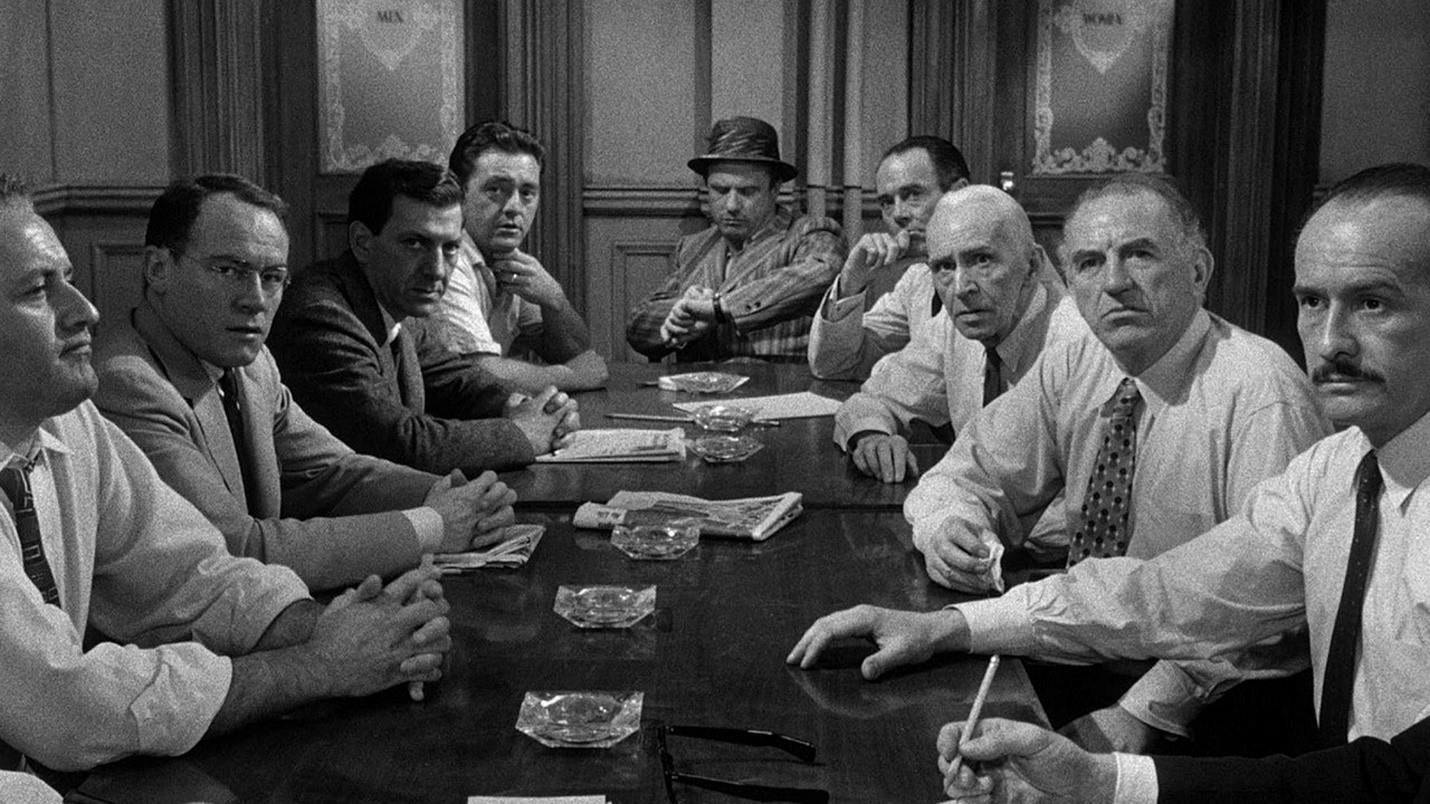
The 1957 classic 12 Angry Men is a mind twister with a plethora of plots and summaries available on the internet trying to decode the motive or intent of the cinematic marvel. I recently stumbled upon the movie, and in my opinion, it entails the grey space society operates in at their convenience. It is well painted with stereotypes and prejudices to simply convene and fasten the process of decision-making or arriving at conclusions. The artistic piece tries to portray the embodiment of this habit at both personal and collective levels. The movie makes an interesting case because of the craftsmanship of planting skepticism in the back of the mind for an otherwise natural-appearing situation. The whole experience is an audio-video mind teaser, just like a stimulating ‘spot the difference’ challenge. I might not be headed in the most accurate direction to where the creator intends to steam and steer the engine of thinking, but it does make me think.
The story starts with a judge passing the ‘death sentence’ and seeking a vote from a bench of 12 jurors who appeared to be previously listening to the arguments in the case of an 18-year-old boy who allegedly killed his father. The bench is expected to make a fact-based analysis of the case in the presence of all the circumstantial evidence as presented and defended in the case that had two ‘eye’ witnesses. Although, to convict the boy with a death sentence, the juror must vote either ‘guilty’ or ‘not guilty’ in absolute unanimity. Therefore, the next scene starts with a skeptic ‘juror 1’, and the movie henceforth is an argument among the twelve jurors on the credibility of the available evidence. As per my understanding, the plot of the story revolves around the idea of the ‘benefit of the doubt’ to be attributed in favor of the alleged accused and the ‘burden of proof’ on allegers. In this case, the burden is huge as it is a matter of life and death.
This narrative is a beautiful unfolding of details that cannot be observed through a myopic lens. The motive of the argument is no more the arrival of a judgment but a ‘not so simple’ proof check of ‘room for doubt’. The dissection of the assumably unassailable testimony of the prime ‘eyewitnesses’ of the case is where the ‘doubt’ is planted. The evidence of the ‘sterling witness,’ when cross-examined through the recreation of the scene of the crime, seemed as guilty as the boy, and that is where the jurors split half and half. It is a complete scene shift where the viewer can sense the subtle gear change from protagonist to antagonist or vice versa. Nevertheless, no one is a villain, and the movie has a ‘just’ ending.
But what intrigues me most is the direct take on a man’s perception, patience, and judgment. The movie is a treat for curious minds, but be cautious of the tough confrontation for one’s subconscious. If one takes the driver seat and steps into the shoes of ‘juror 12’, who was the last to be change his vote, they will indeed be brave to steer away from the fog of biasness for a ‘well-presented’ story knit through ‘partial truths’, that a pre-judicious mind firmly validates. The real test of patience here is the evaluation of fillers in the story and, instead, a recalibration of minute-to-minute detail. Conclusively and without a doubt, ’12 Angry Men’ is a magnificent movie, and it leaves the viewer with the question, ‘Would I have been analytical enough to carry the skepticism past the fatigue and exhaustion of re-re-evaluation’ or to rephrase it in an as complex but minimalist fashion ‘am I an angry man?’.