
By: Eric Omorogieva
Edited by: Jeremy Smith
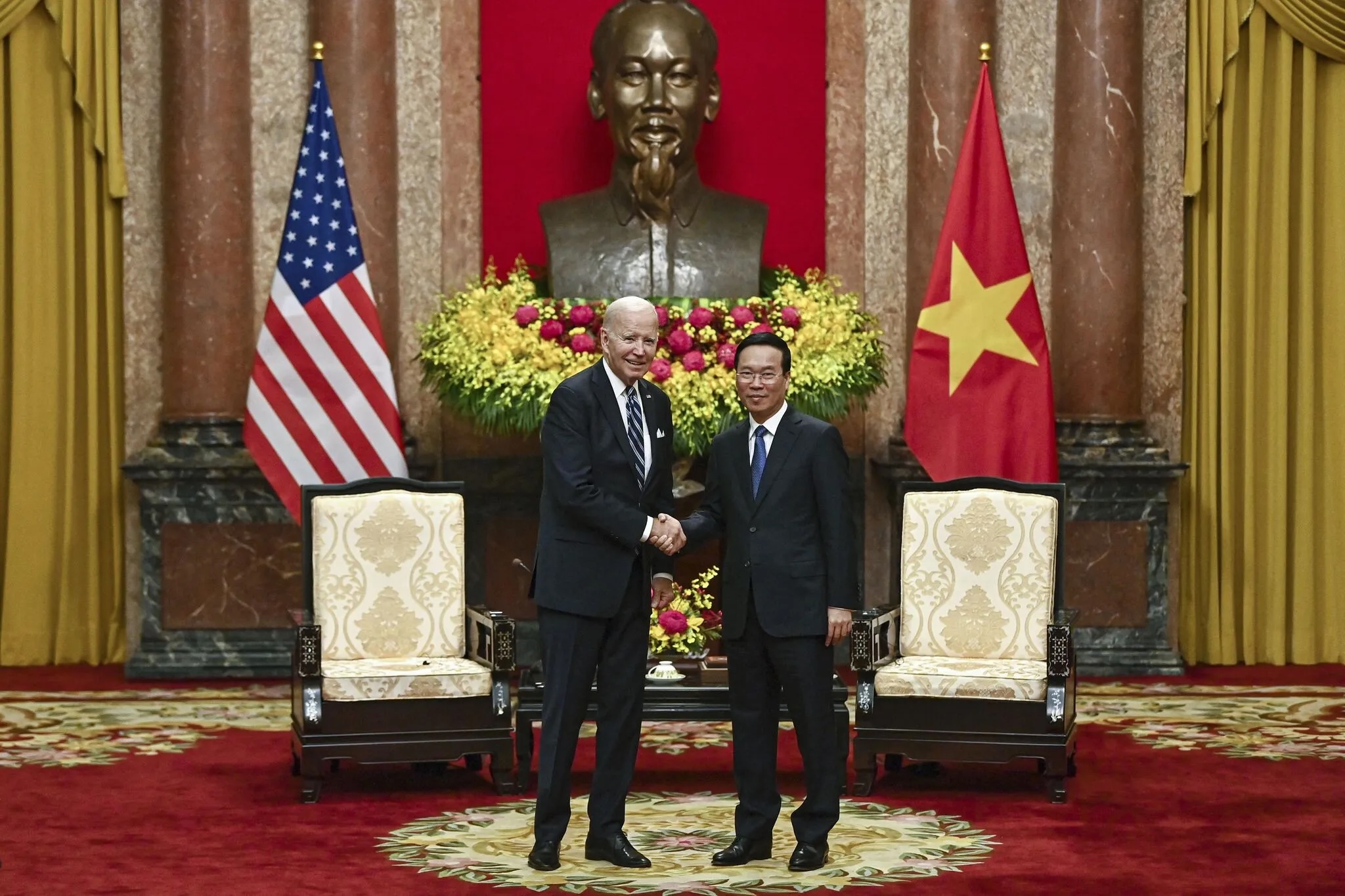
On March 20, Vietnamese President Vo Van Thuong resigned from his position, according to a statement from the 13th Central Committee of the Communist Party of Vietnam (CPV). Little is known about what led to the surprise departure, however the CPV noted that inspections revealed that Thuong violated regulations for how party members should behave, negatively affected public opinion, and damaged the reputation of the party. Thuong was quickly replaced by acting President Vo Thi Anh Xuan, the third Vietnamese president since the start of 2023. Thuong’s predecessor, Nguyen Xuan Phuc, also resigned last year due to corruption accusations. While the news has flown under the radar, it highlights a recent trend in the communist parties of both Vietnam and China that is likely to create complications for Western foreign policy objectives.
In recent years, Vietnam has played an increasing role in the United States and its allies’ efforts to diversify (or “friendshore”) manufacturing and trade away from China. This process has involved efforts to move manufacturing centers to Vietnam, launch new foreign direct investment initiatives, and tap into the nation’s significant rare earth deposits. However, the U.S. strategy also clashes with China’s objectives in southeast Asia and Vietnam’s unwillingness to choose sides. Understanding its importance at the frontline of the U.S.-China rivalry, Vietnam has employed a tactic to play each power off of the other in hopes of gaining the best deals. Dubbed “bamboo diplomacy,” Vietnam’s approach uses relations with each power to make the other desperate for further deepening relations. As a result, U.S. President Joe Biden and Chinese President Xi Jinping both prioritized visits to Hanoi in September and December 2023, respectfully. The United States upgraded its relationship with Vietnam to a Comprehensive Strategic Partnership, while China recruited Vietnam to cosign its signature foreign policy objective to “build a community of shared future.” Hanoi’s wide-ranging network doesn’t end there, either, as it still enjoys warm relations with Russia, India, Japan and takes a leadership role amongst its Association for Southeast Asian (ASEAN) neighbors.
While the United States and its Congress often pit the Communist Party of China (CCP) as its key adversary in “the battle between democracies and autocracies,” Vietnam is hardly a “friend” in this framework: Vietnam, like China, is also led by a communist party with a similar top-down structure, and both face concerns over autocratic rule and human rights violations. In addition, the CPV and the CCP enjoy good relations despite the shaky state-to-state relations between Vietnam and China. CPV General Secretary Nguyen Phu Trong was the first leader to visit China after the CCP’s 20th National Party Congress in October 2022, and visits between the two parties have been consistent ever since, with the most recent being the April 8 meeting between Xi Jinping and Chairman of the National Assembly of Vietnam Vuong Dinh Hue in Beijing. Both countries’ state-party systems allow space to tighten relationships despite challenges such as intensified South China Sea disputes.
China, coming off the first full year of President Xi’s third term as both head of state and general secretary of the CCP, has also suffered a recent series of high-level removals as a part of its own decade-long intensive anti-corruption campaign. In October 2023, former defense minister and state councilor Li Shangfu was removed from office following a corruption investigation and several weeks of disappearance. Additionally, former foreign minister and state councilor Qin Gang was removed from his role due to suspected conduct violations. Both scenarios, as well as many others, follow a similar pattern to that in Vietnam. Anti-corruption campaigns, while important and popular amongst citizens, are often unclear in their processes. Given the lack of transparency, the international community is led to question whether high-level removals done in the name of anti-corruption instead serve to eliminate political opponents and competing factions. Considering these similar occurrences in both countries, it’s important to investigate the state of Leninist party systems in the present era and how they might seek to strategize when faced with power rivalries, economic ups and downs, and national security concerns. If one party’s internal struggle causes unease for U.S officials and analysts, where does that leave the other?
The trend of anti-corruption campaigns and mysterious removals of high-ranking officials within these communist parties could be worrisome for future U.S. prospects. Both China and Vietnam have similar long-term goals that remain their overwhelming focus. By 2045, Vietnam hopes to achieve high-income status on the 100th anniversary of the establishment of the Socialist Republic of Vietnam, whereas the CCP aims to ensure “the great rejuvenation of the Chinese nation” by 2049, the 100th anniversary of the founding of People’s Republic of China. In pursuing these objectives, following the party line has been strictly emphasized, limiting tolerance for corruption or any actions threatening stability. Furthermore, Vietnam’s overarching priority is party and national security, a goal that might not always work smoothly alongside partnerships with foreign companies and maintaining confidence from outside investors.
Overall, the mood in Washington regarding the U.S.-Vietnam relationship remains optimistic, but it should proceed cautiously. While it is important to maintain strategic relations with Vietnam, the United States faces risks of overlooking red flags within Vietnam’s governance that could lead to disappointment or unexpected crises. While the recent shakeup in China has occurred at the ministerial levels and lower, Vietnam has already affected the Politburo and head of state, two of the highest organs within both the state and party. This volatility in Vietnam’s current leadership could hint at instability within party leadership factions that might spill over, causing problems for foreign partners hoping to rebalance their economic relations. In the pursuit of alternatives to China, the United States should remain alert to these ongoing shifts and should avoid fully committing to a framework like “friendshoring” without understanding the internal dynamics within its strategic partners.