
By: Aakrith Harikumar
Edited By: Alexandra Huggins

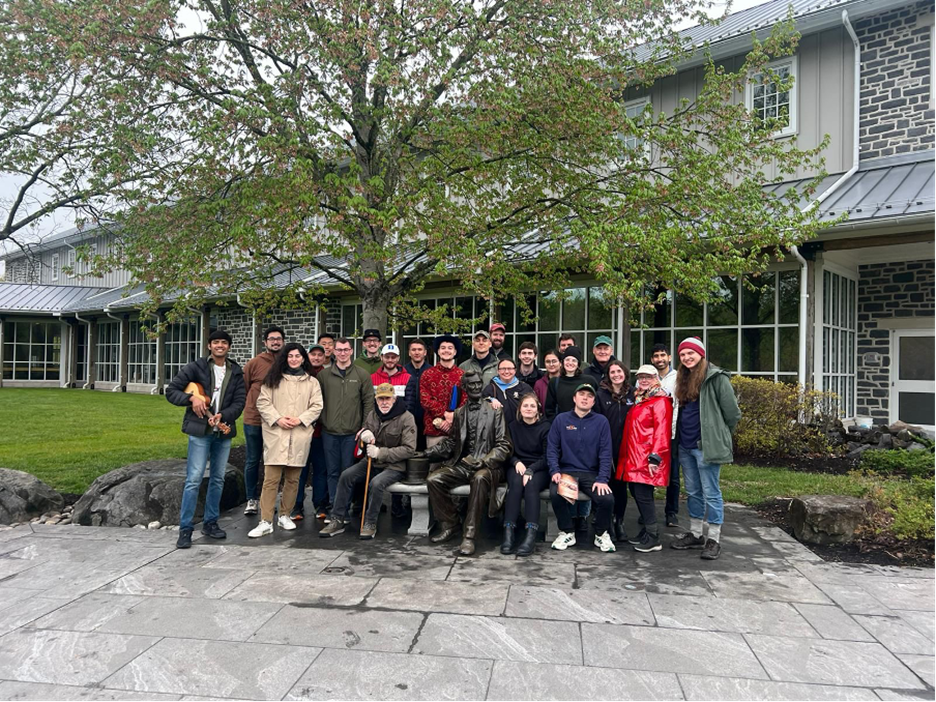
The 2024 Spring Staff Ride Group at Lincoln’s Gettysburg Address Memorial (I’m the one in the corner with a ukulele)
A SAIS staff ride is many things. It’s a dense study of military history, a 5-minute opportunity to portray a famous historical figure, and our closest shot at time travel. But most importantly, it is tradition. The Merrill Center for Strategic Studies has spearheaded the long-running ritual of staff rides to places around DC. But what is a staff ride?
Staff Rides: What You Need to Know
A staff ride is a one or two-day trip to an iconic battlefield to explore a specific battle and study its history and terrain. SAIS’s last domestic staff ride was to Valley Forge, PA, to study the American Revolutionary War. On April 27, 2024, students traveled to Gettysburg, PA, to explore the 1863 Battle of Gettysburg in the American Civil War. In a staff ride, each participant portrays a character from the battle under study by delving into their minds and justifying their decision-making. The 2024 Spring Domestic Staff Ride (SDSR) saw the portrayal of many central figures like General Robert E. Lee, President Abraham Lincoln, Frederick Douglass, General George Meade, and many others. It covered prominent locations like Robert E Lee’s Headquarters, the Pennsylvania Memorial, Pickett’s Charge, and the famous Gettysburg Address Memorial.
SAIS staff rides are led by two student quartermasters and a leadership team for communications, logistics, and character research. Preparing for a staff ride takes a lot of work. From booking a travel bus to reservations for the closing dinner at a lavish and historical restaurant (a huge selling point of a staff ride), the process is two or three months long. This semester, I had the honor of being a co-quartermaster for the SDSR to Gettysburg.
How I Got Here: Reflections of a Quartermaster
I’ll dare to say that our small yet incredibly efficient leadership team may have set the record for “shortest time taken to organize a staff ride.” My co-quartermaster Dylan Yachyshen and our leadership team with Alena Mikhaelyan, Derek Tingblad, and Ross Ito officially began planning for the staff ride only in the first week of April. There came a point (or many) when we thought we couldn’t pull it off because there was no time! That’s why, in many ways, this was the staff ride that almost didn’t happen.
Our trip to Gettysburg was only my second staff ride. My first experience was at Valley Forge in the Fall of 2023. I was an uninformed first-year student from India who knew as much about a staff ride as an average American did about cricket. But apart from being the best lesson of the Revolutionary War, it taught me teamwork, leadership, and the art of making friends. Since then, I knew one thing for sure: I wanted to be a quartermaster at least once before I graduated. Luckily, I talked to the quartermaster for the 2023 Fall Domestic Staff Ride—who, in early March, suggested that I reach out to the Merrill Center with a proposal. Of course, being the master procrastinator that I am, I sat on the idea for three weeks. One day, I panicked and cursed myself for not taking the initiative earlier. I hastily drafted a disjointed two-page proposal that suggested Gettysburg or Antietam for the SDSR. I emailed the proposal to Professors Thomas Mahnken and John McLaughlin—who run the staff ride program at SAIS. A few days later, Professor Mahnken asked to meet with me. I went into the meeting scared, unprepared, and with a feeling that he would tell me that he’d never read a worse proposal. However, Professor Mahnken was highly supportive of the plan. He suggested I pick one location and make it a one-day trip instead of two because we didn’t have much time to plan. Maybe it could have been two if I hadn’t waited three weeks.
The only catch was that I couldn’t go at this alone—physically and logistically. I reached out to many people to be a co-Quartermaster. But it didn’t work out either because they weren’t interested or didn’t have the time to commit. Thankfully, Dylan learned about the staff ride through Professor Mahnken and expressed interest in participating. We assembled our leadership team, and it was mostly smooth sailing, except for a few logistical jump scares here and there.
All’s Well That Ends Well: My Biggest Takeaway
From an organizational standpoint, this staff ride taught me that success is a product of teamwork, patience, and passion. You can’t have any of these without the other. It taught me to be grateful and appreciate the efforts of people around me. It taught me that there’s no concept of a ‘small’ or ‘big’ task. Each task is as important as the other.
History, geography, and military strategy are important yet evident themes of a staff ride. However, staff rides have taught me something much more substantial: Empathy. Much of the history we read distinguishes between ‘good’ and ‘bad’ people. We generally don’t wonder enough why the ‘bad’ people did what they did. Of course, the last thing I want to do here is justify anybody’s actions. But, a big part of staff rides involves portraying figures you may dislike or disagree with. The process encourages you to understand the other side’s objectives and reasoning. It prompts you to listen to different perspectives and discover that history is beautiful not because of its heroes but despite its horrors.