
By: Joseph Schneider
Edited By: Eric Omorogieva
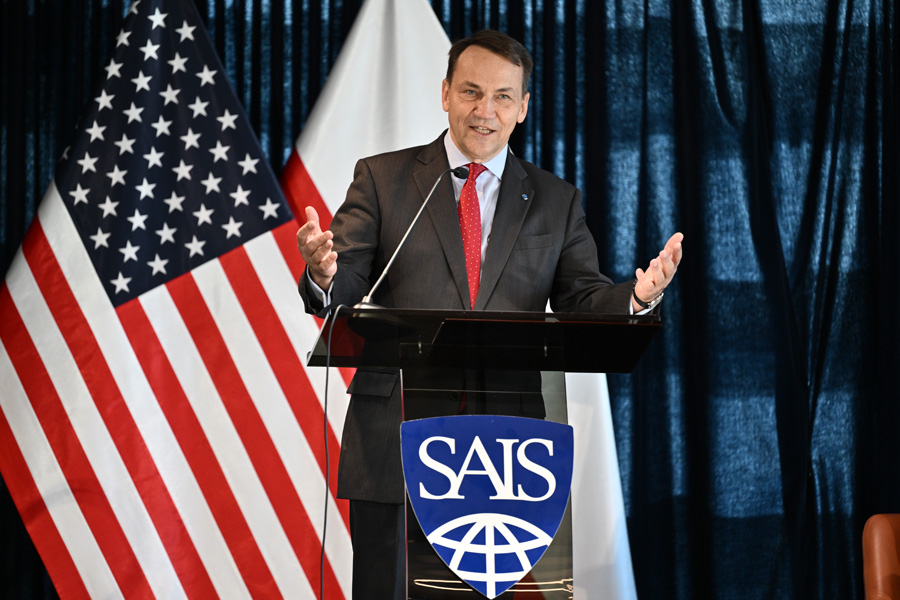
On September 20, Radosław Sikorski, Minister of Foreign Affairs of the Republic of Poland, honored SAIS with his visit as part of The Brzezinski Lecture Series. In his speech, Sikorski gave voice to Poland’s historical apprehension of its former Russian overlord and its consistent support of Ukraine during the war that the latter country has waged in response to Russia’s unjustified breach of its sovereignty. Among the many points he made, Sikorski lauded the democratic system, lambasted populism, and expressed Poland’s fulfillment of its budgetary obligations as a NATO member. He even pointed out that Poland’s projected defense spending as a percentage of GDP would even eclipse that of the United States.
During his lecture, Sikorski managed to raise thought-provoking ideas among the audience. One of them was that any potential peace agreement to end the War in Ukraine required Ukraine’s full consent lest the Donbas region become a sort of European North Korea. Another one was to redefine Europe and the United States as part of an Atlantic community. In this attempt to integrate American and European interests, Sikorski called for the United States to effect a “pivot to Asia, with Europe,” borrowing from President Obama’s famous phrase. Because of the current American debate on how best to respond to China’s growing economic ascendancy and the European dread regarding losing the beloved American security umbrella, this invitation turns out to be a rhetorical masterpiece. If only lip service were sincere.
Although Sikorski attacked Russia’s warmongering stance and warned about the consequences for his country, a Russian neighbor through the Kaliningrad exclave, he also expressed that China had not crossed the most lenient American red lines and gave some examples in which he characterized the People’s Republic as a responsible actor. For the United States, which has weathered a public health crisis from Chinese-produced fentanyl and whose businesses and products stand to lose from China’s trade and business practices, which other countries denounce, Sikorski’s remarks were insensitive. However, this is not the only problematic remark that Sikorski delivered throughout the talk.
Sikorski characterized Russia’s military might as risible because of that usually self-sufficient country’s need for Iranian and North Korean supplies. Nevertheless, given Iran’s destabilization of the Middle East in its current direct and proxy war against Israel, minimizing Iranian capabilities is no laughing matter. Another problematic assertion Sikorski made was that European fatigue was unwarranted given that “only Ukrainians are suffering” and since other countries—like Malaysia and the Philippines—faced food shortages. Sikorski even had the gall to declaim Ukraine’s ability to export its agricultural programs while omitting Russia’s acquiescence through Turkish-mediated accords in the early years of the war. Although Sikorski attempted to explain that only Ukrainians were seeing their lives torn upside down, this statement is insensitive to those whose quality of life the War in Ukraine has worsened. Sikorski only hinted slightly at the economic root causes of populism, which he presented as the result of a rural-urban divide hailing from angst about immigration and female advancement. To many of the people who vote for populist parties, Sikorski’s maxim simply does not apply. Despite all the problems Sikorski’s statements entail, they are not the most notorious.
Sikorski’s most egregious statement came near the end of the speech when he avowed his trip to Michigan “to defend NATO” with a grin. In these politically fraught times in the United States, many voters may take Sikorski’s visit to mean support for Vice President Kamala Harris, whose party has already received a visit to President Biden’s hometown from Ukrainian president Volodymyr Zelenskyy. It is true that President Trump, the other presidential contender, was about to meet the President of Poland Andrzej Duda, whose views align more closely with his. Nevertheless, Sikorski knew the implications of what he had said. Shortly after his statement about visiting Michigan, Sikorski explored the meaning of the Franklin D. Roosevelt, Ronald Reagan, Bill Clinton, George W. Bush, and Donald Trump administrations to Poland to deflect criticism in what was, to all eyes, quickly improvised and eloquent rambling. It is proper for Sikorski to advocate for a convergence in American and Polish interests, but his methods resemble election interference to many. Hence, they are counterproductive.
In summary, although Sikorski’s speech at SAIS showed tantalizing changes in rhetoric, it saw no change in substance. Sikorski’s goal is clear: to extract the most concessions while doling out the least. However, Sikorski still shows insensitivity to his potential partners and their concerns. If he seriously intends to make Europe pivot to Asia alongside the United States, he should first pivot to himself.