
By: Eric Omorogieva
Edited By: Max Edelstein
China upgraded diplomatic ties and announced it will invest 50 billion USD to African states over the next 3 years, but what does this entail?
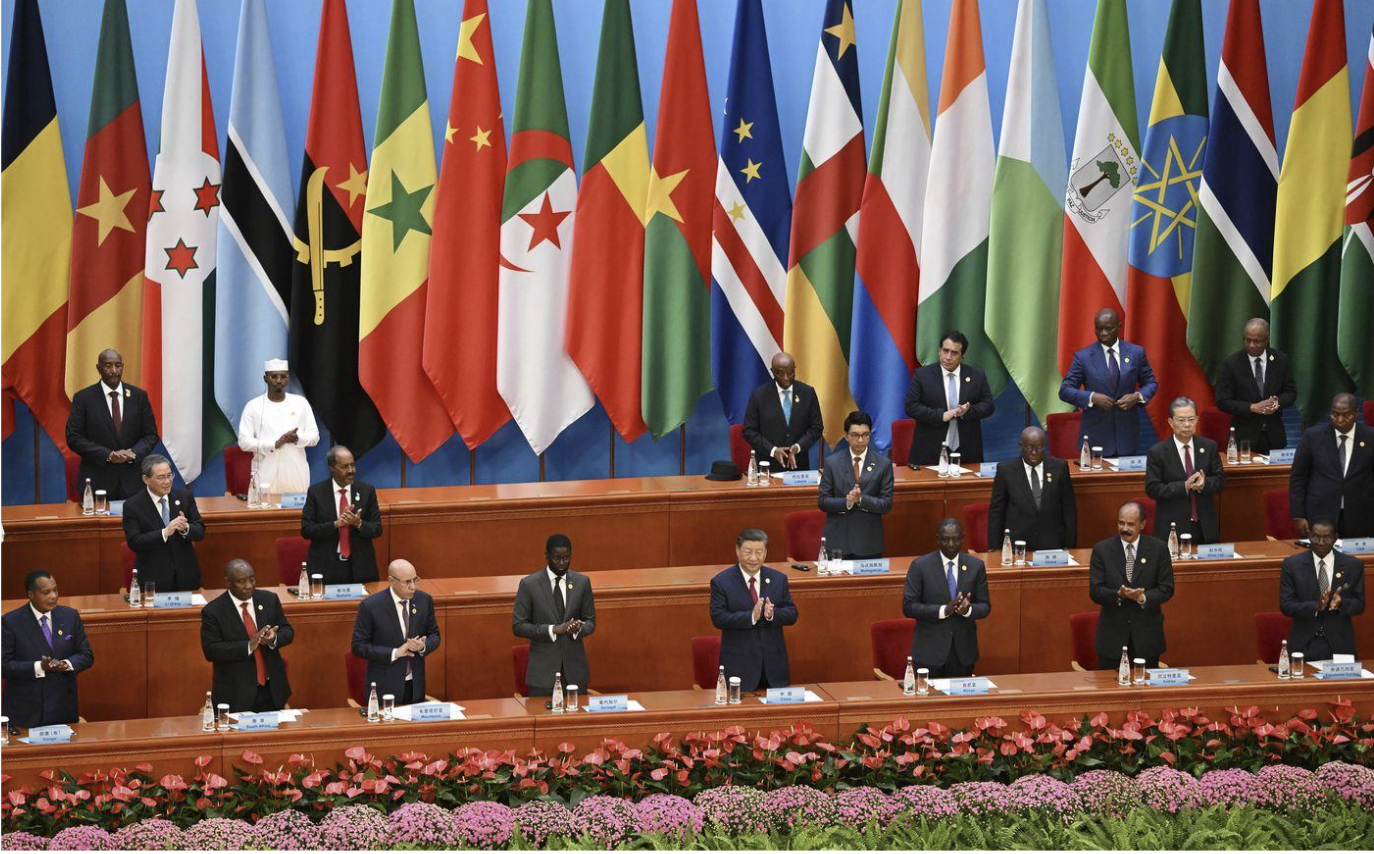
The fourth of last month marked the 9th edition of the Forum on China-Africa Cooperation (FOCAC), a triannual summit between the People’s Republic of China and 53 African states. Since 2000, China’s diplomacy with Africa has prioritized multi-billion dollar investment and loan commitments primarily under General Secretary Xi Jinping’s signature Belt and Road Initiative (BRI). However, analysts have questioned the level of interest China can afford to maintain for the economic development of African partners due to the consequences of the pandemic on the Chinese economy and the traditionally elevated default risk of investing in Africa.
The years since the 2021 FOCAC summit in Dakar, Senegal, have seen a precipitous decline in instances of investments down to less than 2 billion USD a year, a stark difference from the highs of around 10-15 billion or higher that dominated the latter half of the 2010’s. Much of the downward trend lies within economic challenges faced by African nations following the pandemic, as well as China’s own economic recovery. In addition, starting in 2022, Xi shifted BRI objectives from the famous large-scale rail and building projects to focus on “small and beautiful” (小而美). What the term entails for African nations has been unclear, but it may point to reorienting objectives to smaller packaged investments of $50-$100 million rather than billion dollar, risky infrastructure projects. This has left this year’s FOCAC and the future of the China-Africa relationship at a crossroads. Would China be able to continue funding large-scale infrastructure projects and financing?
The PRC answered with a resounding affirmation in resuming the funding and expansion of economic ties between African nations that defined much of its 2010’s diplomatic efforts. Representatives from 51 nations attended the 3-day gathering, with extravagant red carpet welcomes at Beijing Capital International Airport, a dinner banquet, and a series of bilateral meetings between Xi and the leaders of states such as Senegal, Nigeria, Tanzania, Kenya, Zimbabwe, and others. Overall, the event was the biggest showing in FOCAC’s 24 year history.
The focal point of the summit was Xi’s speech, titled “Joining Hands to Advance Modernization and Build a Community with a Shared Future,”. Xi lauded that the “China-Africa relationship is now at its best in history,” upgraded the PRC’s bilateral relations with African states to a “strategic relationship” and the China-Africa relationship to an “all-weather China-Africa community with a shared future for the new era.” These phrases are key terms regarding Beijing’s hierarchy of its diplomatic relations and signals that African states will become more central to its foreign policy.
More importantly, over the next 3 years, the PRC will invest 50 billion USD to African states, from which about 30 billion USD is in credit loans, 10 billion USD in investment from Chinese companies and another 10 billion USD in “assistance in various forms.” However, looking at the fine print of these loans hints at changes in China’s approach. Rather than exclusively state-led investing, there is far more participation from the Chinese private sector. It’s an impressive number, but one that will require more evaluation as projects start and Chinese companies begin to signal their willingness to lend. In addition, the outlined commitments do not mention debt-relief
In an interesting turn of events, the Chinese leadership often evoked the shared colonial history between China and African states rooted in a common struggle against Western nations, and a collective goal of modernization. While commentators of the China-Africa relationship have touched on this parallel, Xi has rarely been this direct in creating space to inflame shared grievances against the West. This framing is likely to remain a tool for China to use when hedging against the West . This modernization effort is underpinned by goals set in the African Union’s Agenda 2063 and China’s efforts to “build a great modern socialist country in all respects and pursue national rejuvenation through a Chinese path.”
Alongside the speech was the release of the FOCAC Action Plan for 2025-2027, an extensive document which outlines ten partnership initiatives as well as a sweeping series of goals and programs that aim to advance modernization and people-to-people exchanges. Here is where China made a surprise announcement to launch zero-tariff treatment for 100 percent tariff lines to Least Developed Countries (LDC’s) which have diplomatic relations with China, including 33 African countries. All signs point towards a China-Africa relationship that has expanded in economic ties, and engaging in exchanges of all sorts, whether it be leadership training, security collaborations or exchange-student programs.
This year’s FOCAC served to prove the China-Africa relationship’s continuity and display a level of sophistication and strategy that may be a reality check for geopolitical competitors aiming to counter China’s influence in the region. The past few years has seen the rise of several FOCAC-inspired “Africa + 1” summits such as the 2022 U.S-Africa Leaders Summit, the 2023 Russia–Africa Summit, as well as competing investment initiatives like the G7’s Partnership for Global Infrastructure and Investment or the EU’s Global Gateway. While there are still a vast array of partnership opportunities and interest to build on relations with the West and other regions, China not only still dominates the picture, but is the most interested.