
By: Jin Ruiyang
Edited By: Jordyn Haime
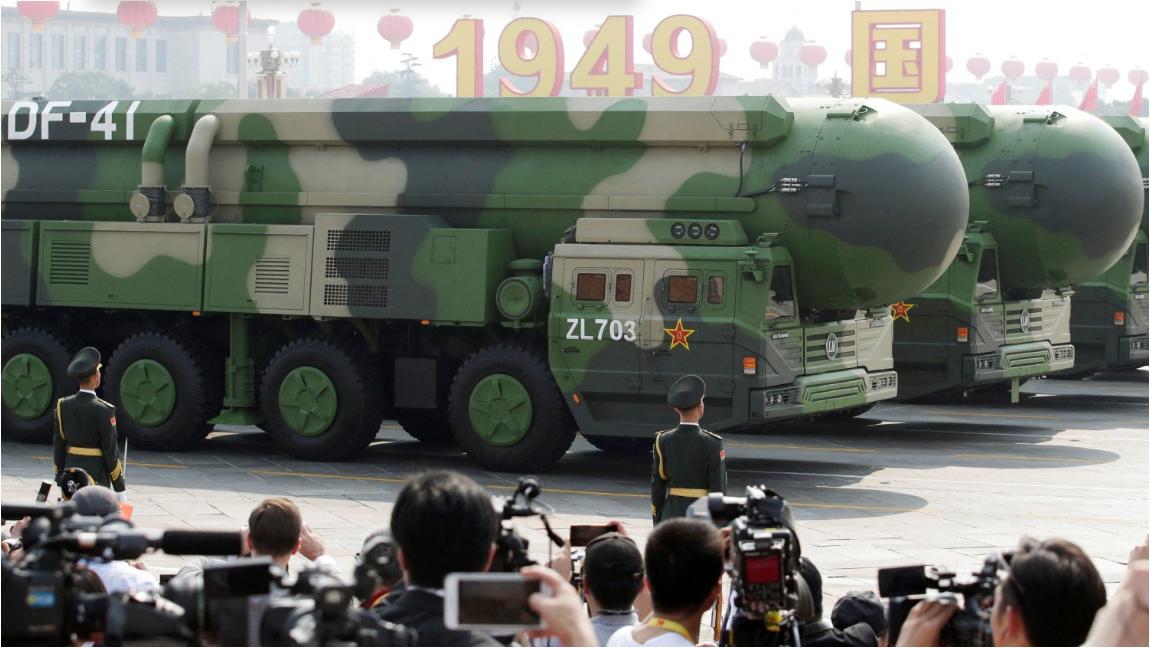
After the Chinese People’s Liberation Army (PLA) Rocket Force launched an intercontinental ballistic missile (ICBM) over international waters in September, several nations quickly criticized the test. Australia, New Zealand, Fiji, and Palau, among other nations, expressed grave concerns, labeling the test “reckless,” and urged China to avoid increasing military tensions within the region.
This test was unique because of its location on the high seas, different from the desert areas within China. Over the past few years, extensive tests have been carried out by the PLA Rocket Force, with about 135 ballistic missiles being tested in 2021 according to a Pentagon report. But this was the first time since 1980 that China has tested ICBM in a manner that simulates a real attack, as is often carried out by the United States, Russia, and India.
This article will focus on the legitimacy of the test rather than its political influence. From the perspective of international law, such a test is permitted—at least not prohibited. According to Zhang Xiaogang, a Chinese Defense Ministry spokesperson, China’s ICBM test launch is completely legitimate and reasonable. Moreover, he pointed out that China always follows a policy of no-first-use of nuclear weapons and a nuclear strategy that focuses on self-defense, and has committed to not use or threaten to use nuclear weapons against nonnuclear states or in nuclear-free regions.
China was also transparent about its plans for the test, which helped prevent miscalculations in the region and prompted praise from the Pentagon, which called it “a step in the right direction.” Russian Presidential Press Secretary Dmitry Peskov also stated that China possesses the full right to conduct such missile tests.
From the perspective of international law, China’s ICBM test launch on the high seas is legitimate under the United Nations Convention on the Law of the Sea (UNCLOS). The main relevant sources are Articles 87 and 88. Article 87 provides the freedom of the high seas: “The high seas are open to all States, whether coastal or land-locked. … It comprises, inter alia, both for coastal and land-locked States: (a) freedom of navigation; (b) freedom of overflight … (f) freedom of scientific research, subject to Parts VI and XIII.” Article 88 provides: “The high seas shall be reserved for peaceful purposes.”
Actually, we can see that the UNCLOS is silent on whether ICBM test launches on the high seas are permitted. This kind of test can be regarded as military activity. However, according to United Nations Convention on the Law of the Sea: A Commentary, edited by Alexander Proelss, “an interesting omission from Article 87 is any reference to a freedom to conduct military activities on the high seas. The point has been especially controversial, in particular as regards nuclear weapons testing.”
As noted above, since the list of freedoms of the high seas under Article 87 is non-exhaustive (inter alia),” China may claim that ICBM test launch constitutes “freedom of the high seas,” and such test is not explicitly prohibited by the UNCLOS.
However, we should notice that the list does not explicitly enumerate ICBM launch tests or other weapons tests. As a consequence, dissenting opinions may also refer to reservation of the high seas for peaceful purposes and claim that such a test is not “peaceful,” but military activity, and thus violates Article 88 of the UNCLOS. Regarding military activities, during the Third United Nations Conference on the Law of the Sea, representatives of several states argued that “the use of the ocean space for exclusively peaceful purposes must mean complete demilitarization and the exclusion from it of all military activities.” However, the United States’ representative, Mr. Learson, believed that “the term peaceful purposes did not, of course, preclude military activities generally.” Debates have existed since the negotiation of this article in 1976, but the final formation stressed the “peaceful use” without clearly forbidding military activities.
To conclude, arguably military activities like such ICBM tests are permissible to the extent that they are not incompatible with “conditions laid down by UNCLOS and by other rules of international law,” according to Proelss’ commentary. Because UNCLOS is silent on this question, it technically neither permits nor prohibits ICBM test activity. From another perspective, there is sufficient state practice to support the legality of such tests on the high seas.