
By: Phillip Schneider
Edited By: Sam Maxwell and Jordyn Haime
University begins, and after one month of classes, the realization dawns that one unsharpened pencil and one-tenth of a college notebook won’t last this student the semester. This tragic realization sent me on a one-kilometer walk of shame to the local bookstore.
Walking out of the university gate I notice how the five and a half hours of sleep paired with three coffees worth of caffeine rushing through my veins impede my ability to read the Chinese version of Google Maps. Sunrays blind my eyes, a BYD races past me without making a sound, and the smell of noodle soup penetrates my nostrils. Around me, people rush to catch a bus, two Chinese uncles are competitively smoking cigarettes, and a sanitary worker sweeps around a communal trash drop-off. At first sight, I believe their fates to be unconnected, but they share a common background.
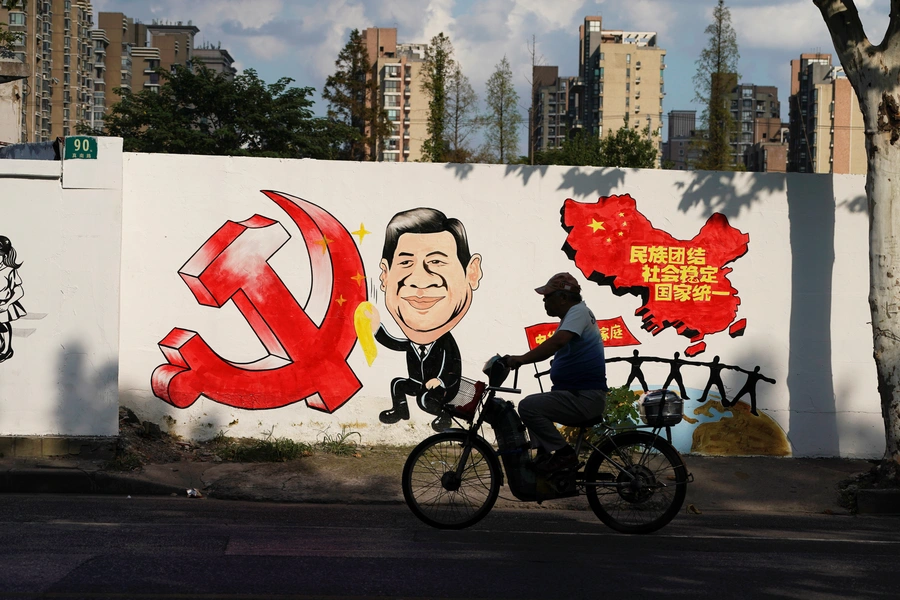
In today’s China, the Communist Party is increasingly concerned with reaching grassroots communities in remote and rural areas. Under the slogan of the “Last Kilometer,” it is covering public spaces with official information on public services and policies.
On my journey to the bookstore, which feels like my personal “last kilometer,” I can hardly escape the propaganda efforts of the party state. Two uncles smoke and chat in front of a poster that encourages the residents of the communal neighborhood to lead a healthy lifestyle, people getting on the bus rush past a screen that propagates the government to be at service of the people, and while the sanitary worker moves bags of trash away from the sidewalk, behind her appears a complicated-looking graph of how to separate waste properly.

Party and Government Messages on the Way from the Hopkins-Nanjing Center to the Librairie Avant-Garde bookstore in Nanjing
In my almost two and a half years of living in China, I have never seen a Chinese person stop in front of one of these posters to take the time and read it. Yet every Chinese person is familiar with their slogans. We might be inclined to think that this is a purely Chinese phenomenon. After all, the Chinese state and Communist Party have an impressive portfolio of propaganda efforts, whereas democratic governments seldom use such overt messaging in public spaces.
But readers born in democracies will find that in their country, it is companies which occupy these spaces. Their advertisements constantly signal to us that by purchasing a certain product we can become more desirable lovers, take better care of our health, or be better parents to our children. We usually don’t interact with these symbols in a very active manner either; yet, they are to be found everywhere, and their slogans pry their way into our subconsciousness.
In his 2018 article “The Pathology of Hard Propaganda,” Haifeng Huang argues that the goal of these messages is not to persuade but to signal dominance. The ubiquity of the message engrains itself into our subconscious and ultimately impacts how we think and speak. While the Xi Jinping quote “To meet our people’s desire for a happy life is our mission” (人民对美好生活的向往,就是我们的奋斗目标) might be familiar to fellow Chinese students in the Hopkins Nanjing Center, my fellow American students know exactly what food I just had, simply by telling them that it was “finger-lickin’ good”.
Messages pushed at us by companies versus messages pushed at us by a government differ in their very nature. But a comparison illuminates how similar the underlying mechanisms and their effect might be. In both scenarios, we might ask why this message seeks to address us and what its goal is. More importantly, we can ask ourselves if these goals align with our own and how we can work towards creating ourselves as a response to these messages.
The most obvious critique of this way of thinking remains valid: most slogans fade away in the busy city life and we never consciously appreciate them. However, the messages that occupy our urban spaces dictate which messages have the chance to nest in our subconsciousness.
This is no reason to despair. The urbanologist Jane Jacobs holds that urban residents and urban spaces have a symbiotic relationship. However, all too often this relationship is overlooked by top-down urban planning and standardized messaging. As residents we have every chance to notice how we interact with these messages and actively engage with our surroundings. From this new consciousness can emerge a will to participate in the designing of our living spaces.
Being a creative force in your habitat can include placing stickers with reminders to drink water, participate in elections or support the local animal shelter in prominent places. Through “yarn bombing”—a practice where objects like hydrants, lampposts, or the wall street “Charging Bull” are wrapped in yarn—grassroots can alter cold and male-dominated cityscapes through the maternal gesture of knitting.
It is the unconventionality of participation that catches our attention. Our individuality demands us to break with normative, mundane and stylized urban design and messaging. It demands us to become aware of how our urban spaces fail to represent and create us on a personal level.
In our urban spaces, all too often it is companies, governments, and city planners that become visible through their respective roles in the city. As residents, it is in our interest to make sure that we are represented through art and messaging that resonates with our values. In this process, we must make ourselves visible through interacting with our surroundings. Only then will our urban spaces allow us to see others and feel seen at the same time.