
By: Lizzie Yang
Edited By: Tom Lattanzio
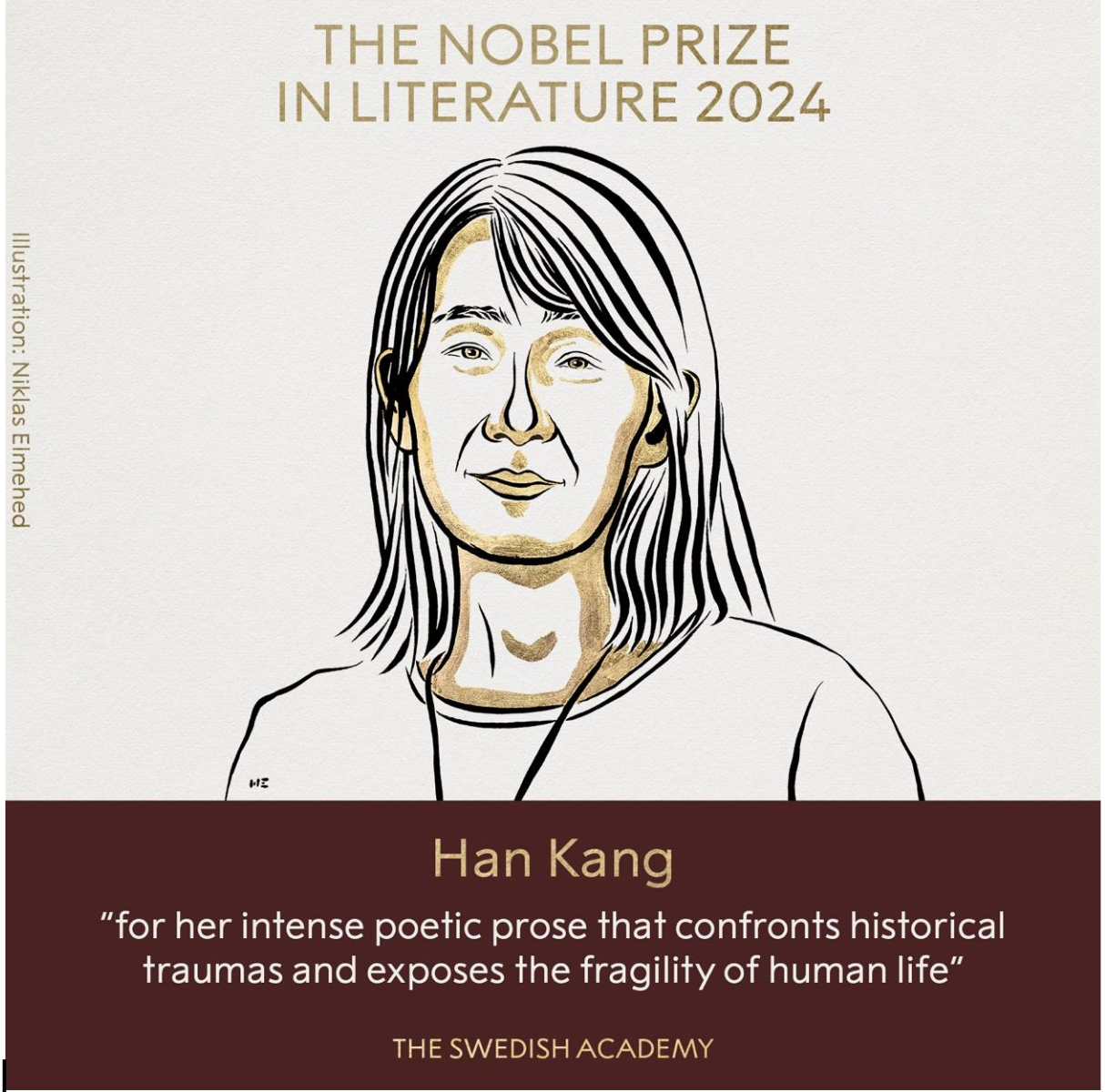
Last October 10th, Han Kang became the first South Korean Nobel laureate in literature, one of the most prestigious literary prizes. The announcement came a day after Hangul Proclamation Day, which commemorates King Sejong’s invention of the Korean alphabet to enhance literacy among the common people. This was a pleasurable coincidence for native Korean-speakers, who now get to read Nobel-prize-winning literature in its original language. According to the biggest bookstores, one million copies of Han Kang’s works were sold within six days following the Nobel announcement in South Korea. This is an unusual phenomenon in our modern society, loaded with digital content. Hopefully, the newly rekindled interest in literature is not ephemeral.
The latest award affirms Han’s literary genius and South Korea’s growing soft power. Following the Korean War, the country achieved the “Miracle on the Han River:” rapid economic growth which propelled it to become the world’s 14th largest economy. Now, it shares the victorious pride with Han Kang, whose name echoes the iconic river in Seoul. Han’s achievement is not only a milestone for South Korea but also for the Nobel Foundation. In its 123-year history, the Swedish Academy has awarded 121 laureates in literature, 65 of whom wrote in Romance languages, including 32 in English, 16 in French, 11 in Spanish, and six in Italian. There are five East Asian laureates—two Japanese, two Chinese, and now one South Korean. The Nobel Committee, often critiqued for its vague selection progress and Western and gender biases, has increased efforts to include more nominations from women and regions beyond North America and Europe, though progress remains slow.
The scarcity of non-Romance language authors among Nobel laureates, however, is not solely due to the committee’s alleged bias. In fact, translation brings forth complexities in conveying the original intent. It is a filter, in which subtle nuances, cultural references, and “vibes” easily get left behind. Han’s English translator, Deborah Smith, was criticized for mistranslation when Han won the Man Booker International Prize in 2016. “Smith amplifies Han’s spare, quiet style and embellishes it with adverbs, superlatives, and other emphatic word choices that are nowhere in the original,” wrote a Korean-American translator in an op-ed in the Los Angeles Times. Whereas, in my interview with a translator of Han Kang’s poetries and a colleague of Deborah Smith, Sophie Bowman vouched for a strong partnership of the two, noting their shared approach of “following the essence” of literature. Such opposing views and doubts about translation accuracy highlight the subjective nature of literature and the barriers posed by language.
Han’s victory nonetheless represents overcoming the daunting barriers of translation. It certainly did not happen overnight, not by chance, but through decades of South Korea’s economic growth that aided funds for growth in arts and the subsequent expansion of its cultural footprint. From the viral phenomenon of “Gangnam Style” to the global acclaim of the boy band BTS and the Oscar-winning Parasite, K-culture has only increased interest in Korean food, fashion, and even classical music, fine art, and literature. As audiences worldwide embraced “the one-inch-tall barrier of subtitles,” to borrow the words of director Bong Joon Ho, they gained insight into uniquely Korean cultural and historical themes. Bowman notes that Korean translators are becoming “more unapologetic, more adventurous” in retaining words like “kimbap,” as global audiences have grown more familiar with the language and culture.
This global appetite is matched by a wave of Korean translators, who skillfully render complex literary works like those of Han’s in ways that resonate internationally. Translators like Smith and Bowman are not mere technical linguists, but literary voices, committed to making words travel and building bridges between writers and readers. Reflecting on Han Kang’s remark, “when you’re translating someone’s writing, you’re translating their soul.” Bowman emphasizes the core of a literary translator’s role lies in using the strengths of both languages to “make a whole that reflects the other whole.”
The Swedish Academy’s shortcoming in recognizing a wider diversity of writers is complemented by the efforts of organizations like Words Without Borders (WWB). WWB is a digital magazine that cultivates authors writing in lesser recognized, indigenous, and marginalized languages to bring literature from all parts of the world close to the center of attention. For example, presenting literature about a Lebanese man grappling with gender identity, an Iranian doctor with trauma from childhood abuse, or the 2010 Haiti earthquake from a Haitian’s perspective. Han’s works were also published on WWB before they became internationally acclaimed. This offered another window of awareness into South Korea’s contemporary history exploring the pro-democratic uprising against a military regime in Human Acts, armed rebellion against the US-backed South Korean government on the eve of the Korean War in We Do Not Part, and modern feminism in a misogynistic society in the Vegetarian. The Swedish Academy’s recognition of Han Kang’s “intense poetic prose that confronts historical traumas and exposes the fragility of human life,” come from WWB’s efforts and delicate works of translators.
Whether a Nobel prize is the ultimate badge of literature excellence or merely an accolade granted by a Western institution is debatable. And yet, its fame generates incalculable admiration for a language and nation, projection of a historical perspective, and demonstration of attributes beyond economic power. If the late 20th century’s “Miracle on the Han River” emerged from South Korea’s desperate urge to manifest a successful democratization, assert its independence from Japan and the U.S., and integrate into the era of globalization, Han Kang’s words uncover the deep emotions buried in the river, once overshadowed by economic pursuits, creating ripples that resonate with readers worldwide. Today, amid the seeming retreat from globalization, perhaps comes the role of the readers seeking for words like that of Han’s, carefully rewritten by literary translators.