
By: Rafael Wexler
Edited By: Joseph Schneider
The election of Donald J. Trump as the 47th President of the United States signifies a shift in United States foreign policy, potentially altering long established relationships with international institutions, especially the United Nations. One of Trump’s initial actions was to announce Congresswoman Elise Stefanik as his choice for United States Ambassador to the United Nations, reflecting the incoming administration’s dedication to emphasizing global collaboration while reforming international institutions. Her nomination has already garnered support from across the aisle.
Since 2015, Congresswoman Elise Stefanik has served New York’s 21st Congressional District in the United States House of Representatives. In December 2023, she received national recognition when the House Committee on Education and the Workforce conducted a hearing regarding antisemitism at United States college campuses. Throughout the hearing, she consistently inquired of the presidents of the Massachusetts Institute of Technology (MIT), Harvard University, and the University of Pennsylvania whether calling for the genocide of Jews breached the institutions’ code of conduct. Ms. Elizabeth Magill, the president of the University of Pennsylvania, stepped down four days following the hearing. Dr. Claudine Gay, the president of Harvard University, stepped down less than a month after the hearing.
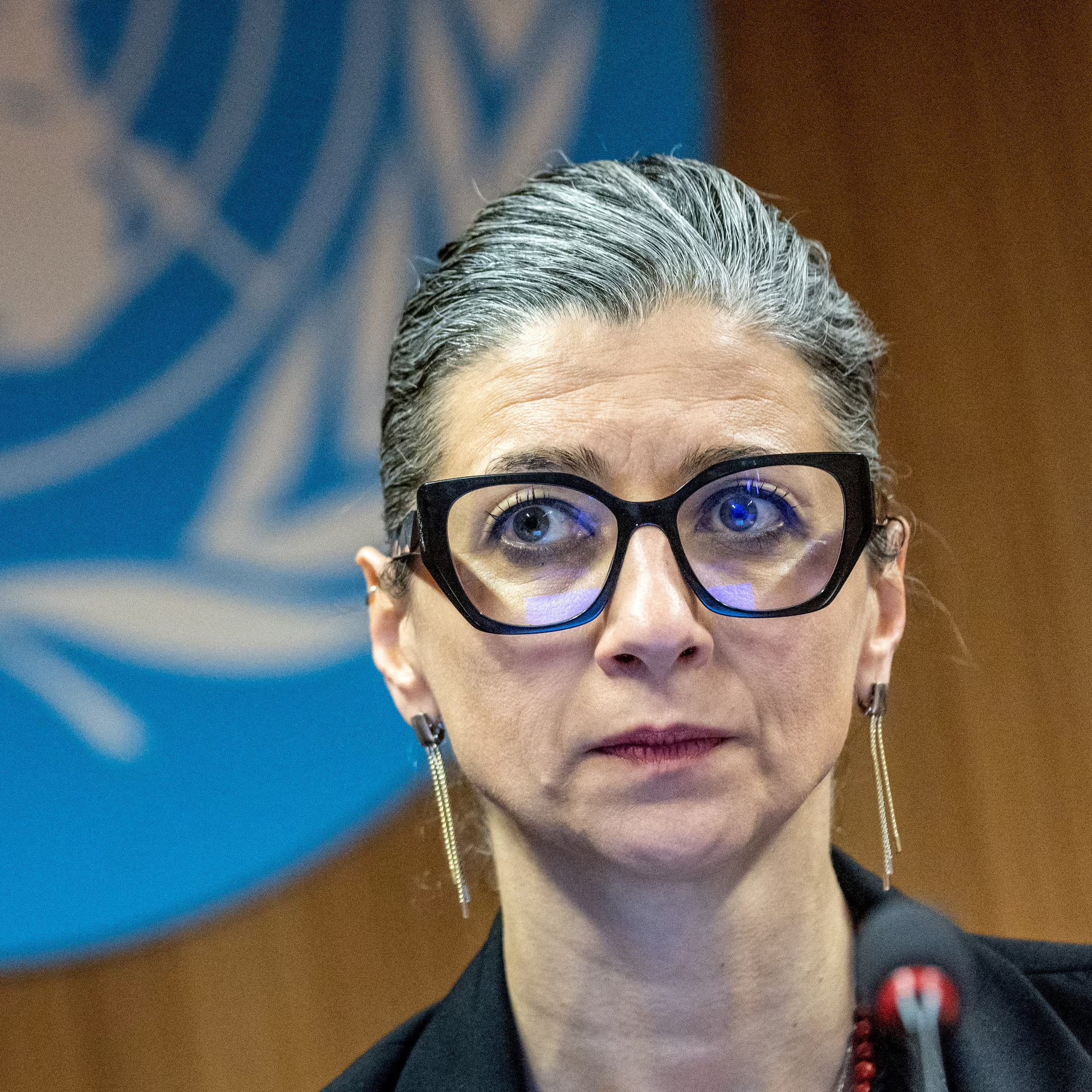
The United Nations will have reached a critical point under the incoming administration. Stefanik’s nomination as United States Ambassador to the United Nations offers a chance to change how the United Nations oversees international matters of significant importance, notably its attitude to the Israeli-Palestinian Conflict and to finding a long-term solution to the conflict itself. A significant first step in this approach would be to address the controversial tenure of Francesca Albanese, the United Nations Special Rapporteur on the human rights situation in the Palestinian territories occupied since 1967, whose activities have aroused concerns about bias and antisemitism in the United Nations.
Since 2022, Francesca Albanese has served as the United Nations Special Rapporteur on the Occupied Palestinian Territories. Her actions have drawn severe criticism to her appointment and the mandate itself, previous United Nations Special Rapporteurs and civil society organizations have characterized as biased and one-sided. There have been multiple instances where Albanese’s rhetoric was widely seen as antisemitic, biased, and inconsistent with the United Nations’ commitment to impartiality. The United States, France, Germany, and Canada condemned Albanese in 2024 for disseminating antisemitic clichés, such as asserting that “America is subjugated by the Jewish lobby,” a classic example and a dog whistle for the trope that Jews control governments. Furthermore, Albanese’s comments minimizing atrocities perpetrated by Hamas, such as excusing Hamas violence as a reaction to Israeli oppression, have prompted further questioning of her integrity (or lack thereof).
Albanese’s actions have directly weakened the United Nations’ credibility in addressing complex geopolitical situations impartially. As an independent United Nations expert, Albanese is obliged by the United Nations Code of Conduct for Special Procedures, which requires all United Nations officials to maintain the greatest levels of integrity, impartiality, and factual accuracy. Instead, Albanese has blatantly broken these standards by spreading false information and advocating violence against Israel.
The dismissal of Francesca Albanese from her position would send a strong signal about the United Nations’ commitment to impartiality. It would not only address long-standing criticism from the international community but would also restore trust in the United Nations’ ability to hold its staff accountable for actions that undermine its legitimacy. Albanese’s dismissal might help in resetting the tone for United States-United Nations relations, showing that the new administration is dedicated to ensuring that international institutions adhere to their fundamental values of fairness and impartiality.
A top goal for the new administration should be to rectify the United Nations’ widespread lack of impartiality. Stefanik’s appointment as United States Ambassador to the United Nations stands for the start of a foreign policy pivot aimed at keeping America’s leadership while ensuring the United Nations fulfills its intended role in global diplomacy, including impartiality when dealing with the Israeli-Palestinian conflict. Stefanik remarked that the incoming Administration intends to work to restore “America First peace through strength leadership on the world stage on Day One at the United Nations.”
Albanese’s statements and actions have hurt the United Nations’ credibility and reputation as an international institution. Removing her from her post would send a message to the international community that the United Nations is committed to combating antisemitism and ensuring that its officials adhere to the international institution’s essential ideals of impartiality and objectivity.
It is time for the United Nations to seriously consider Francesca Albanese’s removal as the United Nations Special Rapporteur. By doing so, the United Nations can prove its commitment to impartiality and collaboration with the new Administration. Stefanik’s appointment as Ambassador to the United Nations offers a chance to set up a new tone for United States-United Nations relations. This measure would be a step toward restoring the United Nations’ credibility and proving commitment to its basic ideals.
A good shift in United States-United Nations relations is conceivable. Removing an official like Albanese would be a positive first step toward proving the United Nations’ readiness to oversee international matters in an unbiased and responsible manner. This step might pave the path for future substantive United States-United Nations partnership, helping both the United Nations’ reputation and United States foreign policy goals.