
By: Blake Uhlig
Edited By: Ali Gostanian
Note: All pictures are the author’s.
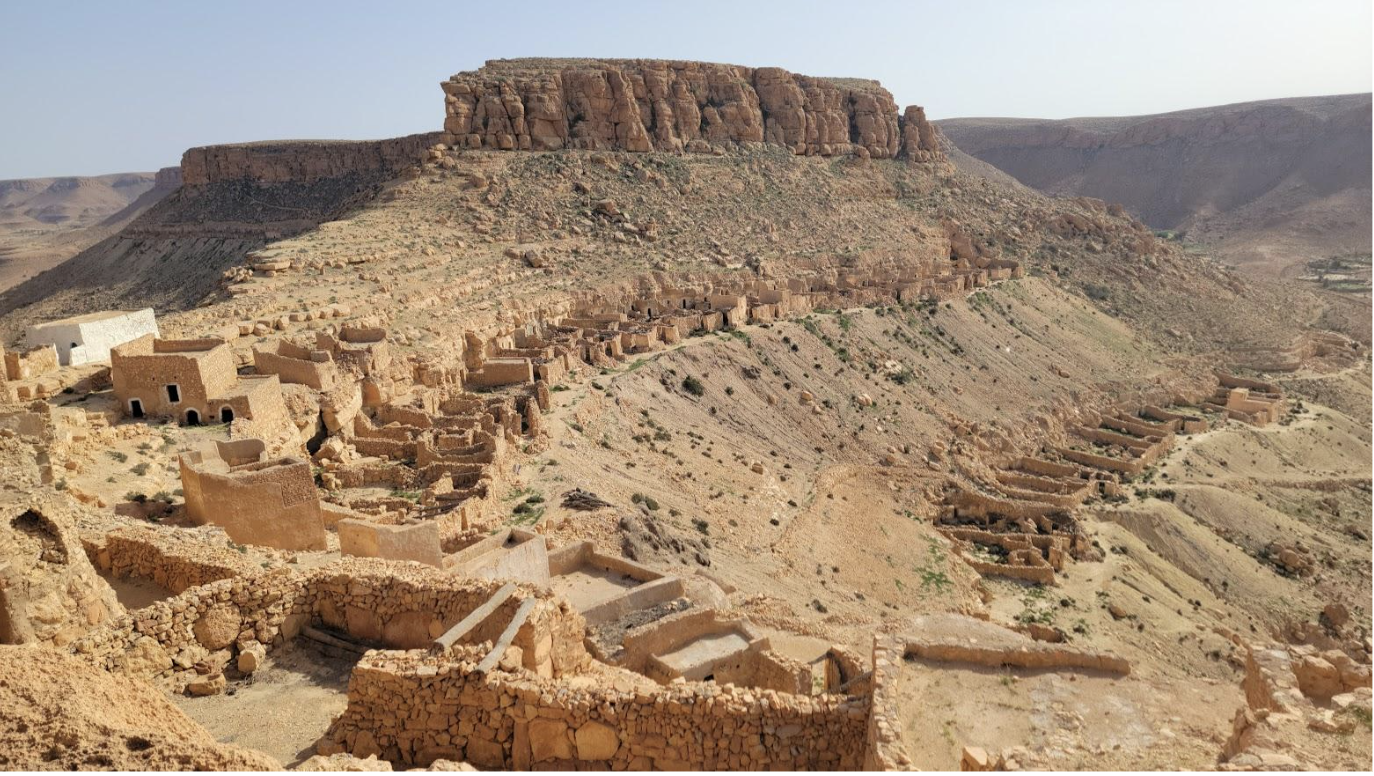
First-Picture Caption: Ksar Guermassa was once a monumental Berber city.
Tunisia has no shortage of historical landmarks. It is the birthplace of the Carthaginian Empire, which ruled North Africa from the Strait of Gibraltar to the Gulf of Sidra in Libya. It was romanized, conquered by vandals, and reclaimed by the Byzantines. The numerous caliphates and dynasties that followed forged civilization from the ashes of empires. The Ottomans and French played their hands, but none could tame the indomitable Berber.
This spring, I documented historical sites at more than sixty locations in Tunisia. The country has undergone much change in recent history. Technological and economic development and natural disasters have pushed the Berber populations out of their ancient villages and ksars, which are disintegrating due to a lack of maintenance. The Arab Spring triggered the plundering of archeological sites. The departure of foreign archeologists and funds has left Tunisia struggling in the sand.

The problems are overwhelming. Colonial period cemeteries have been vandalized and fires set in the Punic tombs north of Hammamet have covered ancient paintings in soot. Installing Roman mosaics on the floors of Tunisia’s most heavily trafficked archeological museums puts them at risk of deterioration. After a new wave of Israeli-Palestinian violence began, renovations at the El Kef synagogue were halted and a shrine in El Hamma was desecrated.
Western Tunisia, in particular, has been a region of significant unrest. It fell victim to a development scheme that favored the East long before the financial crisis. International tourism, the backbone of the state’s economy, never developed here as it did on the coast. High unemployment and lawlessness have led to the widespread looting of its historical sites. Artifacts from the Maghreb are smuggled and exchanged on Tunisia’s borders before making it to the international black market.

Ammaedara in modern Haydrah is less than ten kilometers from the Algerian border and has been subjected to looting. The city provided strategic access to the Atlas Mountains. It hosted the Third Augustan Legion and was made a stronghold by the Byzantines. Its fort is the largest classical structure left standing in the country by area. The large stones used in its construction are fine examples of regional masonry. Instability has been detrimental to its preservation. Excavations have stopped and have not returned.
Haydrah is considered dangerous due to its proximity to the Algerian border and the Kasserine Governorate. The United States has issued a “Do Not Travel” advisory for the area which is tightly controlled by the Tunisian National Guard. Despite being one of the most remarkable archeological sites in the country, it is seldom visited by foreigners. I had the site to myself but quickly drew a crowd. The museum director opened early just for me.
“He’s the first American ever to visit Haydrah,” he proclaimed.
Tunisia’s National Guard watched me with suspicion.
“Who is he? Is he a spy? Does he work for the CIA?” they asked my driver.
The soldiers were skeptical of his explanations. They couldn’t fathom why I would want to visit Haydrah. They took my passport information, and after a few more stops, it was decided I needed to leave under escort.

The escort was handled professionally. I caught a glimpse of ancient Thala and felt immense grief while transiting through the Kasserine Pass. In the Second World War, thousands of soldiers were killed here in a failed Allied assault. The pass now is one of the most dangerous parts of Tunisia. Ten years ago, terrorists took control of Djebel Chambi. Today, only the most battle-hardened remain.
My driver’s son later explained his experiences as a soldier in the park. There was horror in his face when he described the moment his friend was blown to bits by a landmine. When I arrived in Kasserine proper, the National Guard decided I had to leave immediately. I was escorted east to Sufetula, which boasts the best-preserved Roman forum in Tunisia.

It was surreal to explore the ruins while listening to gunfire and roaring helicopters. The Tunisian military has a heavy presence in Subaytilah, with trucks and equipment moving back and forth between it and Kasserine. The site was excavated and gained fame during the colonial period. It still receives the occasional bus of Western tourists.
Except for a few niche enclaves, tourism infrastructure is not developed in Tunisia’s interior. Public transportation is almost nonexistent. Tunisians get around on the louage, a communal bus which is difficult for foreigners to navigate. Most of those interested in exploring the Tunisian West take guided bus day trips. Sites that are serviced by these bus tours have minimal impact on local economies because visitors stay for short periods. This is a frustrating experience for communities that see tourism as their only way to achieve economic development.
Corruption is systematic in Tunisia. There is a great moral divide between those who have done wrong and those who want to do right. How much can you blame the average Tunisian? The lines blur when nothing is guaranteed. Staff at archeological sites have been involved in looting, and security forces turn a blind eye to smuggling for cash. There is an extravagant novelty to it. Former President Zine El Abidine Ben Ali was sentenced to half a lifetime in prison for his crimes, which included embezzling artifacts.
The French built villas on the ruins of Carthage, which became a place for the rich and powerful. After independence, Bourguiba built his palace next to the Antonius Baths in one of the densest archeological zones. This palace has remained the residence of heads of state ever since. In this way, Tunisia was founded on the desecration of its history. Foreign projects have helped preserve Uthina, Carthage and El Jem, but it’s not enough. The future of Tunisia’s past is under threat.