
By: Anonymous
Edited By: Eric Omorogieva
On September 10, 2024, Apple launched the 16th generation of its flagship iPhone. In Zhengzhou, a city located in central China, large numbers of workers had labored tirelessly over the preceding months to assemble this new product. Since the early 2010s, this factory has been the main driving force behind Apple’s products. Until 2019, Chinese factories produced 99% of Apple’s products, with Foxconn’s Zhengzhou plant accounting for nearly half of that.
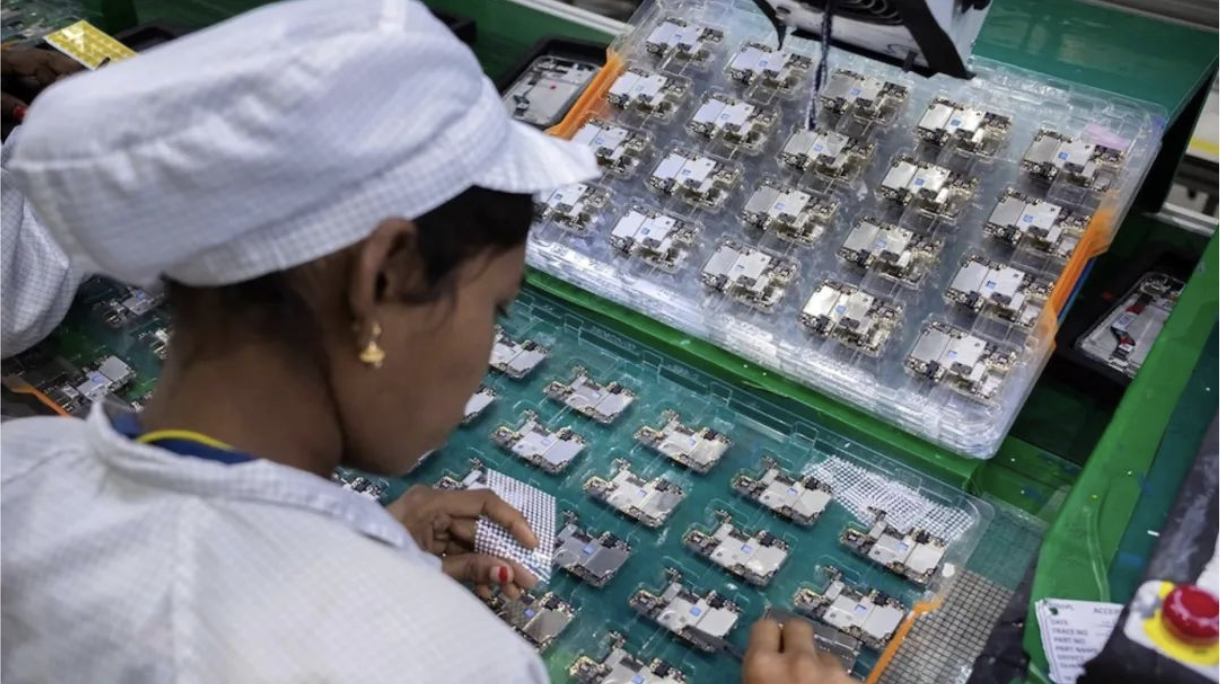
However, this year marked a notable shift in Apple’s supply chain. For the first time, Apple’s factory in India began assembling the latest iPhone Pro model. Assembly workshops and large dormitory complexes are being constructed in Sriperumbudur, in the south of Tamil Nadu state, with motorcycles, auto-rickshaws, and buses transporting employees between factories and housing. India is pushing to take on a production role that China has handled exclusively.
Perhaps this is a partial result of India’s manufacturing 3.0 strategy to attract high-end manufacturing to boost local industry. In 2023, Piyush Goyal, India’s Minister of Commerce and Industry, announced the goal of producing 25% of iPhones in India. This aligns with the broader trend of manufacturing moving from China to South Asia, to mitigate the impact of the turbulent US-China trade war and to take advantage of a more affordable workforce. In 2022, the Biden Administration launched the Indo-Pacific Economic Framework and a series of offshoring policies aimed at enhancing the resilience of supply chains within the United States and its allies. This is just the time for India to signal its growing manufacturing presence.
This trend mirrors history. In the 1990s, low-end manufacturing shifted from developed regions in the US and Europe to China. In 1998, Foxconn opened its first Chinese factory in Shenzhen, and its facilities soon spread across the country, with the Zhengzhou Foxconn plant opening in 2010. This plant has since grown to be one of the primary assembly hubs for iPhones. Over more than a decade, the iPhone has transformed Zhengzhou Foxconn into a small “iPhone city,” complete with bars, supermarkets, karaoke bars, and restaurants to cater to workers’ needs. Chinese media estimate that this single factory supports over 700,000 people.
Similar things are happening in India today. In 2023, estimates showed that India assembled about 13% of the total global output of iPhones from almost zero, and this figure is expected to double this year. The iPhones produced in India not only serve the domestic market, but are also exported abroad, primarily to the United States. Many Western companies consider India as a manufacturing destination as there are over one billion workforce with less than 400 million jobs at present. In the role of component assembling, India is chipping away at China’s dominance.
Producing an iPhone begins with its design, led by Apple’s industrial designers at its Cupertino headquarters in California. As a result, every iPhone manual starts with “Designed in California.” Next is production, with components sourced from over 40 countries worldwide, forming screens, lenses, CPUs, speakers, and more. Typically, around 30% of these components are manufactured in the US, 30% in South Korea, 10% in Japan, 10% in Taiwan. Neither China nor India are the primary sources for component manufacturing. However, once gathered, these components are shipped for assembly—a role that China almost exclusively held before COVID-19.
India’s journey began in 2017, when Apple first assembled iPhone SE and older models in the local factory. Later in 2022, India began assembling Apple’s flagship iPhones. This echoes the Modi government’s Production Linked Incentive scheme. Apple and its suppliers have generated around 165,000 direct jobs. At the same time, local giants such as the Tata Group are gradually taking over the factories controlled by foreign companies.
To further advance its role in global manufacturing, India is still facing several challenges, including business metrics, infrastructure and supply chain issues, and a late entry into the tech manufacturing landscape. While India has an abundance of young workers, it still lacks skilled and semi-skilled workers and offers limited vocational training opportunities. At the same time, foreign corporations have traditionally cited bureaucratic hurdles, the ease of doing business, financial instability, and working conditions as concerns. In 2023, Foxconn split from its Indian counterpart Vedanta, due to the latter’s financial troubles and changed to another. By comparison, China still has the most comprehensive supply chain, manufacturing ecosystem, and the highest level of industrialization on a comparable scale.
Nonetheless, India has time. Its youthful demographic structure and its unique geopolitical position within the US-China conflict offers it substantial opportunities. Looking forward, India stands as a powerful market with steadily improving manufacturing capabilities, and is increasingly positioned as a viable alternative in the global manufacturing landscape.